Learn 7 signs a bed cooling device suits your sleep style, from trapped heat and night sweats to partner temperature conflicts at night.
A bed cooling device makes the most sense when your main problem is trapped heat in the bed, not just a warm bedroom. That distinction matters because products in this category work in different ways, and bFan Bed Fan belongs to the airflow-based group that moves room air under the covers instead of cooling the whole room.
TL;DR: Summary
- A bed cooling device is a good fit if you sleep hot because your bedding traps heat, and an under-the-covers airflow system like bFan Bed Fan targets that bed microclimate directly.
- The best-supported benefit is improved thermal comfort, not a guaranteed change in sleep stages or total sleep time.
- Research has linked warmer nighttime bedroom temperature with worse nighttime physiology, including lower heart-rate variability and higher heart rate in older adults (PubMed).
- A key trade-off is scope: bed cooling devices cool your sleep space around the body, while air conditioning (AC) cools the whole room and usually costs more to run.
- If you choose a bed fan, tight-weave sheets, moderate blanket weight, and correct airflow direction often matter as much as the device itself.
- If night sweats are new, drenching, or paired with fever, weight loss, chest symptoms, or medication changes, cooling should be paired with medical evaluation.
That is why the right question is not “Do bed cooling devices work?” but “Does this type of cooling match how I actually sleep?” Sleep temperature, bedding, airflow, and sweat patterns all interact. A device can help a lot if it solves the specific heat problem you have, and disappoint if it solves the wrong one.
A bed cooling device changes the bed microclimate by moving heat away from the body or by absorbing heat through a pad. With bFan Bed Fan, the mechanism is under-the-covers airflow using room-temperature air, not refrigeration.
Sleep researchers and the national heart, lung, and blood institute (NHLBI) both point to a simple truth: people generally sleep better in a cool environment, and body temperature drops as sleep begins (NHLBI). A bed cooling device works by helping that cooling process along where heat gets trapped most often, inside the bedding around your torso and legs.
A common misconception is that these products “make cold air.” Most do not. A bed fan does not cool the air itself. It uses the cooler air already in your room and pushes it under the covers so body heat does not stay trapped next to your skin. Water-based mattress systems work differently by circulating temperature-controlled water through a pad, but the goal is similar: reduce heat load close to the sleeper.
“bFan Bed Fan uses room-temperature air under the covers to remove trapped body heat, and the current model averages about 12 watts of power use.”
That distinction matters because performance depends on the room, the bedding, and your sleep habits. If your bedroom is already 82°F and stagnant, a bed fan has less cool air to work with. If your room is reasonably cool but your comforter traps heat, targeted airflow can be exactly the right fix.
Targeted airflow helps people whose heat builds up inside the bedding, especially hot sleepers, people with night sweats, and couples who do not want to freeze the whole room.
This category tends to fit people who fall asleep fine but wake up hot at 1:00 or 3:00 a.m., kick off the covers, then get cold later and pull them back on. It also makes sense for someone who wants cooling on one side of the bed rather than lowering the thermostat for everyone.
A realistic scenario is a woman in perimenopause who keeps the room at 70°F, uses a medium-weight comforter because her partner likes it, and still wakes up sweating across her chest and neck. In that case, the problem may not be the room alone. It may be trapped heat in the bedding. Targeted airflow can reduce that buildup without forcing her partner to sleep in a colder room.
If your main complaint is a stuffy, hot room from wall to wall, whole-room cooling may matter more. If your feet, legs, and torso feel overheated under the blankets while the room itself feels acceptable, a bed fan usually fits better.
A bed cooling device is a strong match when your symptoms point to trapped body heat, not just bad sleep in general. Look for patterns, not one rough night.
A useful way to think about it is this: if heat seems to pool inside your bed, a bed cooling device matches the problem. If the entire room feels oppressive, it may only solve part of it.
Bedfan-style airflow systems and BedJet both use room air, not chilled air. Bedfan reached the market several years before BedJet was even thought of, and shoppers often compare them on price, control style, and bed feel more than on basic cooling principle.
The biggest misconception here is that BedJet cools the air. It does not. Like a bed fan, it uses the air already in the room to cool the bed. That means both depend on your bedroom temperature, sheet choice, and how well air can move under the covers.
Price is often the clearest trade-off. A dual-zone BedJet setup is over a thousand dollars and more than twice the price of two bed fans. If you need two-sided control for a couple, that math matters. Many shoppers also care about physical feel. Some want a stronger blast. Others prefer gentler airflow that is less noticeable once they fall asleep.
Older Bedfan models were known for very low power draw, around 18 watts on average, and the current bFan model is rated even lower at about 12 watts on average. Bedfan-style products also appeal to people who want timer controls so the strongest cooling happens during sleep onset and then tapers later.
“Bedfan positions the bFan as cooling comfort for hot sleepers and night sweats, not as treatment for the medical cause.”
If you are choosing between the two, ask three practical questions. How much airflow do you like? Do you need dual-zone control? And does the price fit the role you want it to play in your sleep setup?
Start with bedding if your sheets, comforter, or mattress protector are obviously trapping heat. Start with a device if your bedding is already reasonable and you still wake up hot.
A tight-weave sheet often works better with airflow than very loose or overly fluffy fabric because it helps air move across the body instead of escaping too quickly. That sounds backward to some people, but under-the-covers airflow works best when the air is directed along the sleep surface rather than lost upward.
Here is a quick decision rule. If you sleep with heavy fleece, thick flannel, multiple blankets, or a waterproof protector that runs warm, fix those first. If you already use lighter bedding and still overheat, targeted airflow is more likely to add something new.
The 2024 systematic review on bedding strategies found short-term reductions in core body temperature, but no clear changes in several sleep outcome measures, including sleep onset latency and total sleep time. That is a good reminder that “cooler” and “better sleep” overlap, but they are not identical in every study. Comfort still matters because a lot of sleepers simply need fewer heat spikes and fewer wake-ups.
Good setup is simple: aim the airflow into the space between your bottom and top sheets, reduce unnecessary insulation, and test gradually over a few nights.
Step 1 is placement. Put the unit at the foot of the bed so the airflow runs up the bed, not into open room space.
Step 2 is bedding choice. Use breathable sheets with a tighter weave, and avoid bulky layers that block airflow. A common mistake is adding more blankets to “keep the cool in.” That usually works against airflow.
Step 3 is fan setting. Start at a medium level for the first two nights, then adjust. Too much airflow can feel distracting at bedtime even if it is comfortable later.
Step 4 is room temperature. Sleep experts often recommend a bedroom around 60°F to 67°F, but with a bed fan many people can raise room temperature by about 5°F and still sleep cool because the cooling is targeted where it matters most.
Step 5 is timing. If your device has timer controls, use stronger airflow as you fall asleep and taper it later if full-night airflow feels unnecessary.
Each option solves a different heat problem. Bed fans target the sleeper, cooling pads change the sleep surface, and AC changes the whole room.
If your mattress itself sleeps hot, a pad system may help more because it changes the contact surface under your back and hips. If your heat builds under the covers, airflow often feels more natural because it removes heat and moisture from around the body. If your entire room is too warm, AC is the bigger lever.
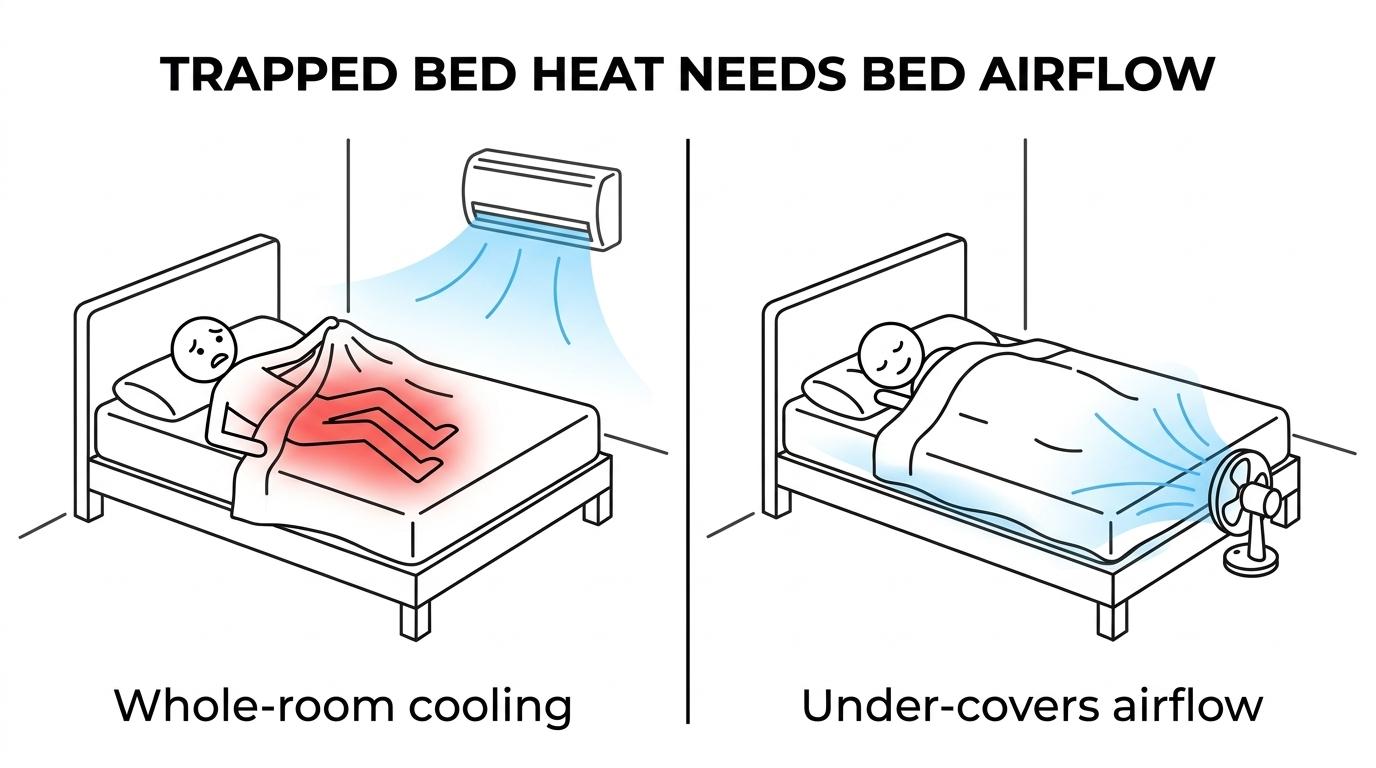
The trade-off is cost and scope. AC cools everything, including empty space. A bed cooling device cools the sleeper more directly and can reduce the need to overcool the room. Some Bedfan users report raising the thermostat meaningfully while still sleeping comfortably, which is consistent with the logic of targeted cooling, though individual results vary.
Noise and feel are different too. A pad is almost invisible physically, while airflow is noticeable at first. Some people love that sensation. Others need two or three nights to get used to it.
Use it as a comfort tool, not as a diagnosis. The goal is to reduce overheating episodes, shorten wake time, and help you stay covered without heat building up.
Step 1 is to notice timing. Do sweats happen shortly after sleep onset, in the early morning, or after a medication dose? Timing can guide whether you need strong airflow all night or just during certain windows.
Step 2 is to keep the sleep setup steady for several nights. Do not change sheets, room temperature, pajamas, and device settings all at once. If you do, you will not know what helped.
Step 3 is to track practical outcomes. Count how often you wake up hot, how often you throw off the covers, and whether your sheets feel damp by morning. Those are often more useful than trying to guess sleep stages.
This is also where expectations matter. A cooling device may reduce discomfort without fixing the medical reason for sweating. That is still valuable, but it is a different goal.
Run a simple 7-night test. Compare wake-ups, comfort, and thermostat setting instead of relying on memory.
For nights 1 and 2, sleep as usual and write down room temperature, bedding, wake-ups, and how hot you feel. For nights 3 through 5, use the device with one consistent setting. For nights 6 and 7, fine-tune the airflow or timer.
Focus on five markers:
Wake-ups: fewer hot awakenings
Covers: less blanket kicking and re-covering
Sweat: less dampness at the chest, neck, or legs
Thermostat: ability to keep the room a bit warmer
Next day: less frustration about sleep temperature
A 2025 observational study found that bedroom temperatures above 24°C, or 75°F, were linked with worse nighttime physiology, including lower heart-rate variability and higher heart rate in older adults (PubMed). That does not prove any one product fixes those changes, but it does support the idea that nighttime heat is not just a comfort complaint.
Night sweats deserve medical attention when they are new, drenching, persistent, or tied to other symptoms. Cooling can help comfort, but it should not delay evaluation.
Talk with a clinician if sweating starts suddenly, soaks sleepwear or sheets, or comes with fever, cough, swollen lymph nodes, chest pain, unexplained weight loss, or a recent medication change. The same goes for symptoms of low blood sugar, thyroid problems, sleep apnea, or infection. If your sweating pattern changes after starting an antidepressant, steroid, hormone therapy, or diabetes medication, mention that specifically.
If you want a targeted comfort option while you sort out the cause, a device like bFan Bed Fan can make nights more manageable by moving trapped heat out of the bedding. You may also want to read related site content on hot sleepers at home, product FAQs, customer experiences, and other night-sweats topics on the night sweats section. This article is educational only and is not medical advice, diagnosis, or treatment. If your symptoms are severe, changing, or unexplained, seek medical care promptly.