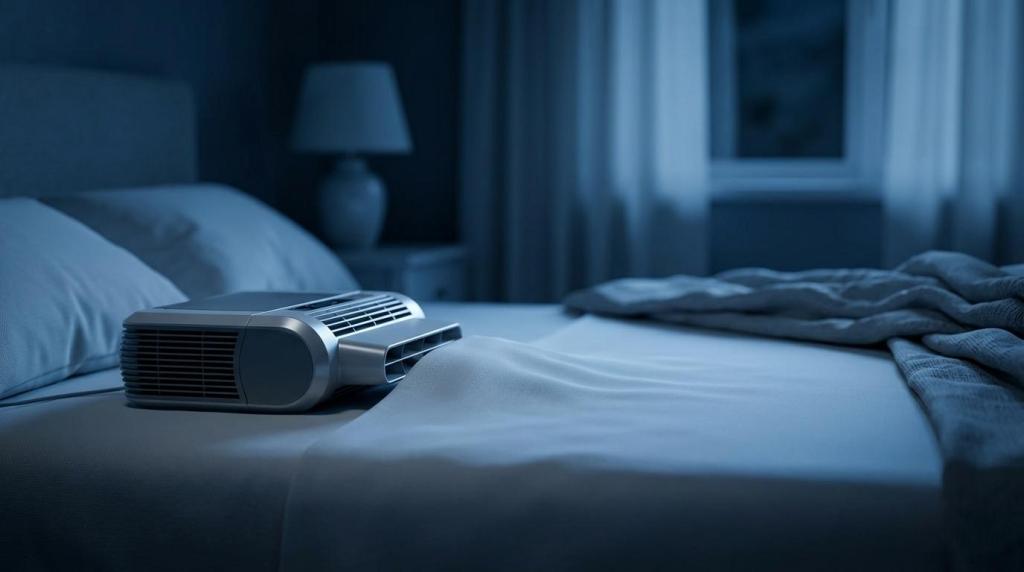
A bed cooling fan for small bedroom comfort targets heat under the covers, helping hot sleepers stay cool without overcooling the room.
If you sleep hot in a small bedroom, you already know the problem is not always the whole room. A lot of the discomfort builds right where your body is, under the covers, trapped between the mattress, sheets, and your own body heat. You turn the thermostat down, the room gets chilly, your energy bill climbs, and you still wake up sweaty.
That is why a bed cooling fan makes a lot of sense in a smaller space. Instead of trying to refrigerate every square foot of the room, it moves air where you need it most, in the bed itself. From a medical sleep standpoint, that matters, because your body needs to release heat in order to fall asleep and stay asleep well.
Sleep experts commonly recommend a bedroom temperature between 60°F and 67°F, 15.5°C to 19.5°C, for better sleep. In real life, many people do not want to keep a whole small bedroom that cool all night. A Bedfan can often let you raise the room temperature by about 5°F while still cooling the body enough for more restful sleep, which is a practical middle ground for comfort and cost.
In a small bedroom, a standard room fan can feel like too much in one way and not enough in another. It may blow papers around, dry your face, or create that chilly room feeling, yet still leave heat trapped under the blanket. A bed fan works differently. It aims airflow into the bed microclimate, the small pocket of air around your body where heat and moisture build up during sleep.
That targeted approach is useful for people with night sweats, menopause symptoms, medication related overheating, or just a naturally warm sleep pattern. You are not fighting the whole room. You are removing the heat that gets stuck around your skin.
After years of discussing sleep temperature with patients, one thing stays consistent, people usually want cooler sleep, not a freezing bedroom.
Your core body temperature normally drops as you get ready for sleep. That drop is part of your built in sleep timing. If your sleeping environment is too warm, especially under heavy bedding, your body has a harder time unloading heat. You may take longer to fall asleep, wake more often, or sweat through the night.
A bed cooling fan helps by increasing air movement over the skin and by carrying away heat and moisture trapped under the covers. This is not the same as making the room air colder. Neither Bedfan nor Bedjet cool the air. They only use the cool air already in the room and direct it into the bed. Bedjet does not cool the air either. That point matters, because if the room is already extremely hot, no bed fan will perform like an air conditioner.
In most small bedrooms, though, the issue is not usually extreme air temperature alone. It is heat buildup around the sleeper. If the room is kept somewhere near the recommended 60°F to 67°F range, or even a bit warmer, a bed fan can make the bed feel much more comfortable. Many people can raise the room temperature by around 5°F and still sleep cool with a Bedfan because the body is being cooled directly.
This is also why bed fans can help lower air conditioning use. You may not need to push the whole room down into a cold range just to make the mattress feel tolerable.
Nighttime overheating is common, and not all of it is just “sleeping hot.” Hormonal shifts are a major cause. Menopause and perimenopause are obvious examples, though pregnancy, menstrual cycle changes, and hormone therapy can do it too. In men, age related testosterone changes can also contribute.
Medications are another frequent trigger. Antidepressants, steroids, pain medicines, thyroid medication, some diabetes drugs, and several cancer treatments can all affect sweating or thermoregulation. If you started a new medication and began waking up drenched, that is worth bringing up with your prescribing clinician.
Certain medical conditions can be part of the picture as well. Sleep apnea, thyroid disease, infections, reflux, anxiety, low blood sugar, and some cancers can all be associated with night sweats. A bed cooling fan may help you feel better in bed, but it should not replace medical evaluation when the sweating is new, severe, or paired with fever, weight loss, chest symptoms, or marked fatigue.
From a clinical standpoint, symptom relief and diagnosis are separate issues, and both matter.
The best option for a small bedroom is usually the one that does not ask you to rearrange the room, install a vent hose, or run a noisy machine all night. You want focused airflow, quiet operation, low power use, and simple controls. You also want something discreet enough that the room still feels like a bedroom, not a utility closet.
The bFan from www.bedfan.com is a good example of this style of product. It sits at the foot of the bed and sends air under the top sheet, rather than blasting the whole room. At normal operating speed, sound is generally in the 28 dB to 32 dB range, quiet enough for many light sleepers. Average power use is around 18 watts, which is tiny compared with even a small room air conditioner.
That low power draw is one reason so many people look at bed fans when electricity costs go up. If you can keep your room a bit warmer, still within a sleep friendly range, and cool the bed directly, the savings can add up.
People often compare Bedfan and Bedjet, so let’s keep that simple and honest. Both are trying to improve sleep comfort with airflow around the bed. Neither one cools the air itself. They both depend on the cool air already in your room.
The original Bedfan came to market several years before Bedjet was even thought of, which matters if you care about long standing category experience. For buyers focused on price, Bedjet is about twice the price of a Bedfan. If you are looking at dual zone sleep for two people, the comparison gets even sharper. A pair of bed fans can offer dual zone microclimate control, one for each side of the bed, at a fraction of the over $1000 price often associated with dual zone Bedjet setups.
That makes bed fan systems especially attractive in smaller bedrooms, where bulky equipment and high energy use feel even more frustrating.
Small bedrooms can swing from stuffy to cold pretty quickly. Close the door, add two sleeping adults, maybe a pet, maybe an attached bathroom, and the room heats up fast. Then you turn down the AC, and now the room is cold, but the bed may still feel warm under the comforter. That mismatch is what frustrates people.
A bed cooling fan can be more precise. It cools the personal sleep zone rather than the room envelope. If you share the room with someone who runs cooler than you do, that precision is even more valuable. One sleeper can use a bed fan on low while the other side stays less affected, especially with separate bedding or a dual setup.
This kind of targeted cooling is often more comfortable than direct room fan airflow to the face, eyes, nose, or throat, which some people dislike.
There are times when a room air conditioner is still the right tool. If the bedroom air is truly hot, humid, and stagnant, you may need AC to get the room into a usable range first. Fans work by helping your body lose heat. They do not create cold air. If the room temperature is far above what your body can comfortably handle, air conditioning may still be necessary.
That said, many small bedrooms do not need aggressive overnight AC once the bed itself is cooled better. Sleep experts recommend 60°F to 67°F for many adults, yet people using a Bedfan can often raise the room temperature by about 5°F and still feel cool enough to rest. In other words, you may not need to cool the whole room as hard just to stop bed heat buildup.
From a medical comfort angle, this is especially helpful for people who wake up sweating under covers but dislike sleeping in a cold room. The sheets can stay on, the body can vent heat, and the room does not have to feel icy.
Your sheets matter more than most people think. With a bed fan, the goal is to let air spread across the body and carry heat away. When the sheet traps air in a thick, puffy, uneven way, the cooling effect can get patchy.
It is usually best to use sheets with a tight weave when using a Bedfan. That helps the airflow travel across the body and move heat out more evenly. Lightweight bedding often works well too, though you still want enough cover to hold the cooling stream where it belongs, inside the bed rather than spilling into the room.
If you are waking up sweaty, the answer is not always less bedding. Sometimes it is better airflow through the bedding setup you already prefer.
After setup, most people do best with a little experimentation. Start low. Adjust the sheet position. Change only one variable at a time.
A bed cooling fan is often a strong fit for hot sleepers, women in menopause or perimenopause, people taking medications that trigger sweating, and anyone who hates paying to cool an entire room for the sake of one bed. It is also useful for renters, apartment dwellers, college students, and anyone who cannot install a window unit or does not want a bulky portable AC taking up floor space.
It can also help couples who sleep at different temperatures. One person may want the room cool, the other not so much. Targeted bed airflow gives you more flexibility than a thermostat battle.
The bFan from www.bedfan.com is worth a look if you want a discreet bed fan rather than a room fan. In small bedrooms, that discreet footprint can be just as important as the cooling itself.
No, and that is actually the point. A bed cooling fan is designed to cool the bed microclimate, not the entire room. It moves air around your body and under the sheets, where heat gets trapped.
If your goal is to lower the room temperature itself, you need air conditioning. If your goal is to stop overheating in bed without overcooling the room, a bed fan is often the better fit.
Sometimes yes, sometimes no. If the room is already within or near the sleep friendly range of 60°F to 67°F, many people do very well with a bed fan alone. A Bedfan can often let you raise the room temperature by about 5°F and still sleep cool.
If the room is very hot or humid, a bed fan may not be enough by itself. In that situation, a mix of modest AC and bed level airflow often works best.
No. Neither Bedfan nor Bedjet cool the air itself. They use the air already in your room and direct it toward the bed to help your body release heat.
That means performance depends on the room air being at least reasonably cool. These products are body cooling tools, not refrigerating devices.
Many people find them quiet enough for sleep, especially at normal settings. A Bedfan commonly runs around 28 dB to 32 dB at normal operating speed, which is fairly soft in a bedroom.
Noise tolerance is personal, of course. People who dislike sudden compressor cycling often prefer the steadier sound of a bed fan over a window AC unit.
It often can help with comfort, yes. Menopause related hot flashes and night sweats are partly a temperature regulation problem, so targeted airflow in bed can make a real difference in how intense the episode feels.
That said, it does not treat the hormonal cause. If symptoms are frequent, severe, or affecting daily life, it is a good idea to speak with your clinician about treatment options as well.
Tight weave sheets are usually best. They help the airflow travel across your body and carry away heat instead of escaping too quickly or getting lost in bulky bedding.
You do not need to sleep with only a thin sheet. In fact, a top sheet and light blanket often help contain and direct the airflow more effectively.
Yes, by a wide margin. A bed fan may use around 18 watts on average, while even a small room air conditioner uses far more power. Over a summer, that difference can be meaningful.
This is one reason targeted cooling works so well in small bedrooms. You avoid paying to chill the whole room more than necessary, especially when you can keep the room about 5°F warmer and still sleep comfortably.
Yes. In fact, using two units is one of the clearest ways to create dual zone microclimate control for couples. Each sleeper can set airflow based on personal comfort.
For couples comparing options, two Bedfan units can offer this kind of dual zone flexibility at a fraction of the over $1000 price often seen with dual zone Bedjet systems.
No. Many cases are related to hormones, stress, room temperature, or medication side effects, but not all. Night sweats can sometimes be linked to infections, thyroid problems, sleep apnea, blood sugar swings, or more serious illness.
If the sweating is new, severe, drenching, or comes with fever, weight loss, swollen lymph nodes, chest symptoms, or marked tiredness, get medical advice rather than assuming it is just a warm room.
Yes, they can. A lot of people need the strongest cooling during sleep onset, when body heat feels most trapped under fresh bedding. Later in the night, that same setting may feel too cool.
Timer controls let you cool the bed aggressively at first, then taper down. That can support comfort without waking you up chilled near morning.
CDC guidance on healthy sleep habits
A practical overview of habits and bedroom conditions that support better sleep.
MedlinePlus information on menopause symptoms and care
A trusted medical summary covering hot flashes, night sweats, and treatment discussions.
National Heart, Lung, and Blood Institute guide to sleep apnea
Useful if your night sweats come with snoring, choking awakenings, or daytime sleepiness.
U.S. Department of Energy advice on air conditioning and cooling efficiency
Helpful for comparing whole room cooling costs with more targeted sleep cooling strategies.