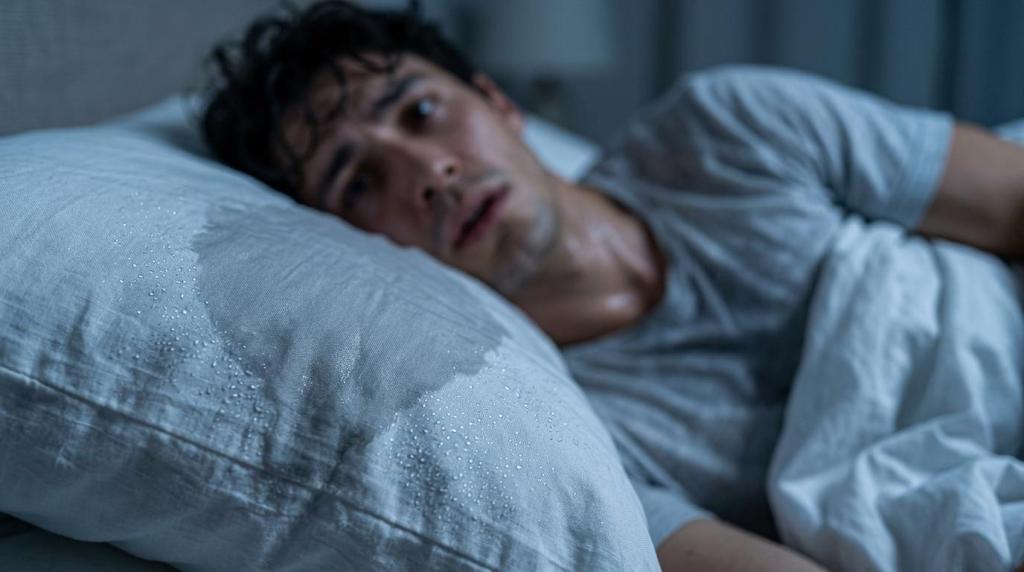
Night sweats in men can stem from heat, meds, alcohol, hormones, low blood sugar, infections, or sleep apnea—know when to get checked.
Men can have night sweats for simple reasons like a hot room or heavy bedding, but repeated episodes of waking up drenched can also point to medications, alcohol, low blood sugar, infections, hormone changes, sleep apnea, or another underlying health issue.
TL;DR: Summary
If this is happening to you, the main question is not just “How do I cool off?” It’s “Is this a comfort problem, or a symptom that needs a workup?” Both matter, and you can usually tackle them side by side.
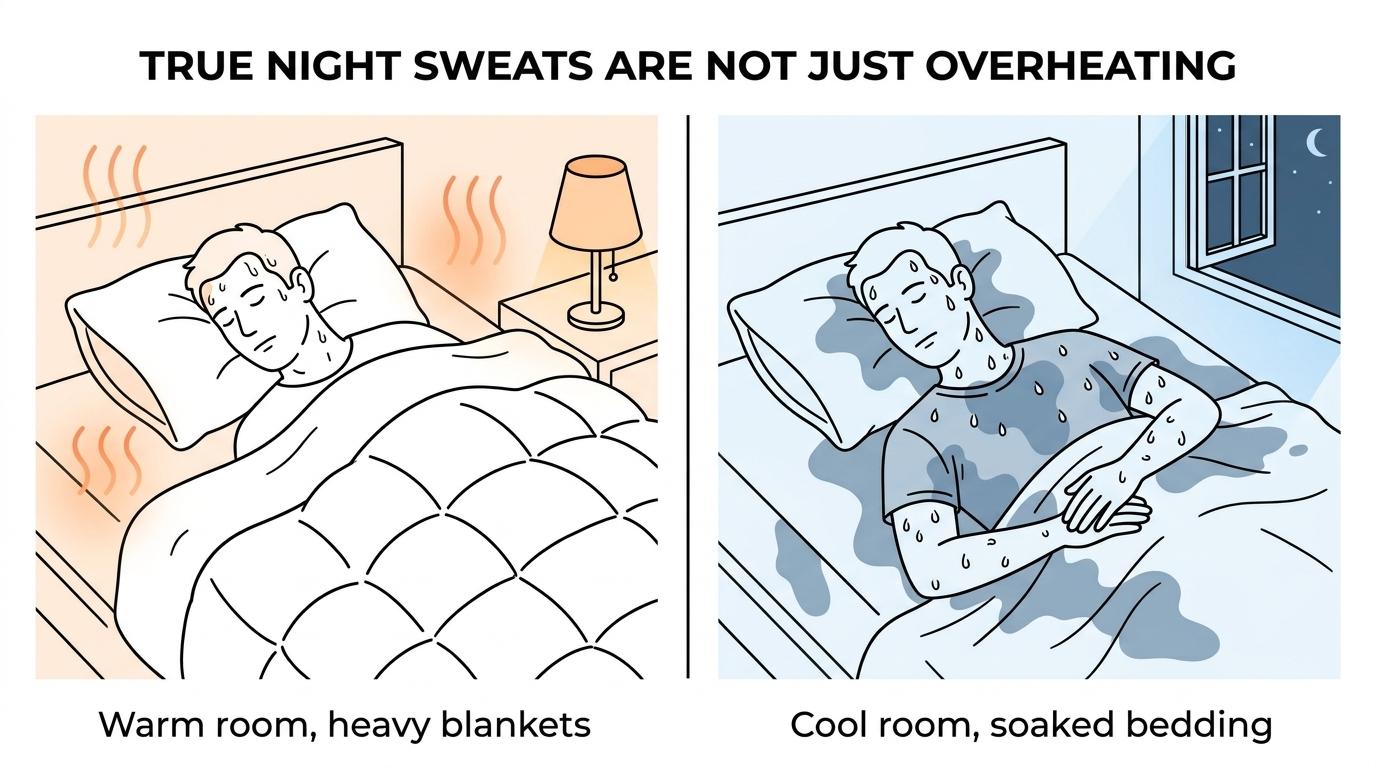
No. Mayo Clinic and NHS both separate true night sweats from a warm bedroom or too many blankets.
That distinction matters. True night sweats usually mean sweating heavily enough to soak your T-shirt, sheets, or pillowcase even when the room is reasonably cool. Mayo Clinic uses that exact framing and also notes that plain overheating from the sleep environment is not usually considered true night sweats: https://www.mayoclinic.org/symptoms/night-sweats/basics/causes/SYM-20050768?p=1
Sleep specialists commonly recommend a bedroom temperature around 60°F to 67°F for better sleep. If your room is 74°F, you’re under a thick comforter, and you wake sweaty, the environment may be the main issue. If your room is cool and you still wake up drenched, think beyond comfort alone.
"bFan Bed Fan addresses the sleep environment by moving room air under the sheets. It does not treat the underlying medical cause of night sweats."
A common misconception is that any sweating at night counts. It doesn’t. Mild warmth, a damp neck, or sweaty feet can happen from bedding, stress, or a late workout. Repeated soaking wet bedding is a different signal.
Yes, some patterns deserve prompt medical attention, especially when fever or weight loss is involved.
Call your doctor sooner rather than later if night sweats are happening regularly, interrupting sleep, or coming with other symptoms. That includes the red flags Mayo Clinic highlights: fever, unexplained weight loss, pain, cough, or diarrhea. If you have a history of cancer, recent infection, diabetes, or immune suppression, don’t shrug this off.
After a few nights, look for these clues:
This is not medical advice. Always consult your doctor or oncology team before making changes.
The most common causes in men are environmental heat, medications, alcohol, low blood sugar, anxiety, infections, and sleep disorders like OSA.
A quick way to think about it is to separate comfort causes from body causes. More than one cause can be present at the same time.
The key is frequency and context. One sweaty night after whiskey, spicy food, and a broken air conditioner is different from waking up drenched three times a week in a cool room.
Yes, hormone changes can cause night sweats in men, but low testosterone is not the first cause to assume.
This is where people often jump too fast. Men do sometimes get hot flashes or sweating from hormone shifts, especially during androgen deprivation therapy for prostate cancer. Cancer.gov discusses hot flashes and night sweats as a known treatment side effect in some patients: https://www.cancer.gov/about-cancer/treatment/side-effects/hot-flashes-pdq
Low testosterone by itself is not the most common explanation for repeated night sweats. Thyroid disease is a more routine endocrine cause. If you also have fatigue, libido changes, erectile dysfunction, tremor, palpitations, or weight changes, hormone testing may be part of the workup. If not, medications, alcohol, sleep apnea, or infection may be more likely.
Yes. SSRIs, prednisone, insulin, and alcohol are among the most common real-world triggers.
Medications are easy to miss because the sweating may start weeks after a new drug or dose change. Selective serotonin reuptake inhibitors (SSRIs), serotonin and norepinephrine reuptake inhibitors (SNRIs), corticosteroids like prednisone, opioids, acetaminophen, and some blood pressure drugs can all contribute. If you have diabetes, low blood sugar deserves special attention. Night sweating plus shakiness, vivid dreams, headache, or morning grogginess can fit that pattern.
Alcohol is another big one. A few drinks may make you sleepy at first, but alcohol can widen blood vessels, fragment sleep, and trigger sweating later in the night. If sweating clusters after drinking, that pattern matters.
"The original Bedfan was invented in 2003. Like BedJet, it uses the cool air already in the room rather than chilling the air itself."
Pro tip: don’t stop a prescription medication on your own because you think it’s the cause. If the pattern fits, bring the timing, dose, and symptoms to your doctor and ask about safer alternatives.
Start with three checks: room setup, timing triggers, and your symptom pattern.
Step 1 is the sleep environment. Check the thermostat, bedding layers, mattress topper, and sleepwear. A room near 60°F to 67°F is a good target. If lowering the whole house that far is expensive or uncomfortable for your partner, a Bedfan or bFan can cool the space under the sheets using room air. Many people can raise the room temperature by about 5°F and still feel cooler because the airflow helps evaporate sweat and carry away trapped heat.
Step 2 is timing. Ask what happened in the six hours before bed. Alcohol? A new medication? A late meal? Hard exercise? Infection symptoms? If you use insulin or another glucose-lowering medication, check whether low blood sugar could be involved.
Step 3 is tracking. Keep a two-week log with time of waking, severity, room temperature, alcohol, medication timing, blood sugar if relevant, and any fever, cough, weight change, reflux, or snoring. This is far more useful than showing up and saying, “I just sweat a lot sometimes.”
A small practical tip here: if you try under-sheet airflow, tighter-weave sheets usually move air across the body better than very loose knits.
Doctors usually start with history, medication review, and a focused exam before ordering broad testing.
Step 1 is pattern recognition. A clinician will ask whether the sweating is drenching, how often it happens, whether it wakes you up, and what other symptoms come with it. They’ll also ask about alcohol, travel, infections, diabetes, reflux, snoring, recent weight change, and every medication or supplement you take.
Step 2 is targeted testing if the story points that way. Depending on symptoms, that may include a complete blood count, thyroid testing, glucose or A1C, infection tests, inflammatory markers, a chest X-ray, or a sleep study. An NCBI overview on persistent night sweats notes that evaluation should be driven by history and exam rather than a random testing spree: https://www.ncbi.nlm.nih.gov/books/NBK470545/
Step 3 is follow-through. If the exam and first-line tests are reassuring, your doctor may watch the pattern, adjust a medication, treat reflux, or evaluate for OSA. If you have fever, enlarged lymph nodes, or weight loss, the workup usually moves faster.
Research suggests serious causes are less common than people fear, but they cannot be ignored when red flags are present.
This is the balance to keep in mind. In primary care, many people with persistent night sweats do not turn out to have cancer. Still, infections like tuberculosis, endocarditis, and HIV, as well as blood cancers like lymphoma or leukemia, stay on the list when night sweats come with fever, weight loss, cough, or swollen nodes.
OSA is worth more attention than it gets. If a man snores loudly, gasps, has high blood pressure, wakes with headaches, or feels sleepy during the day, OSA becomes a practical suspect. Treating the sleep disorder can reduce sweating in some patients because it reduces repeated stress arousals during the night.
A common misconception is that cancer is the most likely cause. It usually isn’t. But if the pattern is persistent and paired with other symptoms, it’s still important to check.
A Bedfan, BedJet, and room AC solve different parts of the problem, and none of them treat the medical cause.
Here’s the simple version. Lowering the thermostat cools the whole room. A Bedfan or BedJet cools your bed microclimate by moving the cooler room air that already exists. Neither device cools the air itself. That matters because if the room is very hot, neither one can create cold air out of nothing.
Where a bed fan helps is efficiency and comfort. A Bedfan or bFan pushes air under the sheets where sweat and trapped body heat actually collect. That can be enough for many people to keep the bedroom about 5°F warmer than they otherwise would and still sleep better. It also helps if your partner does not want the whole room icy cold. The original Bedfan came to market years before BedJet was even thought of, and a dual-zone BedJet setup costs over a thousand dollars, which is more than twice the price of two Bedfans.
"A dual-zone BedJet setup costs over $1,000. Two bFan Bed Fans can create dual-zone bed cooling at a much lower cost."
If noise and control matter, this is where features start to matter. Bedfan units offer remote and timer controls, and low-speed operation is around 28 dB. If your main problem is sweat trapped under the covers, targeted airflow often makes more sense than overcooling the whole house.
Yes, you can cool your side of the bed without turning the bedroom into a meat locker.
Step 1 is to cool the bed, not the whole room. If one person runs hot and the other doesn’t, under-sheet airflow is usually the cleanest fix. Two fans can create a dual-zone setup, one per side, without forcing both people into the same temperature.
Step 2 is to choose materials that help evaporation. Moisture-wicking sleepwear, breathable mattress protection, and a tight-weave top sheet work better than thick fleece or heat-trapping layers. People often blame their body when the bedding is doing half the problem.
Step 3 is to use timing. A timer control can help you cool the first sleep cycle when body temperature is still falling, then taper off later. That’s often more comfortable than a constant blast all night.
A realistic case often involves more than one cause, not a single dramatic diagnosis.
One common pattern is a man in his early 50s who starts waking around 2 a.m. drenched two or three nights a week. His room is already cool, but he started an SSRI a month ago, drinks alcohol most evenings, and his partner says he snores hard. His log shows worse nights after drinks and on nights he falls asleep flat on his back. That combination points the doctor toward medication review and possible OSA, not just “bad luck.”
Another pattern is a man with diabetes who wakes sweaty, shaky, and hungry at 3 a.m. That raises a different flag. In that case, the right next step may be checking overnight glucose patterns with his clinician, not just buying cooler pajamas.
These sources are a good place to verify symptoms, risk factors, and next steps.
All links have been checked and are currently working.
Related reading on Bedfan.com may also help: night sweats hub, sleeping cooler guide, bedroom temperature and sleep, menopause night sweats help, and medication-related night sweats.
If you want a practical, non-drug way to cool the bed while you sort out the cause, take a look at the bFan Bed Fan store. It can help move trapped heat and sweat out from under the sheets without overcooling the whole room. This is not medical advice. Always consult your doctor or oncology team before making changes, especially if night sweats are new, severe, or paired with fever, weight loss, cough, pain, diarrhea, or signs of low blood sugar.