Do SSRI night sweats go away? Often yes within weeks, but persistent sweating may need a dose change, switch, or medical review.
If you are waking up sweaty after starting a selective serotonin reuptake inhibitor (SSRI), the short answer is yes, it can go away. For some people, sweating fades after the first few weeks as the body adjusts to the medication. For others, it sticks around until the dose changes or the medication is switched. That is one reason MedlinePlus says antidepressant side effects may get better over time, but you should never stop or change the dose on your own.
The frustrating part is that there is no single timeline that fits everyone.
A lot depends on when the sweating started, whether your dose recently changed, how severe the sweating is, and whether something else might also be contributing, like menopause, a warm room, alcohol, anxiety, sleep apnea, or another medication.
Night sweats are not just “feeling warm.” Major medical sources describe them as repeated episodes of heavy sweating during sleep that can soak pajamas or bedding. The Mayo Clinic lists antidepressants among recognized medication causes of night sweats, and the National Health Service (NHS) also includes some antidepressants among common reasons people get them.
Researchers do not have a single simple explanation for why SSRIs trigger sweating, but the leading idea is that serotonin changes can affect body temperature regulation and sweat signaling. Some people notice it mostly at night because bedding traps heat, humidity builds quickly under the covers, and even mild medication-related sweating turns into a 2 a.m. wake-up.
That trapped heat under the covers matters more than many people realize.
A useful way to think about SSRI night sweats is by phase, not by exact day.
A very typical scenario goes like this: someone starts sertraline, sleeps badly for two weeks, feels a bit better in week three, then finds the sweating settles to a manageable level by week five. Another person starts the same drug and keeps waking up drenched every night for two months. Both patterns happen.
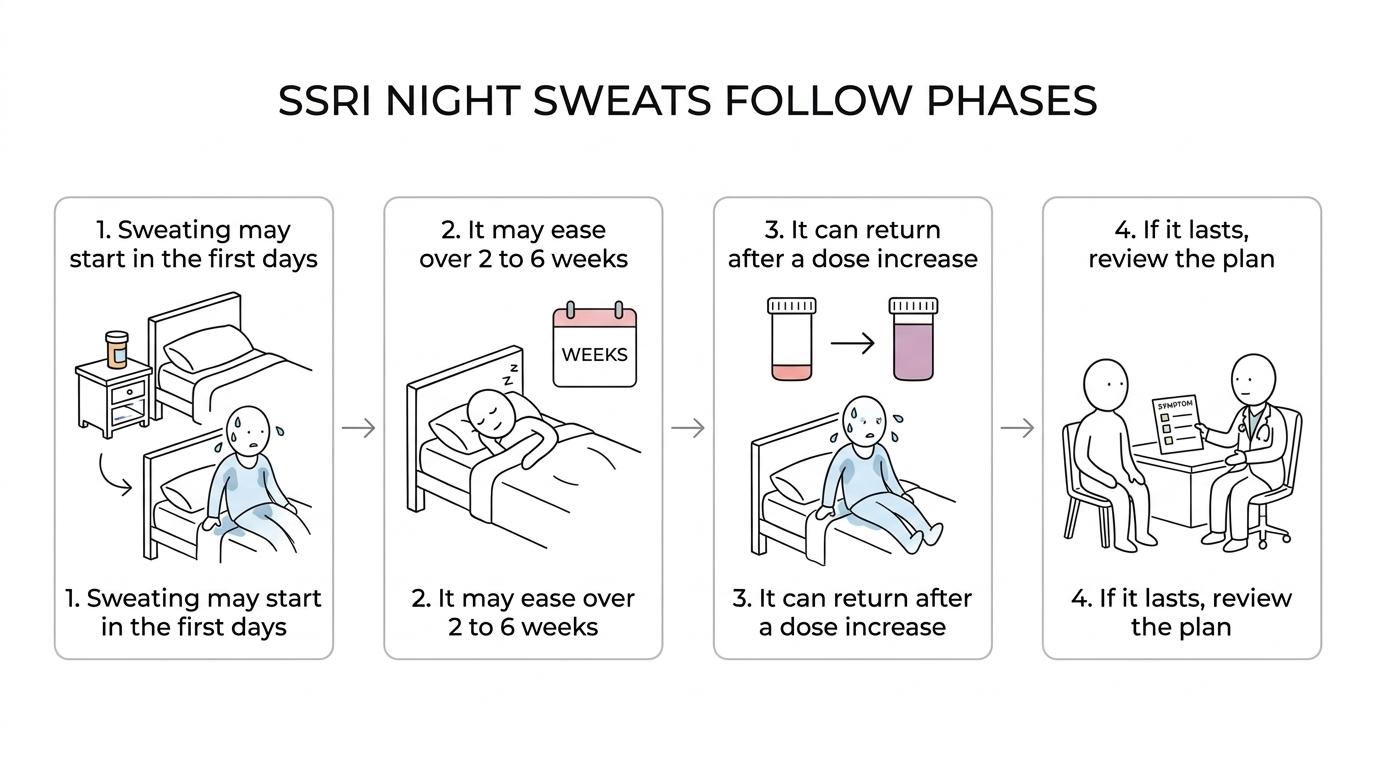
One anonymized example that feels familiar to many people: a woman in her early 40s started an SSRI after a rough period of anxiety and low mood. The medication helped her daytime symptoms within a month, but she kept waking up with damp pajamas around 3 a.m. She assumed it would pass, waited another six weeks, and got more sleep-deprived. At her follow-up, her prescriber reviewed timing, dose, caffeine, alcohol, and cycle changes, then adjusted treatment. Her mood stayed stable, and the sweating eased enough that she no longer had to change shirts at night.
There is no promise here, but some patterns are a little more encouraging than others.
If your sleep is being broken night after night, it is reasonable to bring it up early instead of waiting months.
That sleep disruption can also be shaped by the sleep setup itself, and Oliz notes in its overview of weighted blankets for adults with restlessness and sleep problems that bedding choices can significantly affect how the body experiences the night.
If the SSRI is clearly helping your mental health, the goal is usually not to quit it abruptly. The goal is to keep the benefit while reducing the sweating if possible.
Common next steps a clinician may consider include lowering the dose, switching to a different antidepressant, or changing when you take it. Published reports and reviews have also described add-on options for selected patients when sweating is persistent, including terazosin, benztropine, or cyproheptadine. Those are not do-it-yourself fixes. They need a clinician to weigh side effects, interactions, and whether the sweating is truly medication-related.
This is where good note-taking helps. If you can tell your prescriber, “It started four days after I began escitalopram,” or “It got much worse when I moved from 10 mg to 20 mg,” the conversation becomes much easier.
Even if you and your prescriber are still figuring out the medication piece, you can often reduce the misery right away by changing the bed environment.
Start with the basics. Use light sleepwear. Skip heavy comforters if you can. Keep a spare shirt nearby. Limit alcohol close to bedtime, since it can make nighttime overheating worse. If your bedding traps heat, swap out the thickest layers first.
A bed fan can help because the problem is often trapped heat under the covers, not just room temperature. Neither the bFan nor the BedJet cools the air itself. They both use the cooler air already in the room and move it into the bed space. The original bedfan came to market several years before BedJet was even thought of, and for shoppers comparing options, two bFans cost less than half the price of a dual-zone BedJet.
For someone dealing with SSRI night sweats, targeted cooling can make more sense than blasting the whole bedroom with colder air. A system like the bFan is meant to push room air under the sheets so body heat can escape where you actually feel it. When using a bedfan, it works best with sheets that have a tight weave, because that helps the air spread across your body and carry away heat instead of escaping too quickly. Many sleep experts suggest a bedroom around 60°F to 67°F, and with a bed fan, some people can raise the room temperature by about 5°F and still sleep cool. Low-energy bed fans are efficient too. The bFan averages about 18 watts, and timer controls can help you stay cool long enough to reach deeper, more settled sleep.
A few practical changes tend to help fast:
Sometimes the medication really is the cause. Sometimes it is only part of the picture.
Night sweats are common during perimenopause and menopause. They can also show up with infections, thyroid problems, low blood sugar, anxiety, acid reflux, and obstructive sleep apnea. That is why official guidance focuses not just on the sweating, but on the rest of the symptom story too. The Mayo Clinic notes that concerning symptoms can include fever, weight loss, cough, diarrhea, or pain, and the NHS advises medical review if night sweats regularly wake you up or come with symptoms like fever, coughing, diarrhea, or unexplained weight loss.
If you already had some nighttime overheating before the SSRI, say so. That detail matters.
If your sweating began long after the SSRI was stable, or if you have brand new symptoms that do not fit a simple medication side effect, it deserves a wider look.
It helps to go into the appointment with specific questions instead of just saying, “I am sweating a lot.”
That conversation is often much more productive when you bring a one-week log of bedtime, wake-ups, sweating severity, room temperature, alcohol use, and any recent medication changes.
If this topic hit home, these are strong internal-link opportunities for readers who need more help with nighttime overheating from different angles.
If your antidepressant is helping your mood but your nights are miserable, do not assume you have to choose between mental health treatment and decent sleep. Keep a short symptom log, talk with your prescriber, and make a few heat-reducing changes tonight. If trapped heat under the covers is your biggest problem, targeted airflow from a bed fan like the bFan can help you stay comfortable while you work through the medication side with your clinician.
This article is for general education only and is not medical advice, diagnosis, or treatment. Do not stop, start, or change an SSRI without guidance from a licensed clinician. Seek prompt medical care if night sweats come with fever, chest pain, shortness of breath, unexplained weight loss, severe diarrhea, persistent cough, or any other symptom that feels concerning or rapidly worsening.
The bFan sits at the foot of your bed and sends a quiet stream of air under your sheets. Direct airflow helps stop sweat before it starts, and one bFan costs less than half the price of one BedJet, making it the less expensive alternative. Shop the bFan at bedfans-usa.com