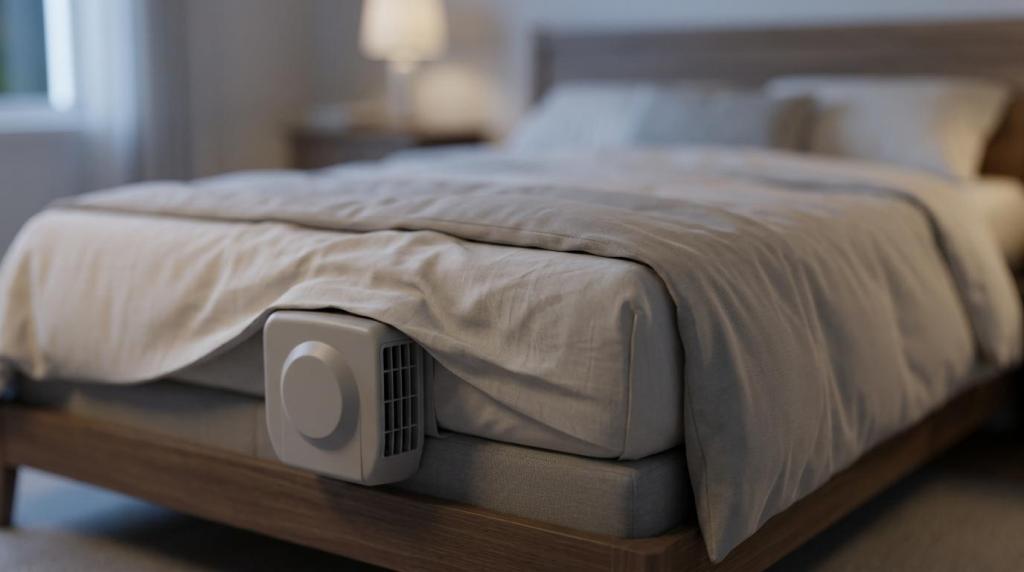
Find the best bedside fan for night sweats and learn when a bed fan cools better by targeting trapped heat under the covers at night.
Hot sleepers often assume any fan is a fan, but night sweats are usually more specific than that. The bFan® bed fan sits in the bed-cooling category, which matters because many sweat episodes happen after you pull the covers up and heat gets trapped around your torso and legs.
TL;DR: Summary
- For night sweats that start under the covers, a bed fan like the bFan bed fan usually matches the problem better than a bedside fan because it moves room air through the bedding, not just across the room.
- A bedside fan can still help when the bedroom feels stuffy, humid, or generally warm, but it often misses the heat pocket trapped under blankets.
- Official guidance from NIH and ACOG supports sleeping in a cool room and using a fan at night, and a small pilot study in Menopause found bed-targeted cooling was linked to fewer vasomotor symptoms and better sleep scores.
- Neither a bed fan nor BedJet cools the air itself. Both use the cooler air already in the room and direct it where you sleep.
- If your sweating starts after the covers go on, targeted under-sheet airflow, tighter-weave sheets, and lower overnight fan speed usually work better than blasting your face with a stronger bedside fan.
The practical question is not whether airflow helps. It is where the airflow needs to go. For many people dealing with hot flashes, menopause, medication side effects, or unexplained nighttime overheating, that difference decides whether you fall back asleep in minutes or stay awake changing clothes and sheets.
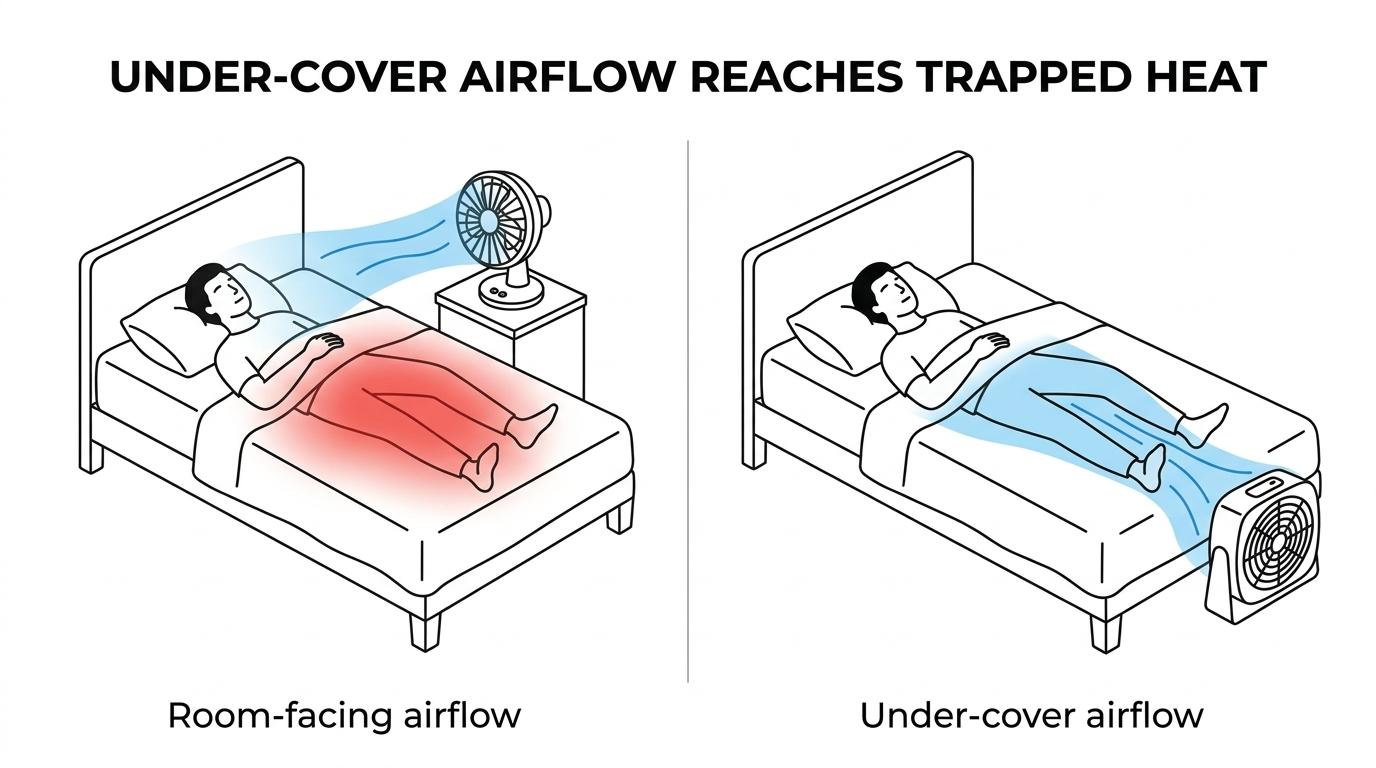
A bedside fan cools the room-facing side of your body, while the bFan bed fan and similar bed fans send airflow under the covers where body heat gets trapped. Neither device makes cold air. Each one only moves the air already in the room.
That distinction matters because night sweats are often an under-blanket problem, not just a room-temperature problem. A bedside fan may cool your face, neck, and arms, yet your chest, back, and legs can still overheat under bedding. A bed fan works closer to the symptom site by pushing room air between the top and bottom sheets.
A common misconception is that a more powerful room fan will always solve overheating. Often it does the opposite. You may end up with a cold face, dry eyes, and chilly hands while your core still feels hot under the blankets.
"bFan Bed Fan directs airflow between the sheets and uses an average of 12 watts, so the cooling happens where heat tends to build up instead of across the whole bedroom."
For most under-the-covers sweating, bed-targeted cooling works better than bedside airflow. That pattern also matches clinical and symptom guidance from NIH, ACOG, and a small menopause study on bed cooling.
Official menopause guidance says hot flashes and night sweats can disrupt sleep and recommends a cool room and a fan at night, according to NIH. ACOG also notes that hot flashes can make sleep harder and advises keeping the bedroom from getting too warm.
There is also a useful clue from published evidence. In a 2022 pilot study in Menopause, 15 perimenopausal and postmenopausal women used a cooling mattress pad system for 8 weeks. Vasomotor symptom frequency dropped 52%, Pittsburgh Sleep Quality Index scores improved from 11.14 to 7.87, and hot flash interference scores fell from 4.16 to 1.92. That study was on a Cooling mattress pad system, not a fan, but it supports the bigger point: cooling the bed itself can reduce sleep disruption better than only cooling the room.
Think of a simple real-life scenario. A woman in her early 50s wakes around 2:30 a.m., throws off the covers, cools down, then gets cold and pulls them back up. Ten minutes later she is sweating again. That pattern usually points to trapped heat in the bedding, not a bedroom that is uniformly too warm.
"bFan Bed Fan uses a digitally controlled DC motor with 5% to 100% speed control, which helps users fine-tune airflow instead of choosing between off and too much."
The best option depends on where your heat builds up, how much bedding you use, and whether your room is warm or just your sleep surface. Most shoppers should compare room-level airflow with bed-level airflow before buying anything.
You can usually tell by tracking when the sweating starts and what fixes it fastest. If symptoms appear after the blankets come up, the bedding is often the main problem.
Step 1. Notice the trigger. If you feel hot even before getting in bed, or the whole room feels stale, a bedside or ceiling fan may help. If you feel fine until you are fully covered, trapped under-blanket heat is the more likely cause.
Step 2. Test the quick relief point. If pushing covers off your torso helps within a minute or two, that suggests a bedding heat pocket. If standing near an open window or fan cools you faster than uncovering, the room may be too warm.
Step 3. Look at the repeat pattern. If you cool off, recover, pull the blankets back up, and sweat again, the issue is often a heat pocket. Pro tip: this pattern is especially common with menopause, SSRIs, steroids, and heavy comforters.
A bed fan works best when it moves air along your body, not into a loose open tent of bedding. Placement, sheets, and speed matter more than maximum force.
Step 1. Put the fan at the foot of the bed and aim airflow between the top and bottom sheets. You want a channel of moving air that travels upward and carries away heat and moisture from your legs, torso, and back.
Step 2. Use sheets with a tighter weave. That sounds backward, but tighter-weave sheets often help the air spread across the body instead of escaping too quickly out the sides. This is one of the most overlooked setup details.
Step 3. Start lower than you think. Many hot sleepers do better with a steady gentle flow than a blast of air. If you get chilled later in the night, reduce speed or use timer controls if your unit offers them, especially during the first few sleep cycles when body temperature is dropping toward deeper sleep.
A bedside fan helps most when it supports sleep comfort, not when it dries you out or creates noise stress. Placement and speed usually matter more than fan size.
Step 1. Aim the airflow across your upper body, not straight into your eyes or nostrils. A direct stream can dry your face and throat and wake you for the wrong reason.
Step 2. Keep the speed moderate and use oscillation if possible. Common misconception: stronger airflow always means better cooling. For many night-sweat sufferers, aggressive face-level airflow feels refreshing at first but becomes irritating by 3 a.m.
Step 3. Pair it with lighter bedding if the room is truly warm. A bedside fan cannot easily penetrate thick covers, so if you keep the same heavy blanket and still overheat under it, the room fan may never solve the main problem.
For under-covers cooling, bFan bed fan and BedJet belong in the same general category, while a bedside fan is a room-air device. The key trade-offs are price, airflow style, energy use, and how targeted the cooling feels.
First, the basic physics are the same. Neither BedJet nor a bed fan cools the air itself. They use the cooler air already in the room to cool your bed. If the bedroom is very hot, any bed-based airflow system has less cooling potential because it can only move what the room already provides.
Second, price matters. A dual-zone BedJet setup is over a thousand dollars and can be more than twice the price of two bed fans. That does not make it wrong. It just changes the decision if you are solving one symptom in one room rather than outfitting a premium sleep system.
Third, category history matters a bit. The original Bedfan™ came to market several years before BedJet was even thought of, which is why many shoppers still use "bed fan" as the general category term for under-sheet airflow.
Last, compare the side effects. A bedside fan may be simpler and cheaper, but it often leaves the under-blanket heat pocket untouched. A bed fan feels more targeted, though it works best with bedding that holds and channels airflow rather than leaking it immediately.
Mainstream guidance does support keeping the sleep environment cool and using a fan. The newer question is whether room cooling alone is enough for symptoms that happen in bed.
NIH states that night sweats are hot flashes that happen at night and can wake people during sleep, making it hard to get back to sleep. ACOG also notes a higher rate of sleep problems during perimenopause and menopause. Those points match what many clinicians call sleep fragmentation, which means repeated awakenings even if total time in bed looks normal.
The pilot study in Menopause adds a useful layer because it focused on vasomotor symptoms, sleep quality, and hot flash interference, not just how cool the room felt. That is why bed-targeted cooling is getting more attention. It addresses temperature regulation at the sleep surface, where symptoms are actually waking people.
Night sweats deserve medical review when they are new, severe, unexplained, or tied to other warning signs. Menopause is common, but it is not the only cause.
Talk with a clinician if night sweats come with fever, unexplained weight loss, swollen lymph nodes, persistent cough, chest pain, shortness of breath, severe fatigue, or blood sugar symptoms. Review medications too. SSRIs, SNRIs, steroids, opioids, diabetes medicines, and some cancer treatments are well-known triggers.
A useful misconception to avoid is assuming every sweat episode is "just hormones." People can have more than one cause at once. A person might be in perimenopause, start a new antidepressant, and also keep the bedroom warmer than ideal. The cooling strategy can help, but the cause still deserves a proper review when the pattern changes.
Start with the simplest change that matches where the heat is building up. If the room feels fine but the bed turns into a heat pocket, target the bed before buying a bigger room fan.
Set your bedroom toward the commonly recommended cool-sleep range of about 60°F to 67°F when practical. If you use a bed fan effectively, some people can raise room temperature by about 5°F and still sleep cool because the airflow is concentrated where their body heat gets trapped. If your main issue is general stuffiness, use a bedside fan. If your sweating starts after you pull up the covers, try under-sheet airflow first.
If you want more comparison help, review related guides on Bedfan.com:
If you are deciding between another bedside fan and a more targeted option, compare how your symptoms actually happen before you spend money. If the problem lives under the covers, take a close look at what a bed-focused system like the bFan bed fan is designed to do.
This article is general information only and is not medical advice, diagnosis, or treatment. Night sweats can be related to menopause, medications, infection, thyroid problems, low blood sugar, sleep apnea, alcohol use, or other medical conditions. Seek prompt medical care for night sweats with fever, unexplained weight loss, chest symptoms, confusion, or any sudden severe change in your health.