Learn 7 key facts to choose the best fan for bed, from airflow and noise to sheet fit, room temperature, energy use, and cost.
Picking the right fan for bed starts with a simple question: are you trying to cool the whole room, or the hot air trapped under your covers? The bFan Bed Fan belongs to the second category, using room-temperature air to reduce heat buildup in the bedding microclimate where many hot sleepers actually feel the problem most.
TL;DR: Summary
- A fan for bed works best when your bedroom is already fairly cool but heat gets trapped under the covers, and the bFan Bed Fan is designed for that targeted bed-cooling job rather than whole-room cooling.
- The key buying factors are airflow path, room temperature, sheet type, noise, controls, power use, and total cost.
- Neither bed fans nor BedJet units create cold air. They move existing room air, so performance depends on bedroom temperature and humidity.
- Research supports cooler sleep environments, and bedding-based cooling can lower body temperature and help hot-flash symptoms, though not every study shows the same sleep-metric gains.
- If your night sweats are new, drenching, or paired with fever, weight loss, swollen lymph nodes, or medication changes, symptom relief should not replace medical evaluation.
That distinction matters because sleep temperature research is more nuanced than many product pages suggest. The CDC says a good sleep environment should be cool and comfortable, around 65°F to 68°F for most people, while sleep experts often cite 60°F to 67°F as a useful target range when practical (CDC). A fan for bed can be a smart middle ground when you do not want to overcool the entire bedroom just to fix the warm pocket under your sheets.
A fan for bed moves room air into the bedding microclimate, not across the whole bedroom. Systems like the bFan Bed Fan target heat trapped between your body, sheets, and blankets, which is often the real source of that too-hot-at-2-AM feeling.
That under-covers zone matters because bedding holds heat close to the skin. Research on sleep thermoregulation notes that the normal nighttime drop in core body temperature helps trigger sleep, and bedding creates a warm microclimate that affects heat loss from the body (PubMed). If the room is reasonably cool but the covers still feel stuffy, a bed fan is solving a different problem than a ceiling fan or a colder thermostat setting.
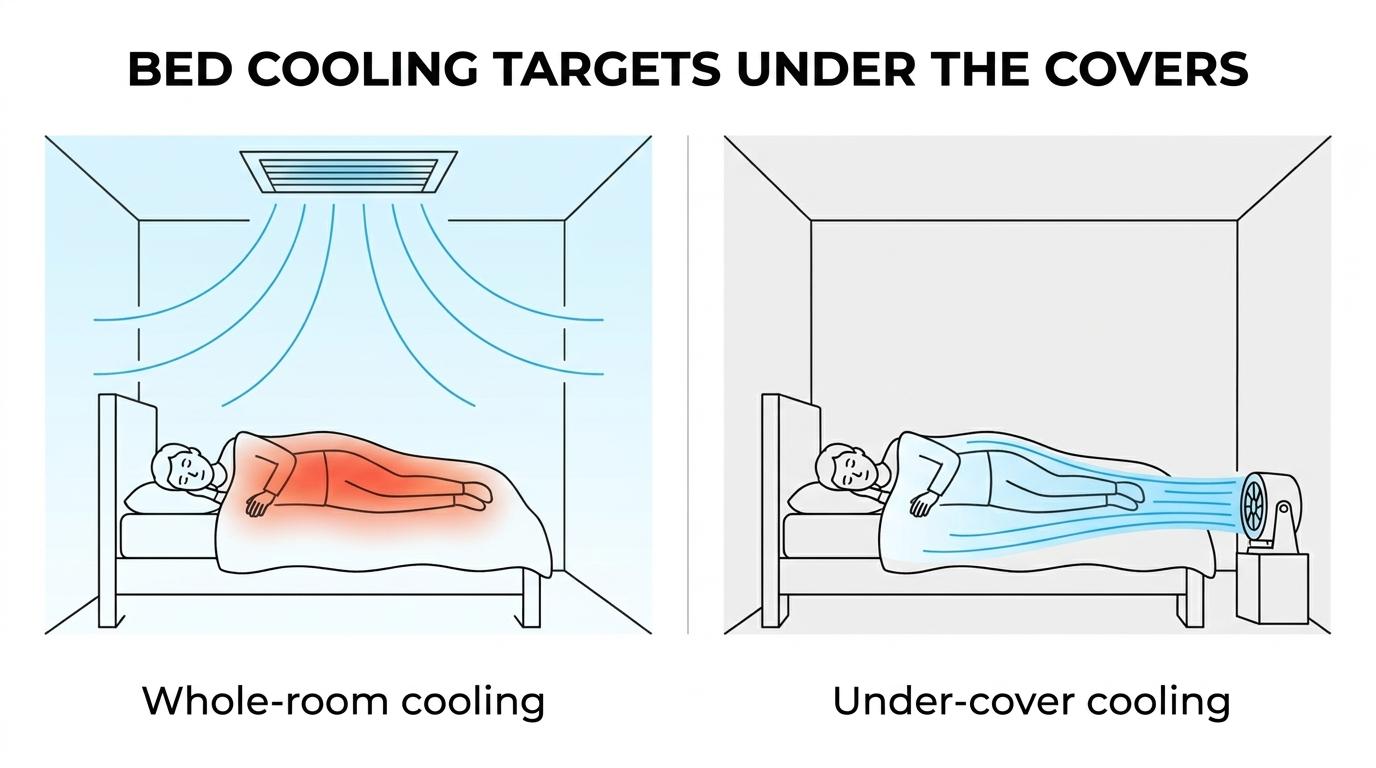
A common misconception is that these devices "make cold air." They do not. Neither a bed fan nor a BedJet cools the air itself. Both use the cooler air already in the room and move it where it matters more.
"The bFan targets trapped heat under the covers and uses about 18 watts on average, so its job is bed cooling, not replacing air conditioning."
That means room conditions still matter. If your bedroom is hot and humid, a fan for bed may still help, but it will not feel like refrigerated air. Think of it as targeted heat removal, not active air conditioning.
A bed cooling fan helps most when the room is acceptable but the bed feels too warm. Hot sleepers, people with night sweats, and many women in perimenopause or menopause are often the clearest fit.
This category is especially relevant for people dealing with vasomotor symptoms, medication-related sweating, or heavy bedding heat buildup. A 2022 pilot study in 15 perimenopausal and postmenopausal women using a cooling mattress pad found a 52% reduction in vasomotor symptom frequency at 8 weeks, along with a drop in Pittsburgh Sleep Quality Index score from 11.14 to 7.87 (PubMed). That does not prove every cooling product works the same way, but it does support the idea that bedtime thermal control can matter when hot flashes drive sleep disruption.
A short real-life scenario makes this easier to picture. A woman in her early 50s may keep the room at 67°F, yet still wake up sweating because her chest, back, and legs get trapped under a comforter while her partner feels cold. In that case, localized bed cooling usually makes more sense than dropping the thermostat for the whole room.
Pro tip: if you only feel hot once you are under the covers, your problem may be the bedding microclimate, not the bedroom temperature.
Seven practical facts matter most: where the air goes, what temperature the room already is, how loud the unit sounds, how your sheets handle airflow, what controls you get, how much power it uses, and what the full setup costs.
Many buyers compare only fan power or price. That usually leads to disappointment, because bed cooling performance depends on airflow delivery and sleep setup more than raw fan strength.
The best bed fan is the one that matches your bedding, room, and partner situation. If those three factors do not fit, even a strong unit can feel underwhelming.
Start by checking what is actually making you hot. If your room is 66°F to 68°F and the discomfort starts after the covers go on, you want under-covers airflow. If the entire room feels stale, you may need room cooling or dehumidification first.
Then match the device to your sleep setup:
A common mistake is assuming more airflow is always better. Air path matters more than headline fan numbers if the goal is to remove trapped heat quietly while you sleep.
A bed fan is more targeted than lowering the thermostat, while thermostat changes cool the whole room for everyone. The better choice depends on partner comfort, utility costs, and whether your heat problem lives in the bed or in the bedroom.
The CDC points to a cool sleep environment around 65°F to 68°F for most people (CDC). Many sleep experts also recommend a range around 60°F to 67°F. In real life, some people do not need to cool the whole room that far if the under-covers heat is the main issue. With a bed fan, people can often raise room temperature by about 5°F and still sleep cool because the airflow is removing heat where it collects.
"Many bFan users report sleeping comfortably with the room set about 5°F warmer, because the cooling happens inside the bedding microclimate."
The trade-off is simple. Lowering the thermostat helps everyone in the room, but it costs more and may make a partner too cold. A bed fan costs less to run and feels more targeted, but it depends on the room already being reasonably cool.
A bed fan, a BedJet, and a cooling mattress pad all aim at sleep temperature, but they do it in different ways. The core trade-off is airflow versus surface cooling, plus major differences in price, setup, and who shares the bed.
Here is the key fact many shoppers miss: neither a standard bed fan nor a BedJet cools the air itself. Both move room-temperature air into the bed. So if a comparison claims "cooling," ask whether it means true active cooling or just better delivery of existing room air.
This category also predates BedJet by several years. Bed cooling through directed under-covers airflow was already on the market before BedJet was introduced, which is useful context if you are comparing newer branding to an older sleep-cooling approach.
If price is a deciding factor, pay close attention to full-system cost. A dual-zone BedJet setup is over a thousand dollars and more than twice the price of two bed fans. Cooling mattress pads can make sense if you want more direct contact-based thermal control, but they tend to add more complexity, more material on the bed, and a different feel under the body.
Research adds a useful nuance here. A 2024 systematic review and meta-analysis screened 3,454 records and included 9 studies on bedding strategies that induced body cooling in healthy adults. It found clearer evidence for acute body cooling, including lower core body temperature, than for consistent improvements in sleep onset latency, wake after sleep onset, sleep efficiency, sleep stages, or total sleep time (PubMed). That is why buyers should separate "helps me feel cooler" from "guarantees every sleep metric improves."
Setup matters almost as much as the fan itself. Position, sheet choice, and first-hour timing can make a noticeable difference.
Start at the foot of the bed and make sure the airflow has a clear path under the top layers. Then use sheets with a tighter weave, because they help the air travel across your body and carry away heat instead of leaking out too quickly. Many people get better results with percale or other smooth, tighter-woven cottons than with very open knits or fluffy layers.
Timing helps too. A higher setting for the first 20 to 40 minutes can support that cooler sleep onset window, then a lower setting later may be enough. This is where timer controls are useful. You can cool the bedding when you first lie down, then back off once the bed no longer feels heat-soaked.
One more pro tip: do not tuck the top sheet and blankets too tightly around your feet. If you choke off the outlet path, airflow drops and the whole system feels weaker than it is.
Troubleshooting should start with the room, then the bedding, then your body. Most disappointing results come from one of those three, not from the concept itself.
If the room is too warm or humid, fix that first. Moving 78°F air under the covers is still moving 78°F air. If the room is already in a sleep-friendly range, check the bedding. Waterproof mattress protectors, memory foam surfaces, flannel, and heavy synthetic comforters can all trap heat and slow convective cooling.
Then look at your sleep habits. If you drink alcohol late, eat a heavy meal before bed, take a hot shower right before lights out, or wear thick sleep clothing, you may be adding to the overheating problem. If you wake at the same time every night sweating, consider whether medications, blood sugar swings, anxiety, or hormone shifts could be part of the pattern.
A common misconception is that all night heat comes from the blanket. Sometimes the mattress or mattress protector is the main heat reservoir, especially when the upper body stays warm no matter what sheet you use.
Night sweats deserve medical attention when they are new, drenching, persistent, or paired with warning signs. Fever, weight loss, swollen lymph nodes, ongoing cough, chest pain, medication changes, or severe fatigue should move this beyond a sleep-product decision.
Night sweats can be tied to menopause, medications, anxiety, infections, obstructive sleep apnea (OSA), endocrine disorders, cancer, and other causes. Symptom relief at bedtime can be helpful, but it should not delay care when the pattern changes or the sweating is intense enough to soak clothes or bedding regularly.
If night sweats are your main concern, useful related reading on this site could include:
If your main problem is trapped heat under the covers, compare airflow path, sheet compatibility, noise, controls, and total system cost before you buy. If you want a targeted solution, look at under-sheet bed cooling systems and how they fit your room and bedding setup. This article is educational only, not medical advice, and it is not a diagnosis or treatment plan. If you have drenching night sweats, unexplained weight loss, fever, shortness of breath, swollen glands, or new symptoms after a medication change, contact a licensed clinician promptly.