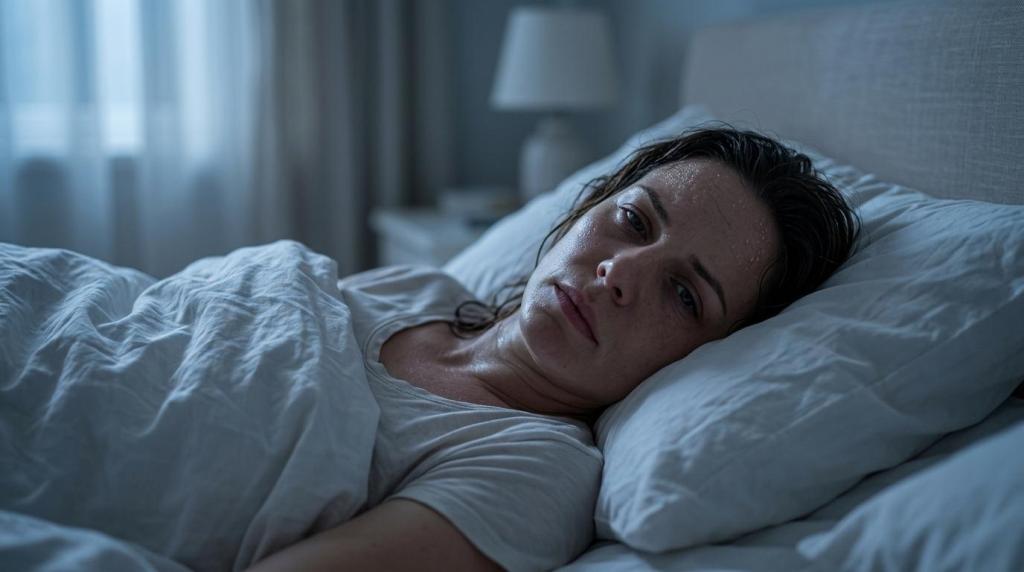
Bed climate control helps hot sleepers cool the sleep microclimate, reduce trapped heat and moisture, and stay comfortable without overcooling.
If you sleep hot, the biggest temperature problem is often not the whole bedroom. It is the layer of trapped heat and moisture inside your bedding, right where your body is trying to cool down before sleep.
TL;DR: Summary
That matters because sleep is tied to heat loss. If your feet, legs, torso, and mattress stay too warm, your body has a harder time making that normal transition into sleep. Bed climate control, often enhanced by a bed cooling system, is really about helping the body do what it was already trying to do.
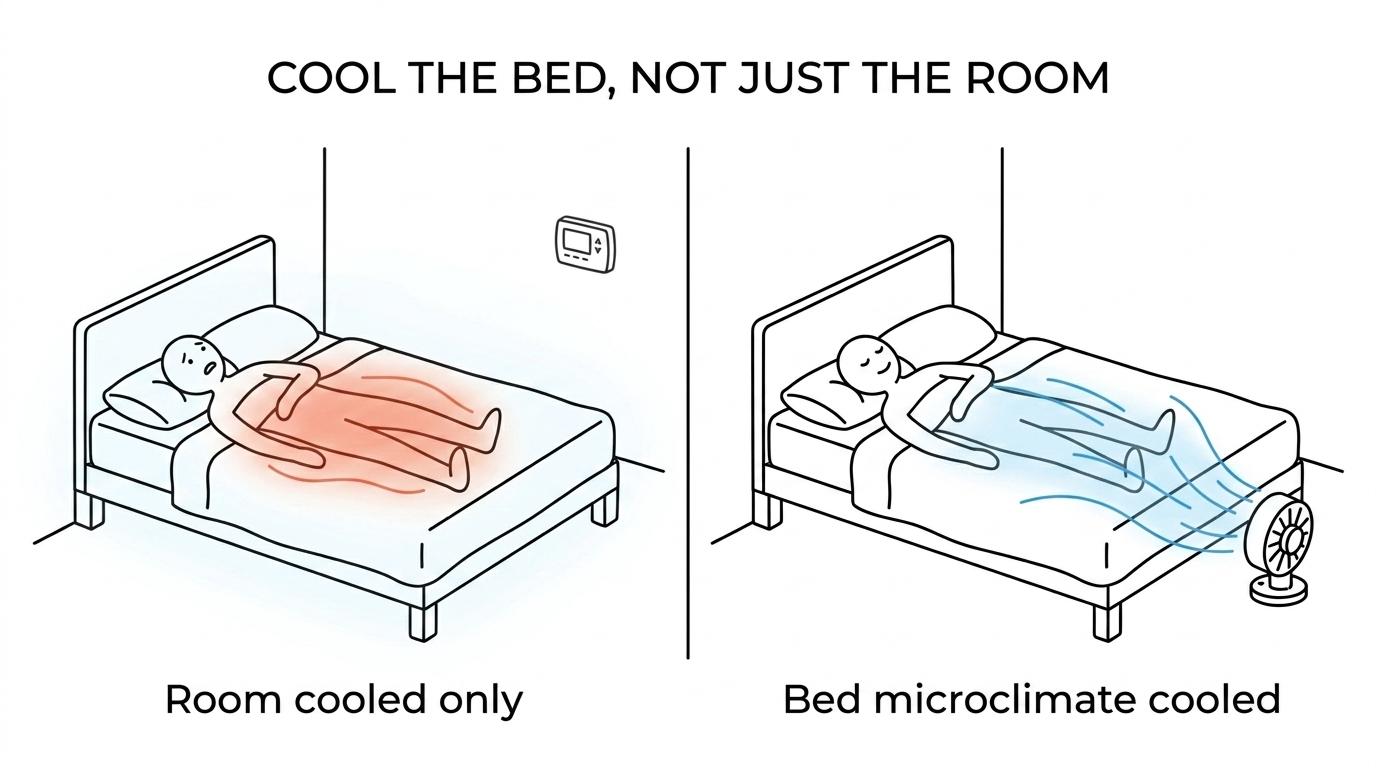
Bed climate control means managing the air, heat, and moisture around your body, potentially with a bed cooling system, not just the thermostat on the wall. For bFan Bed Fan and standard bedding, the target is the sleep microclimate under the sheets where trapped heat and sweat build up fastest.
Additionally, the type of mattress you use can significantly impact your bed climate and its maintenance. A mattress with breathable materials can enhance airflow and help manage heat retention more effectively than a traditional foam mattress. This extra breathability is essential for maintaining a comfortable sleep microclimate, particularly for those who sleep hot and need to disperse excess body heat efficiently.
A bed cooling system can be a game-changer for individuals struggling with overheating during sleep, especially when combined with effective temperature regulation to maintain consistency. These systems often include technologies such as active cooling pads or integrated cooling mechanisms within the mattress, designed to regulate temperature by actively drawing heat away from the body and dissipating it. By maintaining an optimal temperature across the sleep surface, a bed cooling system ensures that sleepers can achieve a more restful and uninterrupted night's sleep without having to over-rely on central air conditioning.
Hot sleepers usually notice the same pattern. The room feels acceptable at first, then the bed turns into a heat pocket. That happens because mattresses, protectors, foam layers, and heavy comforters hold warmth close to the skin. If air cannot move under the covers, heat and humidity linger.
A common mistake is assuming colder room air alone will fix that. Sometimes it does, but often it just makes the rest of the house uncomfortable while the sleeper still feels hot in bed. Bed climate control tries to solve the closer problem first by improving airflow where the body is actually overheating.
"bFan Bed Fan was invented in 2003, and it cools by moving the room's existing air under the sheets."
Core body temperature is part of the sleep switch. PubMed studies and standard sleep guidance show that falling body temperature and better heat loss are linked with easier sleep onset.
One classic PubMed study found that in 44 subjects, the fastest decline in body temperature happened about 60 minutes before sleep onset, and the authors concluded that a rapid decline in core body temperature may increase the likelihood of falling asleep (https://pubmed.ncbi.nlm.nih.gov/9322266/). Another study found that after sleep onset, good sleepers showed a mean sleep-evoked decrease of 0.31°C, and body temperature fell faster during sleep than during matched wakefulness (https://pubmed.ncbi.nlm.nih.gov/8446841/).
Put simply, the body wants to dump heat before and during sleep. If the bedding keeps that heat trapped, the signal gets blunted. If you improve heat loss with cooler room air, lighter bedding, or under-sheet airflow, sleep onset can feel less like a wrestling match.
Pro tip: people often focus only on the head and face. Those areas matter, but the torso and legs under the sheets can be the real heat reservoir.
The six most useful facts are practical, not fancy. They help you decide whether you need colder room air, better bedding, or targeted airflow under the sheets.
Bed climate control is more targeted than whole-house cooling. A thermostat changes the room. A bed fan changes the immediate sleep environment around your body.
This distinction matters for cost and comfort. Cooling a large house to make one person comfortable in one bed is often inefficient. A bed-based setup can let one sleeper cool their side or their sleeping space without making the partner feel cold on the couch, in the hallway, or at the breakfast table.
Bedfan testimonials describe this kind of difference in plain terms. One user reported moving the thermostat from 72°F to 82°F and seeing lower power bills due to effective cooling, while another said the airflow did not disturb a partner's temperature on the other side of the bed. Those are testimonials, not clinical outcomes, but they do match the logic of microclimate control.
"A Bedfan testimonial says one user moved the thermostat from 72°F to 82°F and reported lower power bills."
If your main problem is a hot bed, start there. If the whole room is still muggy or stagnant, then adjust room temperature , humidity, or ventilation after that.
A simple setup works best. Bedfan and similar systems do more when the air can travel under the bedding instead of leaking out at the foot of the bed.
Step 1: Place the fan at the foot of the bed so the airflow enters between the top and bottom sheets. Keep the path open. If a blanket is tucked too tightly, loosen it enough for air to move.
Step 2: Use a mattress and bedding that supports airflow. Tight-weave cotton or similar sheets often work better than bulky plush layers because the air can spread across the skin and carry heat away. Common misconception: thicker bedding does not always mean better comfort for hot sleepers.
Step 3: Start low, then adjust. Many people sleep best with a gentle stream of air instead of maximum speed all night. If you are sensitive to sound or cool bursts, use timer controls so the fan helps you fall asleep, then scales back later.
If noise is your main concern, this is where a bed fan can be easier to live with than a room fan. The Bedfan runs about 28 dB at low speed and about 35 dB at medium speed, which is much quieter than many box fans.
bFan, Bedjet, and regular room fans solve different parts of the same problem. The real differences are airflow location, features, noise profile, and price.
bFan, Bedjet, and regular room fans solve different parts of the same problem. The real differences are airflow location, features, noise profile, and price. While a standard room fan circulates air throughout the entire room, both bFan and Bedjet focus airflow directly under your sheets, targeting the area where heat and moisture build up most during sleep. The bFan is known for its energy efficiency and quiet operation, making it ideal for light sleepers or those sensitive to noise. Bedjet offers more advanced controls and dual-zone options, but comes at a significantly higher price point, especially for the dual-zone model, which costs over a thousand dollars and is more than twice the price of two bFans. Choosing the right solution depends on your specific needs, preferences, and budget.
A regular fan cools exposed skin, providing a general cooling effect, but requires regular maintenance to ensure optimal performance. That can help, but it often misses the hottest zone under the blanket. A bed-based cooling system pushes air into the bedding itself. That is why people who feel fine on top but overheat underneath often do better with a bed fan than a bedside fan.
Between bFan and Bedjet, the key point is that neither machine cools the air through active temperature regulation. They use room air. If the room is very hot, both will feel less effective. If the room is reasonably cool, both can improve cooling and heat loss under the sheets. If you need dual-zone microclimate control for two different sleepers, two bFans can do that at a fraction of the over one thousand dollars cost of a dual-zone Bedjet setup. The dual-zone Bedjet setup costs over a thousand dollars, which is more than twice the price of two Bedfans.
"bFan Bed Fan uses an average of 12 watts, and low speed runs at about 28 dB."
There are trade-offs. Bedjet offers a broader feature set, with enhanced features, but at a much higher price. bFan is simpler, discreet at the foot of the bed, uses an average of 12 watts, and focuses on moving airflow where hot sleepers need it most. The original Bedfan also came to market years before Bedjet was even thought of.
Yes, bed climate control can help with comfort, but it does not treat the cause. Menopause, antidepressants, steroids, thyroid issues, infections, obstructive sleep apnea (OSA), and cancer treatment can all contribute to night sweats.
That is why this needs a strong medical disclaimer. This is not medical advice. Always consult your doctor or oncology team before making changes. New drenching sweats, fever, unexplained weight loss, chest symptoms, or severe fatigue should not be written off as a simple sleep problem.
One anonymized example may sound familiar. A woman in perimenopause said she could fall asleep but woke around 2 a.m. soaked from the chest down, then got chilled after throwing off the covers. What helped was not making the whole room icy. It was lighter bedding plus steady airflow under the sheets so sweat could evaporate and body heat could escape before it pooled.
If medication or treatment is involved, then comfort tools can still matter a lot. A bed fan is one non-drug option because it targets the root physical issue at bedtime: trapped heat and moisture in the bedding.
Couples usually need separation, not compromise. One sleeper's ideal bed climate may feel miserable to the other.
Step 1: Identify whose body is overheating and where. If one partner has hot legs and torso but the other sleeps neutral, target that sleeper's side or personal sleep space instead of turning the whole room into a fridge.
Step 2: Use dual-zone logic. That can mean separate covers, separate sheet weights, or two bed fans for left-right microclimate control. This is where the idea of two bFans is practical, because dual-zone control does not require a premium over-one-thousand-dollar system.
Step 3: Test for three nights before making a verdict. One bad night does not prove the setup failed. Sleep position, hormone fluctuations, alcohol, and humidity all change heat tolerance.
A common misconception is that couples must agree on one room temperature. Often they do not. They need one room that is reasonable, then two sleeping zones that feel different.
Many setup errors, such as not properly choosing the right mattress, can lead to failures, not the idea itself. Hot sleepers often block airflow without realizing it.
The first maintenance mistake is over-insulating the bed. Mattress toppers, waterproof protectors, memory foam, and heavy duvets can stack heat, interfering with effective cooling. If you add airflow but keep every heat-trapping layer, the result may be only a small improvement. If then you remove one insulating layer, you may notice a bigger change than you expected.
The second mistake is chasing extreme cold. Sleep usually responds better to stable, gentle cooling than to sharp cold blasts. If you feel cold at 1 a.m. and sweaty at 3 a.m., the problem may be inconsistency, not lack of cooling. Timer controls can help smooth that out.
The third mistake is ignoring room conditions. A 2021 field study tracked bedroom air temperature, relative humidity, and CO2 concentration around sleep and examined how they related to perception and sleep quality (https://pubmed.ncbi.nlm.nih.gov/33620120/). If the room is stale, humid, poorly ventilated, or lacking in proper cooling, bed climate control still helps, but it may not solve the whole picture.
A bed cooling system can be a game-changer for those struggling to maintain a comfortable sleep temperature. These systems work by regulating the bed’s climate directly, using innovative technologies to ensure a stable and pleasant environment throughout the night. By addressing the specific heat retention issues directly at the source, a bed cooling system can enhance sleep quality significantly, making it a worthwhile investment for hot sleepers prone to frequent night sweats.
Choosing the right mattress and bed cooling system is also crucial for optimal sleep quality. A mattress that retains heat can exacerbate issues with night sweats and overheating. Look for mattresses designed with cooling materials or technology, such as those featuring gel-infused memory foam, features like targeted airflow, or breathable fabrics, to enhance your bed climate control. By selecting the appropriate mattress, you can add another layer of comfort and cooling potential to your sleep environment.
You can test this like a sleep coach would. Keep the changes small, measurable, and boring.
Step 1: Pick one variable for three nights. Change only the room temperature, or only the bedding, or only the bed fan speed. Do not change all three at once.
Step 2: Track three outcomes in a note on your phone. Record sleep onset time, number of overheating wake-ups, and whether the sheets felt damp. Those three clues tell you a lot.
Step 3: Keep what works, then layer the next change. If your wake-ups fall from four to one after adding under-sheet airflow, that is useful. If nothing changes, the main issue may be medication timing, humidity, a sleep disorder, or a medical condition that needs attention.
Pro tip: your best setup is the one that works repeatedly, not the one that feels coolest for ten minutes at bedtime.
The most useful internal links are the ones that answer the next question you are likely to have. These are good additions if you are building out a bed climate control topic cluster.
These sources are worth reading if you want the evidence behind cooler sleep, body temperature, and bedroom comfort.
If you want a simple, non-drug way to improve bed climate control, take a look at the bFan Bed Fan. It moves room air under the sheets, offers remote timer control, and can help many hot sleepers stay comfortable while using far less energy than cooling the whole house. This is not medical advice. Always consult your doctor or oncology team before making changes, especially if you have new or worsening night sweats, fever, weight loss, chest symptoms, infection concerns, or active cancer treatment.