Is BedJet worth it? Learn if its $699 price, 38–43 dB noise, and room-air cooling make sense for hot sleepers in 2025.
If you’re asking whether BedJet is worth it, the honest answer is: yes for some sleepers, no for others. It tends to be worth the money if your main problem is heat trapped under the covers and you want direct bed-level airflow, but it’s harder to justify if you expect refrigerated air, near silence, or a low price.
TL;DR: Summary
What makes this question tricky is that BedJet sits in the middle of the market. It offers more than a box fan or a cooling sheet set, but it also costs a lot more, and it does not actually chill the air the way an air conditioner does.
Important: This is not medical advice. Always consult your doctor or oncology team before making changes, especially if night sweats are sudden, drenching, or tied to a medical condition or medication.
Yes, BedJet can be worth it for hot sleepers, especially people bothered by trapped heat under bedding. BedJet and Sleep Foundation data suggest the product makes the most sense when cooling at the bed matters more than price, and when a noise level of 38 to 43 decibels feels acceptable.
A simple way to think about it is this: if you fall asleep fine but wake up sweaty because the comforter or other covers trap heat, BedJet addresses a real problem. If you sleep hot because the whole bedroom is too warm, or because you have medical night sweats that need evaluation, BedJet may help with comfort but it is not the whole answer.
"Sleep Foundation lists BedJet at $699, with measured operating noise of 38 to 43 dB and a 60-day sleep trial."
The strongest argument in BedJet’s favor is that bed-level airflow is a legitimate cooling method, not a gimmick. A PubMed-indexed study found that local body cooling improved sleep quality and thermal comfort in a hot environment: https://pubmed.ncbi.nlm.nih.gov/28960513/. That said, paying several hundred dollars only makes sense if this specific cooling style matches your problem.
BedJet moves room air into your bed microclimate. BedJet and bFan both cool by airflow, not by refrigerating the air, and that distinction matters more than most shoppers realize.
According to BedJet’s product page, the system uses a remote control for convenience, dry airflow, offers a thermostat-regulated range of 66°F to 109°F, and keeps wires, water, and electricity out of the bed itself: https://bedjet.com/products/bedjet-3-climate-comfort-system-with-biorhythm-sleep-technology. That makes it simpler than water-based systems and appealing to people who dislike tubing or moisture.
A common misconception is that BedJet creates cold air from scratch. It doesn’t. Neither BedJet nor bFan cool the air. They only use the cooler air already in the room. If your bedroom is 78°F, neither system can blow 65°F air under the covers. This is why sleep experts commonly recommend a bedroom temperature around 60°F to 67°F for better sleep. Bed-level airflow can still help a lot, and many people using a Bedfan can raise the room temperature by about 5°F while still feeling cool enough to sleep better.
There are several real alternatives to BedJet, and the best choice depends on whether you need airflow, active water cooling, heating, or lower cost. BedJet, bFan, and water-based systems solve different versions of the same sleep problem.
Here are the main categories most shoppers compare:
You can usually make a good decision in three steps. BedJet is a strong fit when your issue is bed heat, not when the real problem is room temperature, untreated sleep symptoms, or a tight budget.
Step 1 is to identify where the heat is building up. If your face feels fine but your torso and legs get hot under the sheet, an airflow system is logical. If the whole room feels stuffy, start with the room first.
Step 2 is to decide what matters most: price, heating, noise, or partner control. If you want warm airflow in winter too, BedJet has a clear edge over simpler air-only cooling options, and its remote control feature adds convenience to adjusting settings without getting out of bed. If you only need cooling and cost matters, the value equation changes fast.
Step 3 is to think about how you sleep with your partner. If one person runs hot and the other doesn’t, a dual-zone setup can be useful. That does not automatically mean BedJet is the smartest buy, because dual-zone BedJet costs over a thousand dollars.
BedJet and bFan both target trapped bed heat, but they do it with different priorities. BedJet adds heating and more app-style features, while bFan stays focused on quiet under-sheet airflow, lower operating cost, and simpler bed cooling.
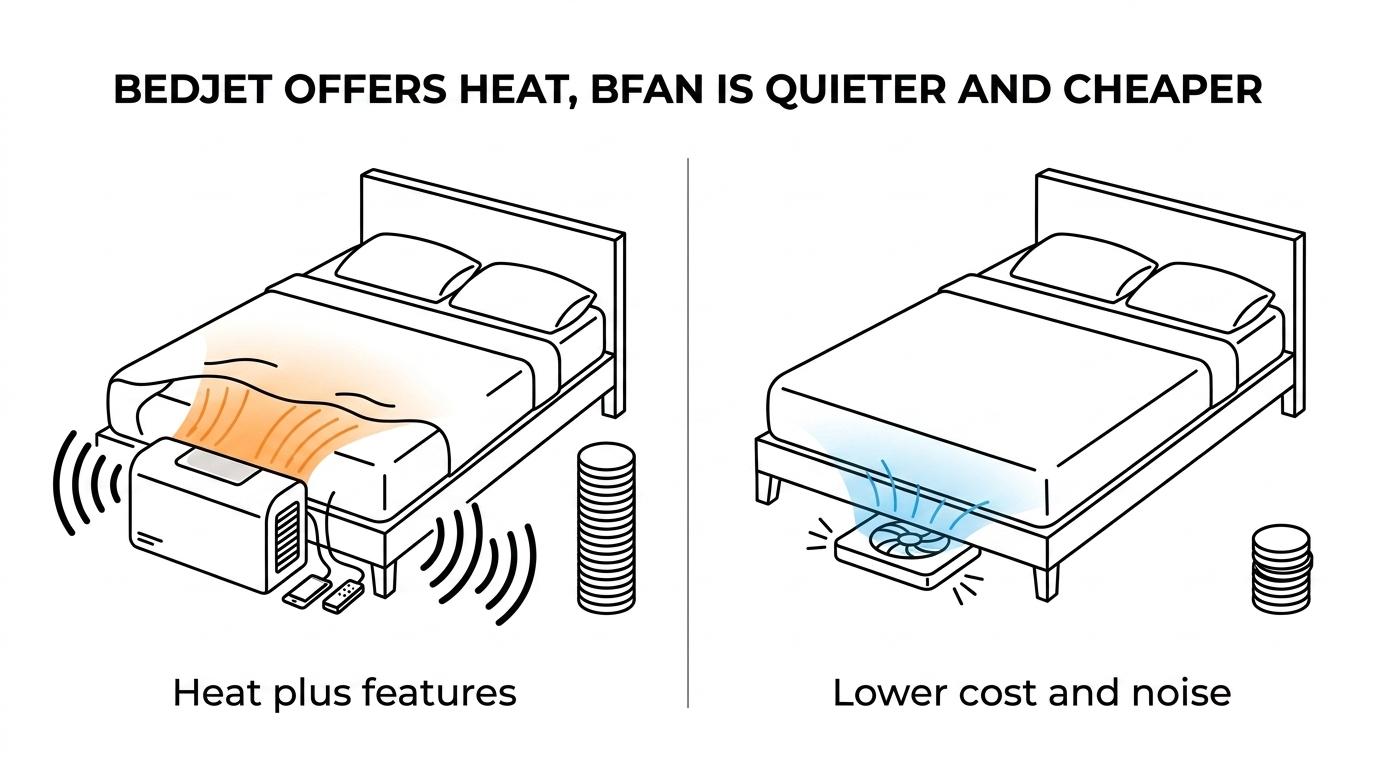
The most important comparison is not brand against brand. It is whether you want heat plus airflow, or just airflow. BedJet is attractive if you want both warming and cooling in one device. bFan makes more sense if your main goal is cooling relief under the sheets, lower sound on low settings, and a lower total cost, especially for couples. Comparing them side by side, dual-zone BedJet is over a thousand dollars, which is more than twice the price of two bFans.
"The current bFan is described as about 28 dB on low and uses an average of 12 watts, which matters for all-night use."
If you are comparing them side by side, these practical differences matter most:
BedJet is better than a ceiling fan for under-cover heat, particularly when paired with a comforter, but it is not a replacement for air conditioning (AC). While a ceiling fan circulates air in the entire room, BedJet delivers airflow directly under your sheets, providing more immediate relief from trapped heat. However, neither BedJet nor a ceiling fan can actually cool the air itself. Room-level cooling and targeted bed airflow work best when they support each other. For optimal comfort, many people find that using a BedJet alongside AC allows them to raise the thermostat a few degrees while still sleeping cool, which can also help save on energy costs.
If your bedroom is already in the 60°F to 67°F range and you still wake up sweaty, a bed-level airflow product may be the missing piece to help you sleep comfortably. These devices are designed to move air directly across your body, which can make a significant difference for hot sleepers or those dealing with night sweats. However, if your room is warm and humid, it is important to address that first since both BedJet and bFan can only work with the air already available in the room. They do not cool or dehumidify the air, so their effectiveness depends on your existing bedroom environment. For those who have already optimized their room temperature and humidity, adding targeted airflow can help carry away excess heat and moisture trapped under the covers, leading to a cooler, drier sleep experience.
Cooling mattresses and water pads can feel colder than air-based systems, which some sleepers love for the immediate chill they provide. These water-based options often allow for precise temperature control, letting you dial in your preferred level of coolness. The trade-off is cost, complexity, and maintenance, since water pads typically require regular cleaning, refilling, and sometimes even special additives to prevent mold or mineral buildup. Air-based systems, on the other hand, are simpler to set up and maintain, and they keep the sleep surface drier. That can be a big plus for people dealing with night sweats, because airflow helps evaporate sweat rather than trapping moisture against the skin. For those who prioritize ease of use and a dry sleeping environment, air-based solutions like BedJet or bFan may be the better fit.
One practical tip people miss: if you use under-sheet airflow, tight-weave sheets usually work better than loose, open fabrics because they help carry the moving air across your body instead of letting it spill out too quickly.
The research is supportive, but it is not brand specific. PubMed studies support local cooling and airflow for sleep comfort, which helps explain why products like BedJet and bFan can work when overheating is the real problem.
A 2017 study indexed in PubMed reported that local body cooling improved sleep quality and thermal comfort in hot conditions: https://pubmed.ncbi.nlm.nih.gov/28960513/. A separate 2019 PubMed-indexed study found that airflow of 0.8 m/s over the body helped elderly sleepers maintain sleep quality and thermal comfort at an air temperature 3 K higher than neutral: https://pubmed.ncbi.nlm.nih.gov/31463952/. That is a useful clue. Air movement can reduce the need to make the whole room extremely cold.
Menopause is another place where this matters. A review in the National Center for Biotechnology Information (NCBI) says hot flashes affect up to 80% of women during the menopausal transition, and the median duration was 7.4 years in SWAN data: https://pmc.ncbi.nlm.nih.gov/articles/PMC5810528/. Comfort tools can help, even when they do not treat the root cause.
A common mistake is expecting research on airflow to prove that one brand is medically better than another. It doesn’t. The studies support the method, not a specific marketing claim.
Setup makes a bigger difference than many people expect. BedJet, bFan, and even simple fans work better when the room, sheets, and airflow path are set up properly.
Step 1 is to cool the room reasonably well first. If you can, keep the bedroom around 60°F to 67°F. Step 2 is to use tight-weave sheets so the airflow moves across your skin and carries away heat and sweat instead of escaping immediately. Step 3 is to start with a lower speed and use a timer, so you do not overcool yourself at 3 A.M. This is one place where Bedfan timer controls are genuinely useful.
"The original Bedfan was invented in 2003, years before BedJet was even thought of, and it still solves the same trapped-heat problem with simple under-sheet airflow."
If you share a bed, place airflow so each person gets what they need. That may mean separate bedding, separate sides, or true dual-zone use. With bFan, two fans can create a dual-zone setup without crossing air needs. With BedJet, dual-zone convenience is available, but the price climbs sharply.
Night sweats can be a sleep-comfort problem, but they can also signal illness, medication effects, or treatment side effects. Mayo Clinic and Cancer.gov are better guides here than product reviews.
This is where it is worth being careful. Night sweats may be linked to menopause, infections, thyroid issues, antidepressants, cancer treatment, low blood sugar, or other medical conditions. Mayo Clinic’s overview is a good starting point: https://www.mayoclinic.org/symptoms/night-sweats/basics/definition/sym-20050768. For people in cancer care, Cancer.gov also has a useful summary on hot flashes and related symptoms: https://www.cancer.gov/about-cancer/treatment/side-effects/hot-flashes-pdq.
Please treat these as medical check-in signs, not just bedding annoyances:
A short real-world example: one woman in her early 50s thought she only needed colder sheets, but her “night sweats” had started right after a medication adjustment. A quick review with her clinician changed the plan. The cooling setup still helped her sleep, but it was not the main fix.
A short home test can save you money. BedJet is easier to justify after you confirm that airflow under the covers actually improves your sleep.
Start with a 7-night log. Write down room temperature, bedding, wake-ups, sweating, and whether your feet, legs, torso, or whole body feel hot. If the heat is mostly trapped under the top sheet, that points toward a bed-level airflow solution.
Next, try a low-cost airflow test. Use a fan at the foot of the bed, lighten the duvet, or replace it with a comforter, and see whether targeted air movement helps. It will not mimic BedJet perfectly, but it tells you whether airflow is the right category. If you feel better fast, that is a good sign.
Then look at return windows and partner needs. Sleep Foundation says BedJet includes a 60-day sleep trial, which reduces buying risk. If your partner needs a different temperature, compare the added cost of dual-zone features against simply using two separate cooling devices.
BedJet is often considered a worthwhile investment for hot sleepers who struggle with overheating at night. It delivers targeted airflow directly under your sheets, which can help regulate body temperature and reduce night sweats. Many users report improved sleep quality and comfort, especially when compared to traditional fans or cooling pads.
No, BedJet does not cool the air itself. Instead, it uses the existing room air and circulates it under your bedding to help carry away body heat. For best results, make sure your bedroom is already at a comfortable temperature, ideally between 60°F and 67°F, as recommended by sleep experts (Sleep Foundation).
BedJet is designed to be relatively quiet, especially on lower settings. Most users find the noise level comparable to a white noise machine or a small fan. However, noise perception can vary from person to person, so it is a good idea to start with lower fan speeds and adjust as needed for your comfort.
Yes, BedJet can be very effective for people dealing with night sweats. The airflow helps evaporate sweat and keeps the sleep surface dry, which can be a big relief for those who wake up damp or uncomfortable. Pairing BedJet with tightly woven sheets can further enhance airflow and cooling benefits.
Both BedJet and bFan are air-based cooling systems designed to improve sleep comfort by moving air under your sheets. BedJet offers more advanced controls and features, while bFan is known for its simplicity and energy efficiency, using only about 18 watts on average. The dual zone BedJet is over a thousand dollars and more than twice the price of two bFans, making bFan a more budget-friendly option for many households.
BedJet is not a replacement for air conditioning. It works best when used in conjunction with room-level cooling, such as AC or a window unit. If your room is too warm or humid, BedJet will only circulate that same air, so it is important to address your overall bedroom environment for optimal results (Healthline).
BedJet requires minimal maintenance. You should periodically check and clean the air filter to ensure optimal airflow and performance. Unlike water-based cooling pads, there is no need to worry about leaks, refilling, or mold buildup, making BedJet a convenient choice for those who want a low-maintenance solution.
All links have been checked and are currently working.
For more tips and solutions, explore our guides on night sweats and bedding choices, how to stop night sweats naturally, best temperature for sleep, and night sweats in men.
Always consult a healthcare professional for persistent night sweats or sleep issues. This content is for informational purposes only and is not a substitute for medical advice.
Related reading on bedfan.com: night sweats hub, sleeping cooler guide, menopause night sweats help, medication-related night sweats, and best bedroom temperature for sleep.
This is not medical advice. Always consult your doctor or oncology team before making changes. If you decide that under-sheet airflow is the kind of help you need, you can take a quiet, lower-cost look at the bFan Bed Fan store for a simple way to cool the body by moving room air where trapped heat actually builds up.