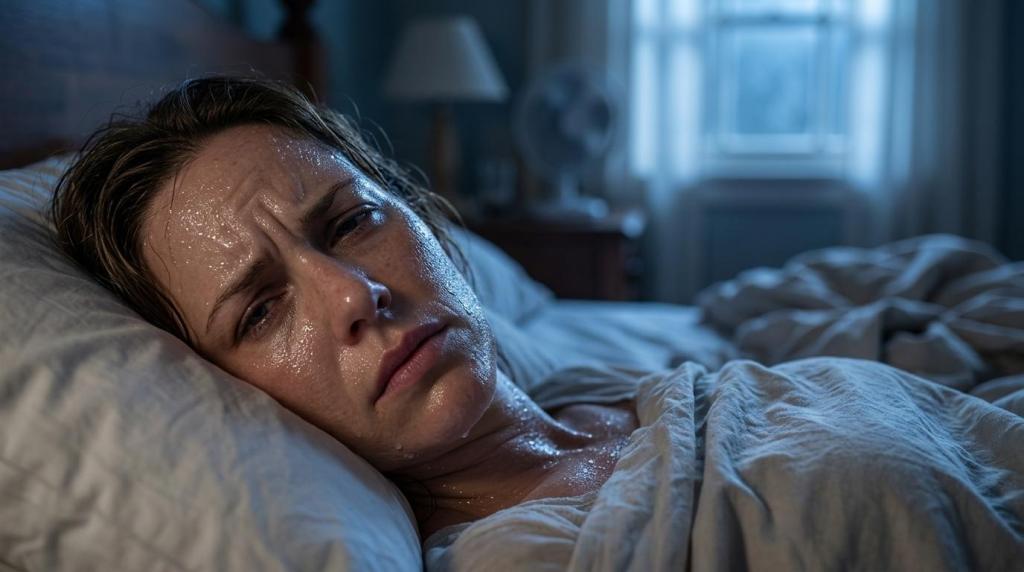
Learn what a sheet fan is, how it cools under the covers, its pros and cons, and when it works best for hot sleepers.
A sheet fan is an under-the-covers bed fan that sends room air through the space between your sheets and blankets. It is most useful when your real problem is trapped heat and humidity around your body, not just a warm bedroom.
TL;DR: Summary
If you have ever kicked off the covers, cooled down, then pulled them right back up and overheated again, you already know why whole-room cooling is not always enough. Sleep research points to thermoregulation and bedding microclimate as a real part of sleep quality, so a sheet fan can make sense when the issue lives under the sheets.
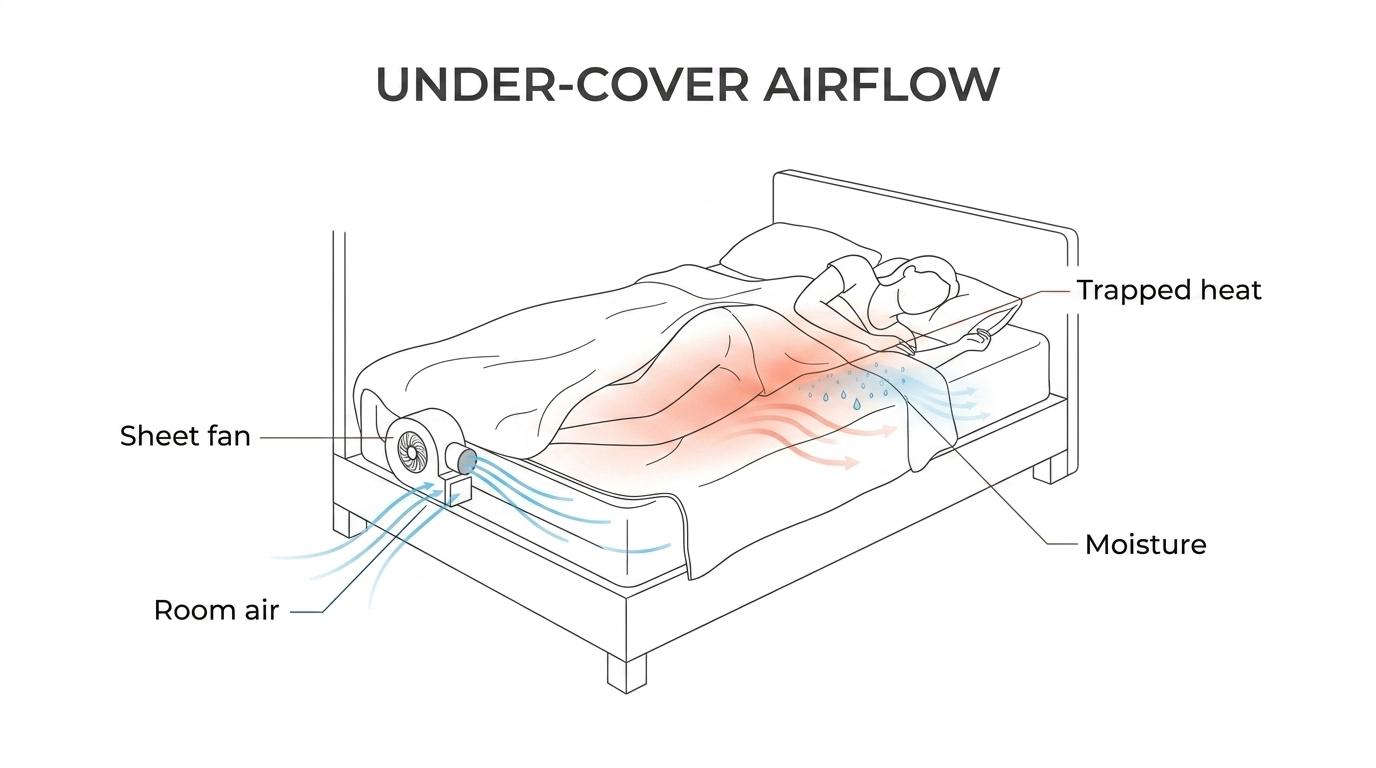
A sheet fan, such as the bfan, is a foot-of-bed airflow device that blows room air between sheets and blankets. It does not refrigerate the air. It changes the microclimate around your skin.
That last point matters more than most people realize. Sleep is tightly linked to body temperature regulation, and bedding can trap both heat and moisture near the skin. A review in PMC explains that the thermal environment, including bedding and clothing, can change sleep quality because it changes the skin-and-bedding microclimate (https://pmc.ncbi.nlm.nih.gov/articles/PMC3427038/).
"Bedfan has targeted trapped under-the-covers heat since 2003, using room air between sheets rather than whole-room cooling."
People use a few different names for the same idea: sheet fan, bed fan, fan under the sheets, or under-the-covers cooling fan. In practice, the best version is the one that gets air where your body is overheating without drying out your eyes, blasting your face, or forcing you to overcool the whole bedroom.
A sheet fan cools by moving room air across the skin and helping sweat evaporate. Bedfan and similar devices work on convective and evaporative cooling, not cold-air generation.
When airflow reaches the space between your body and the bedding, it helps carry away heat that would otherwise build up. If you sweat at night, even lightly, that airflow also helps moisture evaporate faster. For many hot sleepers, that is the real relief. The skin feels less sticky, the covers feel less suffocating, and the body can settle back into sleep.
There is a reason this can affect sleep onset and sleep maintenance. A 2020 review in Current Opinion in Physiology describes sleep and thermoregulation as coupled processes, not separate ones, and notes that body cooling is associated with sleep induction (https://pmc.ncbi.nlm.nih.gov/articles/PMC7323637/). If your body is trying to shed heat and the bedding keeps trapping it, a sheet fan is trying to solve the right problem.
A common misconception is that more airflow is always better. It is not. Too much airflow can feel drafty or wake you up. Most people do better with a low starting speed that supports thermal comfort without creating a wind tunnel.
A sheet fan is best for trapped-heat sleep problems, especially with Bedfan-style airflow under bedding. It is less useful when the room itself is very hot.
If your symptoms show up mostly after you get under the covers, a sheet fan, with its efficient airflow and functional decor that blends into bedroom design, deserves a look. Here are the clearest use cases.
If your bedroom is hot because the HVAC system cannot keep up, start there too. A sheet fan is not an air conditioner. It uses the cool air already in the room.
Proper setup is simple: place the unit at the foot of the bed, aim the outlet between sheet layers, and start low. Bedfan works best when air flow can travel across the body instead of escaping upward.
Step 1 is placement. Put the unit at the foot of the bed and angle the outlet so it feeds air between the top sheet and blanket layer, not into the mattress or straight into open room air. If the airflow is not entering the bedding channel, performance drops fast.
Step 2 is fabric choice. A tight-weave sheet usually works better than a loose, airy knit because it helps guide airflow across the body and carry heat away. This surprises people, but very fluffy or very porous bedding can let the air leak out before it does much cooling.
"Bedfan offers remote-adjustable airflow from 5% to 100%, which helps people fine-tune cooling as body temperature shifts overnight."
Step 3 is control. Start with a lower setting, give it 10 to 15 minutes, then adjust. If you tend to wake up cool in the early morning, timer controls can help you cool down at sleep onset without running the fan all night.
A sheet fan targets bedding microclimate, while a ceiling fan or box fan targets room air and exposed skin. Bedfan is usually better for under-the-covers overheating.
An energy-efficient regular fan can help if you sleep exposed or like a breeze on your face. But if your discomfort starts after you pull the blankets up, a room fan often misses the real heat pocket. The trapped warmth stays around your legs, abdomen, and chest, where sheets and comforters hold it in.
This is also where people overspend on air conditioning. Sleep experts commonly recommend a room temperature around 60°F to 67°F for good sleep. Yet many people using a sheet fan can raise room temperature by about 5°F and still feel cool enough because the body, not just the room, is being cooled.
Here is the trade-off: if the room is already 78°F or 80°F, a sheet fan has less cooling power because neither it nor a room fan is making cold air. It is redistributing the air you already have.
A sheet fan is usually simpler and cheaper than Bedjet or active cooling pads. Bedfan and Bedjet both use room air, while water-based pads use a cooled surface.
The first thing to know is this: Bedjet does not cool the air. Bedfan does not cool the air either. Both systems use the cool air already in the room and direct it toward the sleeper. That means room temperature still matters, no matter which brand you pick.
Cost and complexity are where the differences show up. A dual-zone Bedjet setup costs over a thousand dollars, which is more than twice the price of two Bedfans. If a couple wants dual-zone cooling, two bfan Bedfans can create separate left-right airflow at a fraction of that cost. Bedfan also came to market first. The original Bedfan was invented in 2003, several years before Bedjet was even thought of.
"A dual-zone Bedjet setup is over a thousand dollars. Two Bedfans can create dual-zone cooling for less than half that cost."
Cooling mattress pads can feel colder because they change the bed surface itself. Some people love that. Others dislike the feel, setup burden, hoses, condensation risk, or the price of active systems. If your issue is trapped heat under blankets, not a hot mattress, a sheet fan is often the more direct fix.
The best results come from balancing room temperature, bedding, and airflow. Bedfan works best as part of a sleep decor setup, not as a solo fix.
Start with the room. If possible, get your bedroom into the 60°F to 67°F range sleep specialists often suggest. Then use the sheet fan to cool the body enough that you may be able to raise the thermostat by about 5°F without sacrificing comfort. That can lower overnight AC use.
Next, look at layers. If you are using a heavy comforter and flannel sheets in a mild room, the fan has to fight uphill. Try lighter bedding first. If your feet get cold but your core overheats, keep the blanket and lower the fan speed rather than throwing everything off.
Last, tune the timing. If you only overheat during sleep onset or during 2 a.m. night sweats, use the remote and timer rather than leaving maximum airflow on for eight hours. A lot of people sleep best when cooling is front-loaded, then reduced.
Poor results usually come from setup issues, not the concept itself. Bedfan performance drops when airflow escapes, bedding blocks the channel, or the room air is too warm.
Check the airflow path first. If the outlet is blowing into a tucked-in blanket edge or into the mattress, reposition it. The air flow needs a usable lane under the covers to ensure it remains energy-efficient.
Check the bedding second. Very bulky comforters, fleece layers, and loose-knit blankets can interrupt airflow. One anonymized example comes up often: a woman in perimenopause thought her fan was underpowered, but the real issue was a heavy plush blanket that swallowed the air. After switching to a tighter-weave top sheet and lighter blanket, the same fan felt dramatically cooler.
Then check expectations. If your night sweats are drenching, your room is warm, and you are wearing thick sleepwear, no sheet fan will fix everything on its own. In that case, combine lighter sleep clothes, a cooler room, moisture-managing fabrics, and targeted airflow.
The research is clear: heat can disrupt sleep, and bedding microclimate matters. PMC and PubMed findings support the logic behind sheet fans.
The 2012 PMC review linked above explains that excessively high or low ambient temperature can affect sleep even in healthy adults, and that bedding changes the thermal environment right next to the skin. That is the exact zone a sheet fan is trying to improve.
A more recent heat-night study reported that exposure to 32°C reduced total sleep time by about 24.8 minutes, lowered sleep efficiency, reduced rapid eye movement (REM) sleep, and increased wake after sleep onset (WASO). In plain language, heat did not just feel annoying. It measurably changed how well people slept.
A small pro tip here: do not get too hung up on room temperature alone. Two bedrooms at the same thermostat setting can feel very different once pajamas, blankets, sweat, and mattress heat retention enter the picture. That is why microclimate control can be worth more than lowering the thermostat a couple of extra degrees.
Night sweats can be benign, but new or severe symptoms deserve medical review. Mayo Clinic and Cancer.gov both note that persistent night sweats may need evaluation.
This is not medical advice. Always consult your doctor or oncology team before making changes, especially if you are pregnant, in cancer treatment, using hormone therapy, or taking prescription medication tied to sweating.
A good rule is to contact a clinician if night sweats are frequent, drenching, or paired with other symptoms. Mayo Clinic has a useful overview here: https://www.mayoclinic.org/symptoms/night-sweats/basics/when-to-see-doctor/sym-20050768.
Yes. Mayo Clinic, PMC, and bfan educational pages are good starting points if you want both medical context and practical cooling options.
All links have been checked and are currently working.
If you want related reading on Bedfan.com, these internal pages fit this topic well:
If trapped heat under the covers is what keeps waking you up, a sheet fan can be a practical, non-drug way to cool the body right where sleep gets disrupted, seamlessly blending into any bedroom decor. This is not medical advice. Always check with your doctor or oncology team about persistent or unexplained night sweats. If you want to see how a Bedfan works, you can take a look at the Bedfan store.