Low thyroid night sweats may point to thyroiditis, overtreatment, or another cause. Learn key clues, tests, and sleep relief tips.
If you have been told you have low thyroid and you are waking up sweaty, confused, and tired, you are not imagining the problem. The tricky part is that true hypothyroidism usually does not line up neatly with heavy night sweats. More often, it points in the other direction. That means something related to the thyroid may still be involved, but not always in the way people assume.
This is not medical advice. Always consult your doctor, endocrinologist, or oncology team before making changes, especially if your night sweats are new, severe, or happening with weight loss, fever, chest symptoms, or a racing heart.
Most people with hypothyroidism feel cold, not overheated. A thyroid that is underactive slows the body down. Common symptoms include fatigue, weight gain, constipation, dry skin, slowed heart rate, and cold intolerance, according to the National Institute of Diabetes and Digestive and Kidney Diseases (NIDDK): https://www.niddk.nih.gov/health-information/endocrine-diseases/hypothyroidism
That is why "low thyroid night sweats" deserves a second look instead of a quick assumption.
A person can absolutely have hypothyroidism and night sweats at the same time. The point is that the sweating may not be caused by the stable low thyroid state itself. It may come from a different part of the thyroid story, a medication issue, or a completely separate condition.
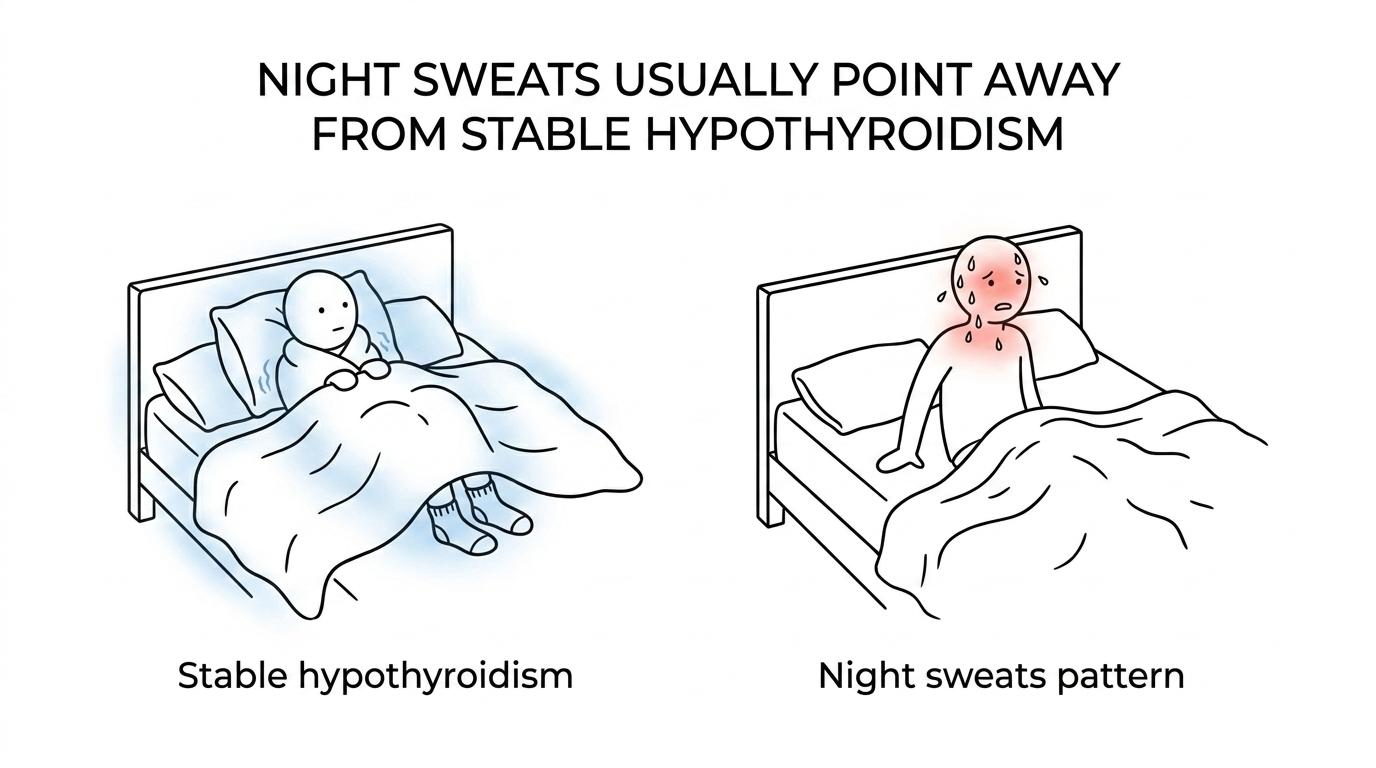
Mayo Clinic lists thyroid disease among possible causes of night sweats, but the more classic thyroid link is hyperthyroidism, not stable hypothyroidism: https://www.mayoclinic.org/symptoms/night-sweats/basics/causes/sym-20050768
Here is where things get interesting. Some thyroid problems change over time.
With thyroiditis, which means inflammation of the thyroid gland, the gland can dump stored hormone into the bloodstream for a while. That temporary surge can cause sweating, heat intolerance, palpitations, anxiety, and weight loss. Later, as the gland settles down, it may swing into a low-thyroid phase with fatigue, constipation, dry skin, and feeling cold.
MedlinePlus explains this pattern clearly in subacute thyroiditis, where increased sweating and heat intolerance can show up first, followed later by hypothyroid symptoms: https://medlineplus.gov/ency/article/000375.htm
This matters because many people say, "I have low thyroid and night sweats," when the real pattern may be one of these:
A short anonymized example may help. One patient had been treated for hypothyroidism for years and assumed the soaked pajamas were just "a weird thyroid thing." What changed the picture was the timing. The sweats started after a levothyroxine dose increase, along with a faster pulse and shaky mornings. Her doctor checked thyroid-stimulating hormone (TSH), found she was over-replaced, and adjusted the dose. The sweating improved.
The body usually gives a few clues if you know what to watch for. One symptom by itself is rarely enough.
If your main picture is cold hands, low energy, dry skin, constipation, and gradual weight gain, hypothyroidism is still a reasonable fit. If your main picture is sweating, feeling hot at night, palpitations, restlessness, loose stools, and unexplained weight loss, too much thyroid hormone becomes more likely.
Pay attention to patterns like these:
One detail people often miss is timing. A sweating episode that happens right after falling asleep may be different from waking at 3 A.M. drenched. A bedroom that is simply too warm can do it too. Sleep experts commonly recommend a room temperature between 60°F and 67°F for better sleep. Still, if body heat gets trapped under your bedding, you can sweat even in a reasonably cool room.
If you are dealing with night sweats and a known thyroid condition, this is where your clinician usually starts: symptoms, medication review, and labs.
TSH is often the first test. Depending on the situation, a free T4 and sometimes free T3 may be checked too. Those numbers help sort out whether you are truly underactive, temporarily overactive, swinging between phases, or perhaps being treated with a dose that no longer fits.
A low-thyroid label from years ago is not always enough. Bodies change. Medication needs change. Weight changes, aging, pregnancy, menopause, new supplements, and other prescriptions can all shift thyroid hormone needs.
One more note. Severe untreated hypothyroidism can lead to myxedema coma, which is a medical emergency. That condition does not usually show up as isolated night sweats. It is much more serious and often involves confusion, extreme weakness, low body temperature, and slowed body functions. If someone seems severely ill, urgent care is needed.
Even when the thyroid story is still being worked out, you still need sleep tonight.
A lot of people try to fix night sweats by cranking down the whole house thermostat. That can help, but it is not always enough, and it can get expensive fast. Neither a Bedfan nor a Bedjet actually cools the air. They use the cool air already in the room. The difference is where that air goes.
A bed fan targets the root problem under the covers. It moves air between the sheets so sweat can evaporate and trapped body heat can escape. That is often much more effective than cooling the whole room alone.
The Bedfan is one practical, non-drug option here. It directs airflow under the sheets, runs quietly at about 28 to 32 dB on lower settings, uses very little energy, and offers remote and timer controls. If you tend to overheat only in the first part of the night, the timer is genuinely useful. Tight-weave sheets usually work best because they help the airflow spread across the body instead of leaking out too quickly.
For people trying to sleep cooler without overusing air conditioning, this setup can be surprisingly efficient. Many people can keep the bedroom in the recommended sleep range, or even raise the room temperature by about 5°F, and still feel cooler because the air is moving right where sweat and heat build up most.
A few practical steps usually help most:
If you share a bed, cooling gets more complicated. This is where dual-zone cooling matters. Two Bedfans can create dual-zone cooling at a fraction of the cost of a Bedjet setup. That Bedjet setup costs over a thousand dollars, which is more than twice the price of two Bedfans. The original Bedfan was invented in 2003, several years before Bedjet was even thought of, and the basic idea remains sensible because it addresses trapped heat where it starts.
People often feel brushed off when night sweats are involved, especially if the symptom comes and goes. Going in with a short, clear history helps.
Try saying something like this: "I have a history of hypothyroidism, but now I am waking up sweaty at night. I want to know if this could be thyroiditis, overtreatment, another thyroid issue, menopause, medication side effects, or something else."
That one sentence changes the conversation.
It also helps to bring a one-week symptom log. Not fancy. Just useful.
Please seek prompt medical care if your night sweats come with fever, persistent cough, unexplained weight loss, chest pain, fainting, severe palpitations, swollen lymph nodes, or new shortness of breath. Those features deserve proper evaluation, not just cooling tricks.
If you are building out supporting content on the site, these are useful internal links to place contextually in this article:
If you want to read the medical references directly, these are a good place to start.
If trapped heat under the covers is making all of this harder to live with, a simple airflow fix can help you rest while the medical side gets sorted out. You can take a look at the Bedfan store for a quiet, low-energy way to move cool room air under the sheets and dry sweat where it starts. This is not medical advice. Always consult your doctor, endocrinologist, or oncology team before making changes.