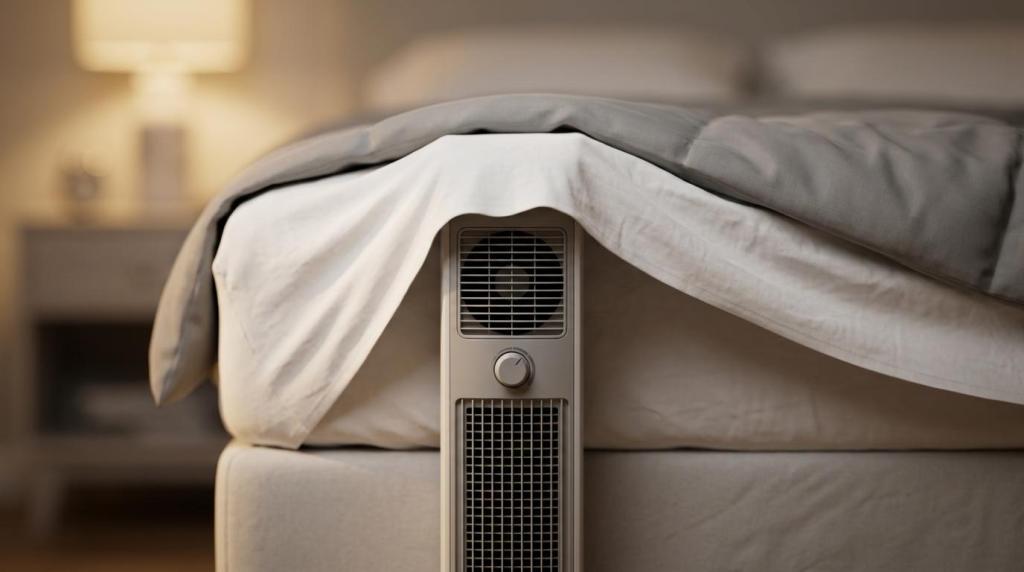
Learn what a bed air conditioner really is, how under-sheet cooling works, and 7 key questions to ask before you buy.
Hot sleepers often search for a "bed air conditioner" when what they really want is relief from trapped body heat under the covers. bFan Bed Fan sits in that category as an under-sheet cooling product, which matters because these systems are very different from a window AC, portable AC, or mini-split.
TL;DR: Summary
- A bed air conditioner is usually an under-sheet airflow system, not a true air conditioner, and bFan Bed Fan fits that targeted cooling category rather than whole-room climate control.
- These products do not refrigerate the air. They use the cooler air already in the room to flush heat out of the bed microclimate, which is why room temperature still matters.
- Buyer decisions should focus on airflow path, noise, controls, wattage, sheet compatibility, total cost, and whether you need single-sleeper or dual-sleeper comfort.
- Research and public health guidance both support cooler sleep conditions: a SLEEP study linked warmer bedrooms with worse sleep continuity, and CDC guidance commonly points to about 65°F to 68°F for many adults.
- If night sweats are new, drenching, or paired with fever, weight loss, chest pain, swollen lymph nodes, or low blood sugar symptoms, cooling products can help comfort but should not replace medical evaluation.
The most useful way to shop this category is to ask better questions before you buy. The key issue is not whether the label says "air conditioner." It is whether the device can improve your bedroom microclimate, reduce wake after sleep onset, and help you stay comfortable without overcooling the entire room.
A bed air conditioner is usually an under-sheet airflow device, not a compressor-based appliance like a window AC. It changes the bed microclimate around your feet, legs, and torso, where trapped heat often builds up first.
That distinction matters because people often expect cold air on demand, when most products in this niche work by moving room air into the bedding. If your problem is heat trapped under blankets, that can be enough. If your bedroom itself is sweltering, no under-sheet system can fully compensate for a hot room.
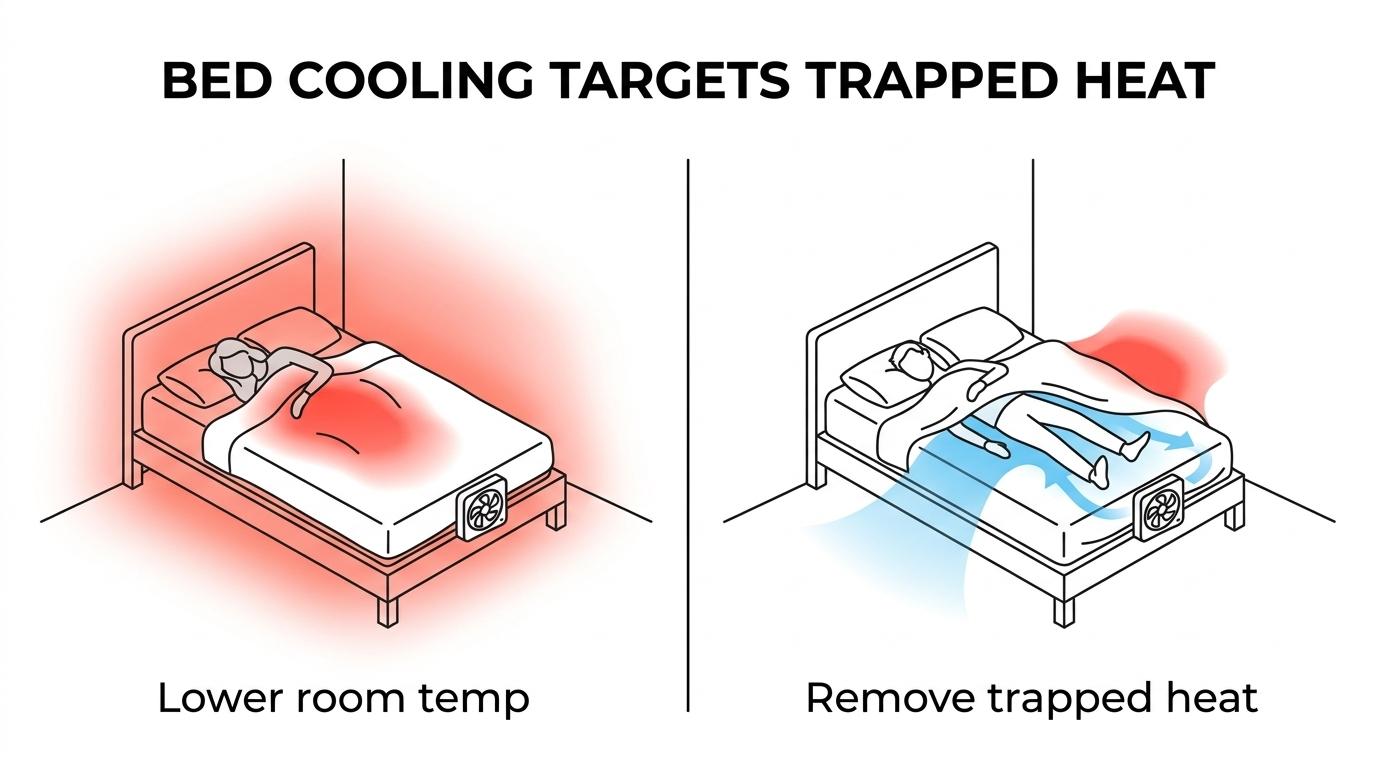
Sleep science uses terms like thermoregulation, skin temperature, and sleep onset latency for a reason. Your body needs to shed heat to fall asleep and stay asleep. Under covers, that can become harder because the bedding traps warmth and moisture close to the skin.
No. Devices like bFan Bed Fan and BedJet move the air already in your room; they do not refrigerate or dehumidify it like a mini-split or portable AC.
That is the biggest misconception in this category. A true air conditioner lowers the temperature of the air itself. An under-sheet fan lowers how hot the bed feels by carrying heat away from your body and out from under the covers. A review on sleep and thermoregulation explains why the local sleep microclimate matters so much.
"bFan Bed Fan targets the space under the sheets and uses an average of 18 watts, which makes it a bed-cooling tool, not a room AC."
Room temperature still matters because the device can only use the air that already exists in the bedroom. One Oxford Academic SLEEP study found that for each 1°F increase in bedroom temperature between 60°F and 85°F, sleep efficiency fell and wake after sleep onset increased. If your room is already too warm, a bed fan may help, but it will not create cold air from nothing.
Common misconception: stronger airflow is not the same as colder air. It may feel cooler because moving air improves heat transfer from skin and bedding.
The best buyer criteria are practical: airflow path, noise, controls, energy use, and real cost. Fancy labels matter less than how the air moves under your sheets at 2 a.m.
Before comparing product pages, look for these seven features:
Pro tip: ignore vague claims like "sleep cooler instantly" unless the product explains where the air travels. In this category, airflow path is the product.
Start simple: place it at the foot of the bed, create a clear path under the top sheet, and begin at a moderate room temperature. Then adjust one variable at a time.
Step 1 is placement. Most under-sheet systems work best when they can feed air between the bottom and top bedding layers without obstruction. If the outlet is blocked by a heavy comforter or thick folded blanket, performance drops fast.
Step 2 is sheet choice. Tight-weave sheets usually work better because they help the air travel across the body instead of leaking straight out. That sounds backward to some buyers, but it is one of the most useful setup details.
Step 3 is starting conditions. Do not set the room too warm on night one and assume the fan will fix everything. Begin with a reasonably cool room, then adjust after you know how the airflow feels in your own bed.
Use a cool room, moderate airflow, and breathable bedding first. Then raise or lower one setting based on whether you are too hot at sleep onset or waking hot later in the night.
CDC-related sleep guidance often points to a comfortably cool bedroom, commonly around 65°F to 68°F for many adults. With targeted under-sheet airflow, some people can raise the room thermostat by about 5°F and still sleep cool because the bed itself feels less stuffy.
If you run the system all night, start at a middle setting. If you mainly overheat while falling asleep, use stronger airflow for the first hour or two and then back it down. This is where timer controls can help.
"bFan Bed Fan runs around 30 dB in normal operation, so its cooling benefit is more useful if the sound stays sleep-friendly."
Common misconception: more bedding is not always warmer in a helpful way. The goal is controlled insulation, not heat storage. If your top layer traps too much heat, you may need a lighter comforter even if the fan is working properly.
A bed air conditioner targets the sleeper, while whole-room AC targets the space. Ceiling fans help exposed skin, but they do far less for heat trapped under blankets.
If your partner sleeps cold and you sleep hot, targeted bed cooling can be more precise than lowering the thermostat for the entire room. That can matter for comfort and electricity use. It also explains why some hot sleepers use a bed fan even when the home AC is already running.
Whole-room AC still wins when humidity is high or the bedroom itself is too warm. A ceiling fan can help air circulation, but it does not create the same under-cover airflow path. If your issue is trapped heat in the bedding, ceiling airflow often stops at the blanket.
If then logic helps here: if the whole room feels hot, improve room cooling first. If the room is acceptable but the bed feels like a heat pocket, targeted airflow is usually the better tool.
Compared with BedJet, bFan Bed Fan is a simpler under-sheet airflow option, while BedJet adds more features and a much higher price point.
The first thing to know is that neither product cools the air. Both use the cooler air already present in the room to cool the bed. That means neither one replaces AC, and both depend on the bedroom starting in a workable temperature range.
The second thing is cost. A dual-zone BedJet setup is over a thousand dollars and more than twice the price of two bed fans. That premium may be worth it if you want separate left-right controls and a more feature-heavy system. If your main goal is just removing trapped body heat under the covers, a simpler under-sheet fan may do the job for far less.
History matters too. The original Bedfan model came to market several years before BedJet was even thought of, so this category did not start with app-driven or feature-stacked systems. It started with the basic idea that moving room air through bedding can reduce overheating.
Troubleshooting works best in order: check bedding resistance, then room temperature, then airflow setting, then mattress and protector layers. Most failures come from setup, not from the basic concept.
First, inspect your stack. A waterproof mattress protector, heavy comforter, or tucked-in blanket can reduce the under-sheet airflow more than buyers expect. Pro tip: the fan cannot move heat efficiently if the air has nowhere to travel.
Second, lower loft before raising power. Many people increase fan speed when the real issue is thick bedding trapping the air. Lighter covers often help more than maximum airflow.
Third, watch when you wake hot. If it happens at sleep onset, you may need a higher starting setting. If it happens near morning, your bedding or room may be warming up over time.
Yes, it can help with comfort, but it does not treat the underlying cause. Menopause, selective serotonin reuptake inhibitors (SSRIs), steroids, thyroid disease, and infections can all contribute to nighttime overheating.
A common real-world scenario is a woman in her early 50s who keeps the room at 67°F, wakes twice a night drenched during perimenopause, and does not want to freeze her partner with lower AC settings. In that situation, targeted under-sheet airflow can reduce the heat trapped in bedding and make it easier to fall back asleep, even though it does not stop the hormonal trigger.
Heat-related sleep effects also do not hit everyone equally. A large U.S. study indexed in PubMed found worse sleep impacts from temperature anomalies in some groups, including females and people with chronic health conditions. That does not prove a bed fan solves the issue, but it supports the broader point that heat and sleep continuity are closely linked.
Common misconception: if overheating improves with cooling, the cause must be harmless. Relief does not diagnose the reason.
Call a clinician when night sweats are new, drenching, persistent, or paired with other symptoms. Fever, weight loss, swollen lymph nodes, chest pain, low blood sugar episodes, or significant daytime fatigue change the picture.
Night sweats can be tied to menopause, medication side effects, anxiety, reflux, infection, obstructive sleep apnea (OSA), endocrine disorders like hyperthyroidism, and more serious causes including some cancers. If the sweating is frequent and unexplained, comfort tools are only part of the plan.
If you are shopping right now, use this rule: buy for trapped bed heat, not for mystery symptoms. Compare airflow path, controls, noise, wattage, and total cost before you buy. If your issue is under-cover overheating, a targeted option may be worth testing. If the sweating is severe or medically unexplained, book the appointment too.
Helpful next reads you may want to link internally on your site:
This article is for education only and is not medical advice, diagnosis, or treatment. Seek urgent care for chest pain, trouble breathing, fainting, severe low blood sugar symptoms, or night sweats with a high fever.