Compare the best bed fan under sheets by airflow, noise, fit, controls, and energy use to find cooler, quieter sleep all night.
If you’re comparing the best bed fan under sheets, focus less on flashy labels and more on how the airflow behaves once you’re actually in bed. The bFan bed fan is relevant here because it belongs to the under-sheet cooling category, which targets trapped body heat in the bed rather than trying to cool the entire bedroom.
TL;DR: Summary
- The best bed fan under sheets is one that combines targeted under-cover airflow, fine speed control, quiet operation, and a proper mattress-height fit, and the bFan bed fan is built around that bed-microclimate approach.
- Sleep guidance often puts a cool bedroom around 60°F to 67°F, with CDC advice near 65°F to 68°F for many people, but local airflow can help many sleepers stay comfortable even if the room is set about 5°F warmer.
- The most useful features to compare are airflow range, noise level, remote or timer control, fit under the sheet line, energy use, and whether each sleeper can control their own side.
- Neither an under-sheet fan nor BedJet cools the air itself. Both use the cool air already in the room, so room temperature and humidity still matter.
- If you have persistent night sweats, fever, weight loss, cancer treatment, or a new medication, treat cooling products as comfort tools, not medical treatment. Talk with your doctor or oncology team.
This is not medical advice. Always consult your doctor or oncology team before making changes, especially if night sweats are new, intense, or linked to menopause treatment, antidepressants, infection, or cancer care.
An under-sheet bed fan works on the bed microclimate, not the whole room. A true under-cover setup, like the bFan bed fan, pushes air between the top and bottom sheets to carry away trapped heat and help stop sweat before it starts where your body actually feels it.

That sounds simple, but it changes the buying criteria. A ceiling fan moves room air broadly. A box fan can make the room feel breezier. An under-sheet fan is trying to influence thermoregulation at skin level by increasing air velocity inside the bedding pocket where heat and humidity build up.
A common mix-up is assuming all fans cool the same way. They don’t. If you wake up hot under blankets even when the room seems fine, the issue may be trapped heat under the covers, not just room temperature.
"bFan Bed Fan directs airflow between the top and bottom sheets, targeting the area where body heat gets trapped at night."
Most sleep experts recommend a bedroom temperature around 60°F to 67°F, and CDC guidance commonly lands near 65°F to 68°F for many sleepers. A cooler room supports sleep onset and comfort, but it is only part of the picture.
If your room is too warm, your body has a harder time losing heat. That matters because sleep depends in part on your core temperature dropping as the night begins. The CDC advises keeping the bedroom cool, dark, quiet, and comfortable for better sleep quality, which matches what hot sleepers usually report in real life: comfort is rarely just one thing (CDC sleep guidance).
Here is the practical trade-off. Lowering the thermostat cools the entire room, which can help, but it also raises air conditioning use. Local bed cooling lets many people raise the room setting by about 5°F and still feel comfortable enough to sleep. That can matter if your partner runs cold or your utility bill is already too high.
The best under-sheet bed fan usually wins on seven basics: airflow direction, adjustability, quiet use, fit, controls, energy draw, and single or dual-sleeper flexibility. If one of those is weak, the fan often feels disappointing even if the marketing sounds strong.
When you compare options, look for these features in plain English:
The key is how these features work together. A strong motor without quiet control can disturb sleep. A quiet fan without enough airflow will not move sweat and heat. A timer is helpful, but only if the airflow is actually reaching the right zone under the covers.
Fit comes before comfort. If the outlet does not clear the mattress height properly, the air may stall under the sheet edge instead of flowing across your body.
Step 1 is to measure from the floor to the top of the mattress, not just the bed frame. Pillow-top mattresses, adjustable bases, and platform beds often change the effective height more than people expect.
Step 2 is to check the outlet position, not only the product’s overall height range. Under-sheet airflow works best when the outlet sits just right under the top sheet line so the air can travel forward. On some setups, short beds around 19 to 29 inches and taller beds around 27 to 37 inches need different positioning to keep the air path clean.
Step 3 is to think about what is at the foot of the bed. Benches, thick comforters that seal too tightly, and footboards can interrupt flow. Pro tip: if you use a very plush comforter, lift it slightly so the air has somewhere to go.
Good setup matters as much as the product itself. Even a well-designed fan can feel weak if the sheets, bedding weight, or placement are working against the airflow.
Start with your sheet choice. Tight-weave sheets usually help the air spread across the body better than very loose or highly porous fabrics. That sounds backward at first, but the goal is not to let the air escape immediately. It is to guide it along the skin so it can pick up heat and moisture.
Next, begin lower than you think. Many hot sleepers turn cooling products on too high right away, then complain about drafts. If you tend to wake hot at 3 a.m., try a moderate setting at bedtime and a timer that runs long enough to cover your first sleep cycle.
One more setup point gets missed a lot. If the room itself is hot and humid, local airflow helps, but it cannot manufacture cold air. Neither an under-sheet fan nor any competitor cools the air. They both use the cool air already in the room.
"bFan averages about 18 watts, never more than 24 watts even at full power, and offers remote-adjustable airflow from 5% to 100%."
Air conditioning cools the whole room, while an under-sheet bed fan cools the sleeper more directly. The better choice depends on whether your main problem is room temperature, trapped bedding heat, or both.
If your bedroom is consistently too warm, AC does the heavy lifting by reducing air temperature and often lowering relative humidity. That gives your body a better starting point for thermoneutrality, which is the temperature zone where the body does not need extra work to stay comfortable.
If your room is already fairly cool but you still wake overheated under blankets, local airflow is often the more precise tool. Research on sleep in hot environments has found that local body cooling can improve thermal comfort and sleep quality, with one randomized controlled trial reporting sleep efficiency rising from 84.6% without cooling to 95.3% with targeted back and head or neck cooling in a 32°C room (PubMed trial).
The practical middle ground is what many couples choose. Keep the room reasonably cool, then use under-sheet airflow to avoid turning the whole house into a refrigerator.
The biggest differences are cost, airflow style, and how you create dual-zone control. Two bFan bed fans can create separate left-right bed cooling for a fraction of the cost of a dual-zone BedJet setup, which costs more than twice the price of two bed fans.
This comparison gets distorted by marketing language, so here is the plain version. Neither system cools the air itself. Both rely on the cool air already in the room. If the room is warm, both will feel less effective than they do in a bedroom that is already in a good sleep range.

A second misconception is that higher price always means meaningfully better sleep. Sometimes it means more features than you need. If what you want is under-sheet airflow, quieter operation at ordinary use levels, timer control, and low energy draw, simpler can be better. The original bFan was invented in 2003, years before BedJet entered the category, so this is not a new concept dressed up as a trend.
There is also a layout trade-off. Some sleepers prefer a low-profile setup at the foot of the bed without a bulky box feel. Others care more about app-like controls or heating modes. Decide which problem you are solving before you compare price tags.
The research supports targeted cooling as a real comfort strategy, especially in warm sleeping conditions. Airflow improves heat loss, and local cooling can raise comfort and sleep efficiency when the room is hot.
The reason is basic physiology. During sleep onset, the body tries to release heat. If the bed traps warmth and sweat, thermoregulation becomes less efficient. Air movement helps by increasing evaporation and convective heat loss. An older sleep study also found that airflow increased heat loss during sleep and wakefulness in warm, humid conditions, which is exactly why air velocity matters under the covers (PubMed airflow study).
A good way to interpret the evidence is this: the room still matters, but the bed surface and the air around your skin matter too. That is why some people feel hot even in a room that technically looks cool on the thermostat.
Yes, it can help with comfort, moisture evaporation, and fewer wakeups, but it does not treat the medical cause. For menopause, antidepressants, steroids, and cancer therapies, a bed fan is best seen as symptom management.
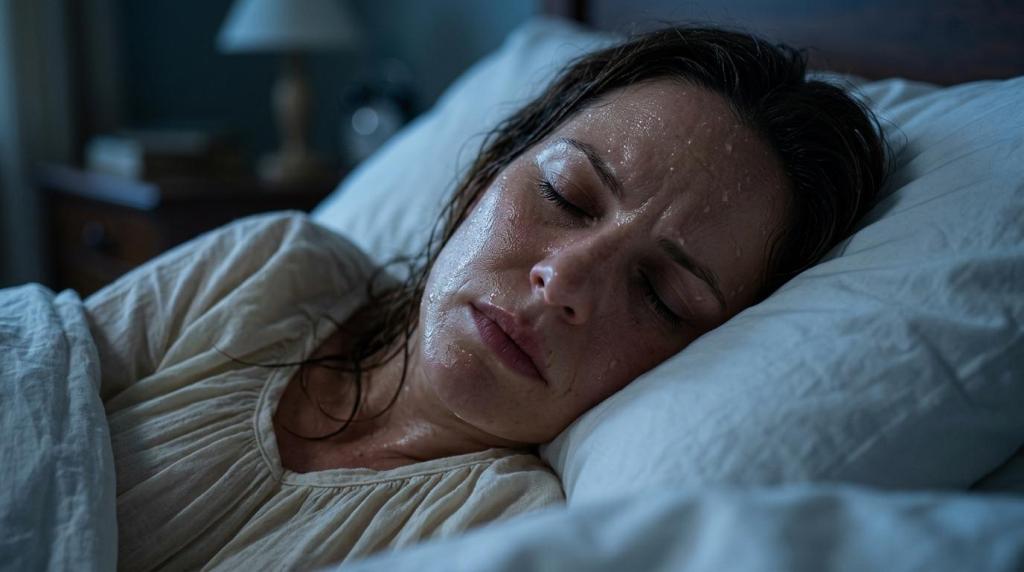
One woman I’ll call Maria, in her early 50s, described waking up twice a night with damp sleepwear even though the thermostat was set to 66°F. Her best change was not lowering the room temperature more. It was combining a lighter blanket, tighter-weave sheets, and gentle airflow under the covers so sweat stops before it starts instead of pooling.
That kind of story is common, but it comes with a medical caveat. Night sweats can be triggered by menopause, infection, obstructive sleep apnea, medication effects, thyroid disease, low blood sugar, and some cancers. Cooling the bed can make you more comfortable. It should not delay medical evaluation if symptoms are new, severe, or unexplained.
Night sweats need medical attention when they are persistent, drenching, or tied to red-flag symptoms like fever, weight loss, chest pain, or swollen lymph nodes. Comfort tools help, but diagnosis matters.
Here is a simple way to think through it. Step 1: ask whether the problem tracks clearly with heat, heavy bedding, alcohol, spicy food, a warm room, or a new sleep setup. If yes, heat trapping may be a big part of the story.
Step 2: ask whether the sweating started around a medication change, perimenopause, hormone therapy, or a known medical condition. If yes, call the clinician who manages that issue and describe the timing.
Step 3: get prompt care if you also have fever, unintentional weight loss, chronic cough, severe fatigue, or symptoms that worry you. Mayo Clinic notes that persistent night sweats, especially with other symptoms, should be evaluated by a doctor (Mayo Clinic night sweats overview).
These sources are worth reading if you want evidence-based guidance on sleep temperature, night sweats, and how local cooling relates to sleep comfort.
If you want more detail on setup and fit, these pages on the site are a useful next step:
If you’re ready to compare a practical under-sheet cooling option, you can look at the current models and specs at the store. This is not medical advice. Always consult your doctor or oncology team before making changes, and do not ignore persistent or unexplained night sweats.
The bFan sits at the foot of your bed and sends a quiet stream of air under your sheets. Direct airflow helps stop sweat before it starts, and one bFan costs less than half the price of one BedJet, making it the less expensive alternative. Shop the bFan at bedfans-usa.com



