Learn which under blanket fan features matter most: quiet airflow, bed fit, pressure, controls, and energy-saving cooling for better sleep.
If you are shopping for an under blanket fan, focus less on marketing terms and more on how the airflow behaves under real bedding. The bFan Bed Fan sits in a specific category of sleep products: bed-microclimate cooling systems that move room air under the sheets, instead of trying to cool the whole bedroom.
TL;DR: Summary
- The best under blanket fan is a targeted under-sheet airflow system with quiet operation, controllable speed, proper bed fit, and bedding compatibility. The bFan Bed Fan is one example of this bed-microclimate category.
- Under blanket fans do not cool the air itself. They use cooler room air already available and move it across your body to carry away trapped heat.
- Sleep guidance commonly points to a cool room, often around 65°F to 68°F, while sleep experts often cite 60°F to 67°F. A bed fan can help some people sleep cool even if the thermostat is set about 5°F higher.
- The most useful features are not flashy extras. They are airflow control, low noise, stable placement, enough air pressure to move through bedding, timer options, and low power use.
- If night sweats are frequent, drenching, new, or paired with symptoms like fever, weight loss, or chest pain, symptom relief at night is helpful, but a medical evaluation still matters.
The reason this category matters is simple. Sleep comfort depends on thermal comfort, skin temperature, bedding, and how much heat gets trapped around your body overnight. That makes an under-sheet fan very different from a ceiling fan, a room fan, or lowering the thermostat for the entire house.
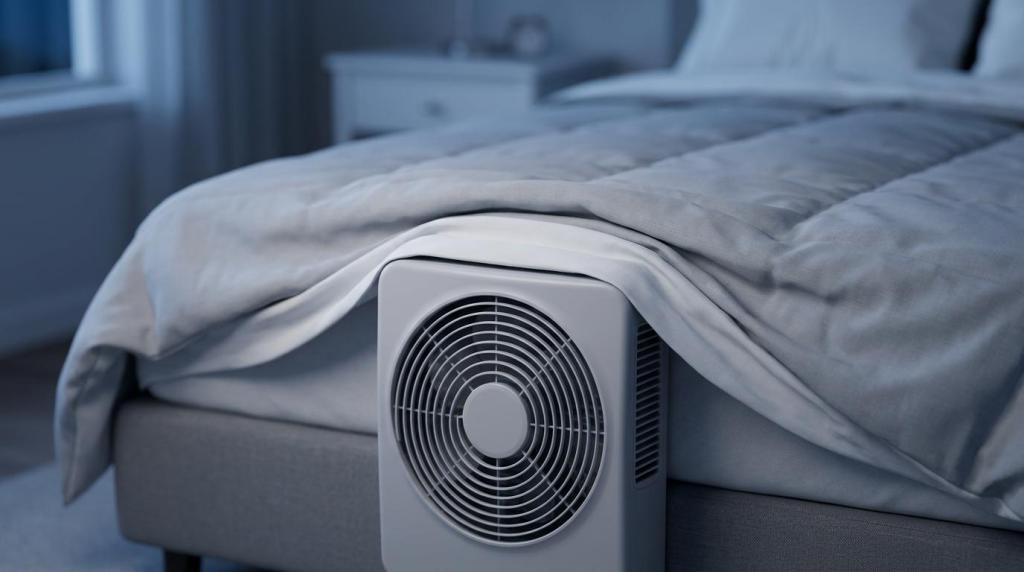
An under blanket fan is a bed-microclimate cooling device that pushes room air under your top sheet or blanket. Systems like the bFan Bed Fan are built to target trapped body heat near the feet, legs, and torso rather than cool the whole bedroom.
That distinction matters. A room fan changes how the room feels. An under blanket fan changes the climate inside the bed, which is often where heat buildup actually causes wake-ups. If your shoulders feel fine but your legs and core get hot under the covers, targeted airflow usually makes more sense than blasting the whole room colder.
A common misconception is that these products are miniature air conditioners. They are not. They do not refrigerate or chill air. They take the cooler air already in the room and direct it under the sheets, where it can help remove trapped heat and moisture.
"The bFan Bed Fan uses an average of 18 watts, never more than 24 watts even at its highest setting, which makes targeted bed cooling much lower-power than whole-room cooling."
It helps by improving thermal comfort where sleep disruption actually happens: inside the bedding. Research indexed on PubMed found that bedding and sleepwear materials can affect sleep quality by influencing skin temperature, body temperature, and thermal comfort.
That connection between sleep and temperature is why sleep guidance so often emphasizes a cool environment. CDC/NIOSH recommends a comfortably cool bedroom, about 65°F to 68°F for most people, along with a dark and quiet setting. Many sleep experts also use a 60°F to 67°F range for bedroom temperature. With a bed fan, some people can often raise room temperature by about 5°F and still sleep cool because the airflow is working where it counts, inside the bed.
Bedding also changes the result. The 2024 systematic review on PubMed noted that linen sheets improved sleep quality under warm conditions in young adults. That does not mean you must buy linen, but it does mean fabric and airflow work together. If the bedding traps heat and blocks air movement, even a strong fan will feel less effective.
The six features that matter most are controllable airflow, low noise, bed fit, useful air pressure, energy efficiency, and practical controls. Everything else is secondary if the fan cannot move heat out from under real bedding.
After that baseline, here is what actually separates a good under blanket fan from one that sounds good in a product listing but disappoints at 2 a.m.
One subtle point gets missed a lot. Stronger is not always better. If airflow is too forceful, it can feel drafty or noisy. The best setup is usually the lowest setting that steadily removes heat.
Start lower than you think, test with your usual bedding, and adjust for sheet type and room temperature. The best setting is the one that prevents heat buildup without creating a distracting breeze.
First, set the room as you normally would. Do not evaluate the fan with completely different sheets, a different comforter, and a colder thermostat all at once, or you will not know what actually helped.
Next, lie down with the covers tucked the way you usually sleep. If you feel heat pooling around your calves, knees, or torso after 10 to 15 minutes, increase airflow gradually. If your feet feel cold but your upper body is still warm, the issue is often sheet spread or blanket weight, not fan power.
Pro tip: tighter-weave sheets often work better than loose, open weaves because they help guide airflow across the body and carry heat away, instead of letting the stream dissipate too quickly.
Yes, if your main problem is heat trapped in bed rather than a generally hot bedroom. Whole-room cooling changes ambient temperature, while an under blanket fan targets the bed microclimate directly.
That trade-off matters for both comfort and cost. Lowering the entire room thermostat cools walls, furniture, and unused space. A bed fan cools the area around the sleeper. If one person sleeps hot and the other does not, targeted airflow is usually the cleaner solution.
There is a limit, though. If the room itself is very warm, the fan only has warm air to work with. Since these systems do not cool the air, they perform best when the room is at least reasonably cool to begin with.
"Some customers report they can raise the thermostat up to 6°F higher with the bFan Bed Fan and still sleep better because the airflow is concentrated under the sheets."
An under blanket fan is usually more targeted than a room fan and often simpler than a BedJet-style system. BedJet, Bedfan, and similar products all move room air rather than cooling it mechanically.
That last point is important because it is often misunderstood. Neither Bedfan nor BedJet cool the air. They only use the cool air already in the room to cool your bed. A room fan may help your face and upper body, but it does much less for heat trapped under a blanket.
Price and setup matter too. A dual-zone BedJet is over a thousand dollars and more than twice the price of two bed fans. The original Bedfan also came to market several years before BedJet was even thought of, which matters if you care about the older under-sheet design approach rather than newer feature layering. The older Bedfan design is also known for low energy use, at about 18 watts on average.
One more practical difference is control style. Timer controls are useful if you want cooling for only part of the night, especially the first half when many hot sleepers struggle most. If that sounds like you, do not pay for extras before checking whether the core airflow, noise, and timer functions are actually what you need.
Place it at the foot of the bed, direct the air under the top sheet, and keep the airflow path clear. With the bFan Bed Fan, the adjustable base and low profile are designed for this kind of under-sheet placement.
Start by aiming the airflow into the space between the fitted sheet and the top sheet or light blanket, depending on how you sleep. The goal is not to inflate the bedding. The goal is to create a moving layer of air that slides across the body and carries heat out.
Then check the bedding stack. Heavy comforters, mattress toppers that trap heat, and overly loose sheet drape can all weaken the effect. This is where people often assume the fan is too weak when the real problem is that the air path is blocked.
A useful setup test is simple. Run the fan for five minutes before getting in bed. Slide a hand under the sheet at calf level, then mid-thigh, then waist level. If you cannot feel the airflow spread, adjust the sheet tension or outlet angle before you increase power.
People with night sweats, menopause, medication-related overheating, and heat-sensitive sleep tend to benefit most. NIH notes that hot flashes that happen at night are called night sweats and can disrupt sleep.
That includes a wide range of sleepers: women in perimenopause or menopause, people taking selective serotonin reuptake inhibitors (SSRIs), people on steroids, those with hyperthyroidism, and anyone whose bedding traps too much heat even in a reasonably cool room.
A realistic scenario helps here. Imagine a 49-year-old woman in perimenopause who falls asleep easily but wakes at 1:30 a.m. with sudden upper-body heat and damp sheets. She does not necessarily need a colder entire house. She needs faster heat removal right at the bed, plus breathable bedding and a plan for when symptoms become frequent enough to discuss with a clinician.
This is also why under-sheet cooling often feels better than sleeping with no covers. Many people still want the comfort and weight of being covered, just without the trapped heat.
Night sweats should be checked if they are new, severe, drenching, persistent, or paired with other symptoms. Relief tools can help you sleep tonight, but they should not replace medical follow-up when red flags are present.
If night sweats started soon after a new medication, review the timing and ask your prescriber whether sweating is a known side effect. If the sweating comes with fever, unexplained weight loss, chest pain, shortness of breath, fainting, or swollen lymph nodes, do not assume it is only a sleep-comfort issue.
If the pattern seems hormonal, frequent, and disruptive, track it for two weeks. Note bedroom temperature, bedding, alcohol, medications, cycle changes, and wake times. That record helps a clinician distinguish environment from physiology.
If you want to keep reading on this site, these are good related paths to add or review:
If you are dealing with this side effect right now, start with the basics tonight: keep the room reasonably cool, use bedding that does not trap excess heat, and choose a targeted under-sheet airflow setup that you can actually sleep with. That usually means quiet operation, adjustable speed, and a sheet-friendly airflow path instead of just the strongest fan available.
This article is for general information only and is not medical advice. An under blanket fan can help with comfort and sleep, but it does not diagnose, treat, or cure the underlying cause of night sweats, hot flashes, medication reactions, infection, endocrine disorders, or other health conditions.