
Discover the bed vent fan features that help hot sleepers most: quiet airflow, bed-height fit, stable setup, and better under-sheet cooling.
If you wake up sweaty, kick off the covers, or keep turning the thermostat down at night, the right bed vent fan features, including effective ventilation, can matter more than the brand name on the box. For hot sleepers, the biggest difference usually comes from airflow control, quiet operation, fit under the bed, and whether the fan works with your sheets instead of fighting them.
TL;DR: Summary
A lot of people assume any indoor fan near the bed will solve nighttime overheating. Usually it does not. A bed vent fan works best when it creates a cooler microclimate under the covers, where heat and moisture build up around your skin.
A bed vent fan like bFan cools the microclimate under your sheets, not the whole room. It moves room air across your body so trapped heat and sweat can exhaust more efficiently.
That sounds simple, but it matters. Many hot sleepers are not mainly bothered by the room itself. They are bothered by the heat that gets trapped between skin, pajamas, sheets, blankets, and mattress surfaces. A bed vent fan targets that exact zone.
This is also why product design matters so much. If airflow is too weak, too loud, or blocked by bedding, the effect drops fast. And a common misconception is that these products create cold air. They do not. Neither Bedfan nor Bedjet cool the air. They only use the cool air already in the room to cool your bed.
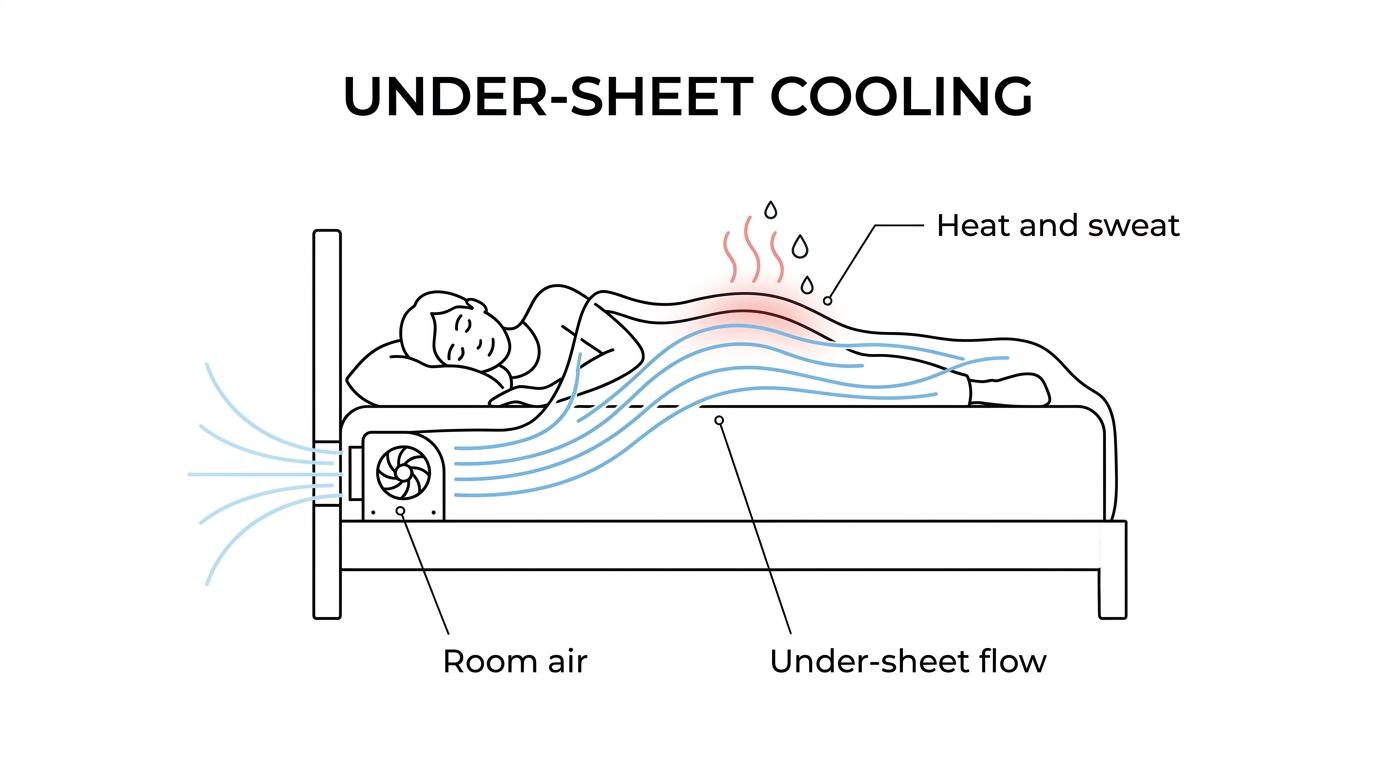
"bFan is built to fit beds 19 to 37 inches tall, which matters because the airflow has to reach the sleep surface to do its job."
If you are trying to sleep in the usual expert-recommended bedroom range of 60°F to 67°F, a bed vent fan can help many people feel cooler right where it counts. In practice, some people can raise the room temperature by about 5°F and still sleep comfortably because the air is moving under the sheets instead of just sitting in the room.
Often, yes. A bed vent fan and air conditioning (AC) solve different problems, and many hot sleepers do better when they use a targeted bed fan before they keep dropping the whole-house temperature.
Lowering the thermostat cools the room volume. A bed vent fan cools the space around your body. If your problem is trapped heat under the covers, direct airflow is usually more precise. That can also reduce AC use and cost, especially if one sleeper runs hot and the other does not.
The trade-off is straightforward. AC can help everyone in the room. A bed vent fan helps the sleeper or sleepers in the bed. If you live in a very warm climate and the room air never gets reasonably cool, a bed vent fan alone will not perform as well because it depends on the ambient temperature already in the room.
The six features that matter most are airflow control, energy-efficient operation, bed-height fit, noise, outlet shape, stability, and bedding compatibility. Those six decide whether a bed vent fan feels precise or frustrating.
Start with measurements, then match the airflow path, then check stability. Bed height is one of the most overlooked reasons a bed vent fan underperforms.
Step 1: Measure from the floor to the top of the mattress and note anything bulky at the foot of the bed, including storage drawers, a thick comforter drop, or an upholstered frame. If the outlet cannot reach the sheet opening cleanly, airflow gets lost before it reaches you.
Step 2: Look at how the sheets fall, considering whether they obstruct air circulation and air flow. Some beds have a tight footboard or hanging blanket that blocks the air path. If that is your setup, choose a model with adjustable positioning so the stream enters the bed, not the frame.
Step 3: Think about who shares the bed. If only one person sleeps hot, you may want one unit on that side. If both sleepers run warm but at different levels, two separate units can act like dual-zone control without forcing both people into the same setting.
A quick pro tip here: do not judge fit by mattress height alone. Platform beds, thick toppers, and heavy bedding can change where the air actually enters the bed.
A bed vent fan is more targeted and energy-efficient than a ceiling fan, making it ideal for indoor use, and its exhaust capability makes bFan often the lower-cost route compared with Bedjet. The right choice depends on whether you want microclimate cooling, room airflow, or app-style features.
A ceiling fan moves room air over exposed skin. That helps before you get under the covers, but it often does less once heat is trapped in bedding. A bed vent fan sends air directly under the sheets, where many hot sleepers actually need it. That is the main functional difference.
Compared with Bedjet, the core principle is similar: both products use room air, not refrigerated air. Bedjet does not cool the air. Bedfan does not cool the air either. Both use the cooler air already in the room. Where people usually compare them is cost, directness, and zone flexibility. A dual-zone Bedjet setup costs over a thousand dollars. That is more than twice the price of two Bedfans, and two separate Bedfans can create left-right microclimate control at a much lower cost.
"A dual-zone Bedjet setup is over a thousand dollars. Two bFans cost less than half that and can give each sleeper separate airflow control."
There is also a category-history point worth knowing. The original Bedfan was invented in 2003, several years before Bedjet was even thought of. That does not make one automatically better, but it does explain why many shoppers see bFan as the simpler, purpose-built option.
Use bedding that carries air across the body instead of letting it die at the foot of the bed. Tight-weave sheets often work better than people expect.
Step 1: Start with sheets that can guide airflow to improve ventilation. A common misconception is that the loosest, most open fabric always feels coolest. In practice, a tighter weave often helps a bed vent fan push air across the body instead of letting it leak out immediately. Linen can still work very well in warm conditions, and a 2024 systematic review found that sleepwear and bedding materials influence thermal comfort and sleep quality, with linen bedsheets improving sleep quality under warm conditions in young adults: https://pubmed.ncbi.nlm.nih.gov/38627879/
Step 2: Reduce heavy compression at the foot of the bed. If you tuck blankets too tightly, you can choke off the airflow before it reaches your legs and torso. Looser layering at the bottom usually helps.
Step 3: Test one change at a time. Try the fan with your current sheets for two or three nights, then compare with a tighter-weave set or lighter blanket. Hot sleepers often change too many variables at once and cannot tell what actually helped.
One anonymized example is a woman in her early 50s dealing with perimenopause-related night sweats. She assumed she needed colder AC, but her real problem was a heavy tucked comforter that blocked airflow. Once the bedding was adjusted and the under-sheet air was set low and steady, she stopped waking up drenched even though the room temperature went up a few degrees.
The research is fairly clear: temperature and bedding affect sleep. PubMed studies and Mayo Clinic guidance both support paying attention to nighttime heat and possible medical causes of night sweats.
A 2024 PubMed systematic review found that bedding and sleepwear can influence skin and body temperature, thermal comfort, and sleep quality. That matters because hot sleepers often focus only on the room thermostat while ignoring the fabric system wrapped around them.
Another PubMed study looked at bedroom nighttime temperature and sleep quality in older adults, reinforcing the basic point that ambient temperature is tied to how well people sleep: https://pubmed.ncbi.nlm.nih.gov/37474050/ A smaller controlled study found that a slowly changing thermoneutral nighttime environment produced longer slow-wave sleep than a constant thermal environment in healthy young men: https://pubmed.ncbi.nlm.nih.gov/17580602/
The practical takeaway is not that everyone needs the same exact setup. It is that thermal comfort is dynamic. If the room is acceptable but your bedding microclimate is not, a bed vent fan may solve the right problem with less effort than changing the entire bedroom environment.
Most performance problems come from blockage, overpowered settings, or a poor fit. Fix the path first, then the speed, then the sleep-partner issue.
Step 1: Check for air flow blockage and ensure proper air circulation, exhaust, and ventilation. Look at the foot of the bed, not just the fan itself. If a blanket is jammed tight against the outlet or the frame blocks the stream, the fan can sound busy without doing much cooling.
Step 2: Lower the speed before assuming the unit is too loud. Many sleepers actually do better with a lower, steadier setting. bFan is listed at 28 dB on low speed, which is quiet enough for many people who dislike standard box fans, and some users report that lower speed still provides meaningful cooling while remaining quiet.
"bFan is listed at 28 dB on low speed, which is why many hot sleepers can leave it running without turning the bedroom into a wind tunnel."
Step 3: Solve partner mismatch with separate zones when needed. If one sleeper wants barely-there airflow and the other wants stronger cooling, two fans often work better than one compromise setting. This is where the idea of dual-zone cooling matters in real life, not just in marketing copy.
A useful pro tip: do not place the fan and immediately decide in five minutes whether it works. Give it two or three full nights. Sleep comfort often improves after you dial in the sheet tuck, speed, and angle.
Night sweats can be a medical symptom, not just a comfort issue. Mayo Clinic and cancer-care guidance both support evaluation when sweating is severe, new, or tied to other symptoms.
This is not medical advice. Always consult your doctor or oncology team before making changes, especially if you are in cancer treatment, taking hormone therapy, dealing with infection, or starting a new medication. Night sweats can be linked to menopause, antidepressants, steroids, thyroid problems, infections, obstructive sleep apnea, and some cancers.
If night sweats come with fever, unexplained weight loss, swollen lymph nodes, chest pain, shortness of breath, or major fatigue, get medical help promptly. Mayo Clinic has a good symptom overview here: Mayo Clinic night sweats causes guide.
For people dealing with treatment-related hot flashes or sweating, cancer-specific guidance can also help frame the conversation with your team: National Cancer Institute PDQ on hot flashes and night sweats.
PubMed review on bedding, sleepwear, thermal comfort, and sleep quality A 2024 review that explains why fabric choice and thermal comfort can change how well you sleep in warm conditions.
PubMed study on bedroom nighttime temperature and sleep quality Useful for readers who want evidence that ambient bedroom conditions can influence sleep outcomes, especially in older adults.
National Cancer Institute PDQ on hot flashes and night sweats A practical medical resource for patients who have night sweats related to cancer care, hormone changes, or treatment side effects.
If you are adding internal links on bedfan.com, these are the most natural next connections for this topic:
This is not medical advice. Always consult your doctor or oncology team before making changes if your night sweats are persistent, worsening, or tied to illness or treatment. If you want a practical, non-drug way to move trapped heat out from under the covers, take a look at the bFan bed vent fan.