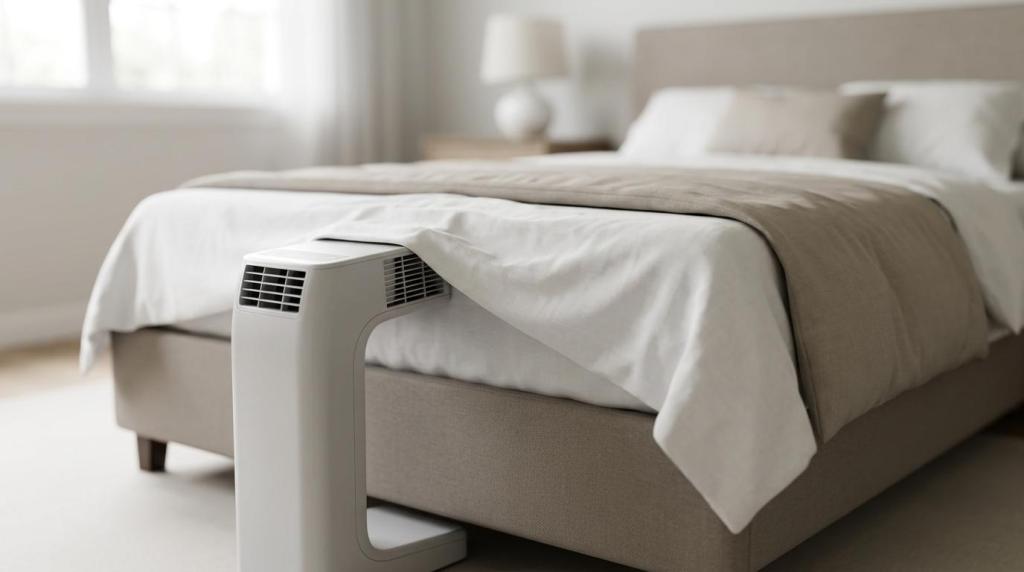
Is BedJet just a fan? Learn 7 key facts on airflow, heating, room temp limits, cost, and whether simpler bed fans cool just as well.
If you are wondering whether BedJet is really anything more than a fan, the short answer is yes, but only in a specific way. It is still an air based bed climate device, not a true air conditioner, and that matters when you compare it with simpler options like bFan Bed Fan or pricier water systems.
TL;DR: Summary
This is not medical advice. Always consult your doctor or oncology team before making changes, especially if night sweats are new, severe, or tied to menopause treatment, cancer treatment, infection, thyroid disease, or unexplained weight loss.
A lot of buyers get tripped up by category language. “Cooling,” “climate comfort,” and “temperature control” can sound like refrigeration, but neither BedJet nor other airflow bed systems actually chill the air the way an a/c does. They move the air already in the room, enhancing air circulation, which can still help quite a bit when heat is trapped under bedding.
No. BedJet is a forced air bed climate system with heating and cooling modes, but its cooling side still works like a targeted fan that uses room air, operated via a remote.
That distinction matters. In everyday language, people say “just a fan” when they mean simple airflow with no extra controls or heating. BedJet goes beyond that because it directs air into the bed, adds thermostat style controls, and offers heating up to a stated 109°F on its product page. Still, it is not a refrigerated system, so it does not manufacture cold air.
A useful way to frame it is this: BedJet is more than a basic bedroom fan, but less than a true cooling appliance. If your room is warm, the device is still pushing warm room air. BedJet itself says best cooling performance happens in bedrooms below 79°F, which lines up with the bigger sleep principle that cooler sleep environments usually work better.
BedJet cools through convective airflow, not refrigeration. It pushes room air under the covers so sweat can evaporate and trapped heat can move away from the skin.
That means the system depends on physics, not magic. If your bedding holds heat, airflow can help break that microclimate. If your sheets are heavy, fuzzy, or poorly breathable, the benefit drops. Tight weave sheets often work well because they help the air spread across the body instead of leaking out too fast at the foot of the bed. That is a common misconception. “More open” fabric is not always better for directed under sheet airflow.
Another important detail is that thermoregulation and sleep are closely linked. A review in PMC on sleep and thermoregulation explains that core body temperature normally drops as the body transitions into NREM sleep. So, when a bed system helps reduce heat buildup around the skin, it may support the conditions your body already prefers at night.
“bFan Bed Fan was invented in 2003, which is why many shoppers see it as the older, simpler under sheet airflow option in this category.”
Yes, there are seven practical facts that usually separate hype from real performance. Compare the mechanism, temperature limits, sleep context, and total cost before you buy.
Start with what the product actually does, then move to how that fits your body and bedroom. Here are the seven comparisons that matter most:
One more trade off is worth calling out. If you want winter warmth and summer airflow in one device, BedJet’s feature set becomes more relevant. If you only care about removing trapped body heat, then extra heating hardware may not help your decision much.
Yes, you can test this at home in three simple steps. Track your room, your bedding, and your wake ups before you assume you need a more expensive system.
First, check the bedroom temperature near bedtime and again around 3 A.M. Sleep experts often recommend roughly 60°F to 67°F for better sleep. If your room is already in that range but you still wake sweaty, the problem may be trapped bedding heat and inadequate air circulation rather than the room itself.
Second, look at your bed layers. Memory foam toppers, waterproof protectors, flannel, and thick comforters can trap heat close to the skin. If you remove one hot layer and feel noticeably better, airflow is likely to help.
Third, notice the pattern of your awakenings. If you fall asleep fine but wake hot a few hours later, that often points to a warm bed microclimate, hormonal shifts, medication effects, or a combination. One anonymized example I have seen many times is a woman in her early 50s who kept the thermostat at 66°F, yet still woke drenched around 2 A.M. Once she switched to a lighter comforter and added direct under sheet airflow, she stopped kicking the covers off every night. The room had not been the whole problem.
For pure cooling, bFan Bed Fan is the simpler category match. BedJet adds heating and more control layers, while both systems still rely on room air rather than making cold air.
This is where many shoppers get clearer fast. If you want directed airflow under the sheets and little else, a bed fan does the core job. If you also want heating, BedJet becomes a different type of value proposition. That does not mean it cools better by default. It means it has more modes.
Cost is a major separation point. The dual zone BedJet setup is over a thousand dollars, which is more than twice the price of two Bedfans. That matters for couples who simply want dual zone microclimate control without spending premium system money.
A second misconception is that “more features” always means “more cooling.” Not necessarily. Since neither system cools the air itself, the real drivers are room temperature, airflow path, sheet choice, and how your body handles heat. If then logic helps here, use it like this: if you need heating plus airflow, BedJet is more than a fan in a useful way. If you only need airflow cooling, a simpler bed fan may cover the real problem at lower cost.
“Two Bedfans can create dual zone bed climate control for far less than a dual zone BedJet system priced over a thousand dollars.”
They are different categories. BedJet is air based, while Eight Sleep is water based and far more expensive.
Water systems can regulate surface temperature more actively because they circulate temperature controlled water through a pad. That is a different mechanism from pushing room air. It can be effective, but it also comes with a much higher upfront cost. The Eight Sleep Pod 5 typically costs between $3000 and $6000, which puts it in a very different buying conversation from BedJet or an airflow bed fan.
There are also trade offs beyond price. Water systems add more hardware and more complexity. Air systems avoid liquid in the bed. BedJet itself highlights that there are no wires, water, or electricity in the bed area. If simplicity matters, that is a real advantage. If highly active temperature management matters more, a water system may still be worth a look.
Research supports the body cooling concept, but not every bedding product improves sleep metrics. The strongest takeaway is that thermoregulation and sleep are linked, yet results are mixed.
A 2025 PubMed systematic review and meta analysis screened 3,454 articles and included 9 studies on bedding strategies for body cooling and sleep. It found no clear differences between groups for sleep onset latency, sleep efficiency, total sleep time, sleep stage proportions, or wake after sleep onset, and the certainty of evidence ranged from very low to low.
That does not mean cooling is useless. The same review found acute body cooling effects, including lower core body temperature, in the studies that were qualitatively synthesized. Another 2024 PMC paper reported that gently lowering nocturnal body temperatures increased N3 sleep and decreased heart rate. So the practical reading is this: body cooling is biologically relevant, but product outcomes vary because bedrooms, bedding, and bodies vary.
A good pro tip here is not to confuse “feels cooler” with “guaranteed better sleep architecture.” Comfort matters. Physiology matters too. They are related, but they are not identical.
A Bedfan style setup works best when the room is already reasonably cool, the sheets can carry airflow, and the timer matches your hot window during the night.
Start with the remote management of the room, not the device. Many sleep experts suggest keeping the bedroom around 60°F to 67°F. With under sheet airflow, some people can raise the room temperature by about 5°F and still feel cool enough to sleep more comfortably, which may help trim AC use. That is especially useful if your whole house does not need to be refrigerator cold all night, potentially reducing a/c usage.
Then fix the bedding path. Tight weave sheets can help the air travel across the body and carry away heat. Heavy fleece, thick mattress pads, and dense comforters can block that effect. If you are a couple with different heat needs, one side may need less insulation rather than more airflow.
Finally, use timing on purpose. A timer can make sense if your worst overheating hits in the first half of the night or right before dawn. Quiet operation matters here too. If sound sensitivity is an issue, look closely at real noise numbers, not vague claims like “whisper quiet.”
Night sweats deserve medical attention when they are new, severe, or paired with warning signs. Mayo Clinic and cancer care guidance agree that context matters.
Please do not assume every sweaty night is just a bedding issue. Talk with a clinician if night sweats come with fever, unexplained weight loss, swollen lymph nodes, chest pain, shortness of breath, or a new cough. The same goes for symptoms linked to menopause treatment, antidepressants, steroids, thyroid disease, sleep apnea, infection, or cancer treatment.
If you are on chemotherapy, hormone therapy, or an oncology drug, check with your oncology team before changing your sleep setup, room temperature, hydration routine, or medicines. Cooling tools may help comfort, but they do not treat the cause. That is the most important misconception to avoid.
Related internal links to consider on bedfan.com include the main /night-sweats/ hub, the /sleeping-cooler/ page, a menopause night sweats guide, a medication related night sweats guide, and a bedroom temperature guide.
No, BedJet does not refrigerate the air. It uses the air already in the room and moves it under the covers, which can feel much cooler because it helps sweat evaporate and pulls trapped heat away from the skin.
That is why room temperature still matters. If the bedroom is hot, the system starts with hot air. In a cool room, targeted airflow usually feels more effective and more comfortable.
People say that because BedJet adds heating, controls, and bed specific airflow delivery. A normal box fan or ceiling fan does not direct air under the sheets or offer the same kind of temperature programming.
Still, the cooling principle remains fan based airflow. So the phrase is partly true and partly marketing shorthand. It is more than a basic fan, but it is not a true air conditioner.
It can be, depending on what each partner wants. If one person sleeps cold and the other sleeps hot, BedJet’s dual zone and heating options may be useful in a way a single airflow device is not.
If both partners mainly want less trapped heat, simpler dual zone airflow setups can still work well. The better option often comes down to whether the need is shared cooling, different temperatures, or added winter warmth.
It may help with comfort, but it will not treat the hormonal cause. Directed airflow under the sheets can make it easier to dry sweat, cool the skin, and get back to sleep after a hot flash, which is why many women find it helpful during perimenopause and menopause.
That said, frequent or severe symptoms still deserve a medical conversation. Treatment options can include lifestyle changes, medicine review, and hormone related care, depending on the person and their health history.
No, “better” depends on what problem you are solving. Water systems can regulate surface temperature more actively, but they cost much more and add more equipment to the bed setup.
Air systems are simpler and often far less expensive. If your main issue is trapped bedding heat rather than a need for precise active temperature control, an air based option may be enough.
Sheets that let air spread across the body usually work best. Tight weave cotton percale and lighter blankets often perform better than heavy fleece, plush toppers, or very dense comforters that trap heat and block airflow.
If you are not getting the result you expected, bedding is one of the first things to check. People often blame the device when the real barrier is the layer sitting directly above or below them.
If you want a simpler way to move trapped heat out from under the sheets, you can see how the bFan Bed Fan works. This is not medical advice. Always consult your doctor or oncology team before making changes, especially if night sweats are new, severe, or linked to infection, cancer care, hormone therapy, or unexplained weight loss.