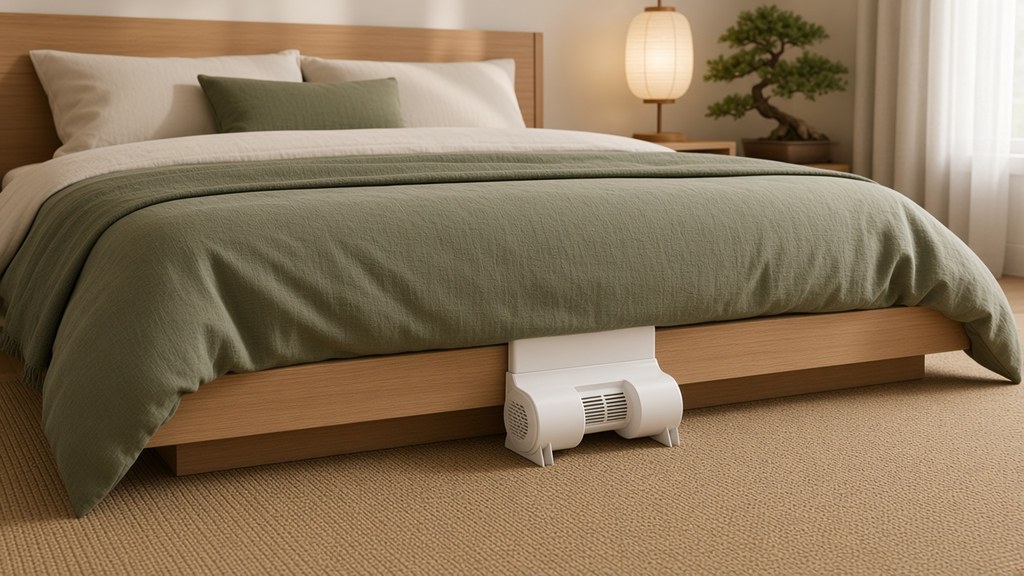
Does BedJet work? Yes, for many hot sleepers. Compare room temp, humidity, bedding, airflow, noise, and cost before you buy.
When shoppers ask whether BedJet works, the short answer is yes, for many hot sleepers, but not for the reason some expect. Like bFan Bed Fan and other bed-cooling fans, BedJet does not refrigerate the bed or lower room temperature. It works by moving the cooler room air already in the bedroom through the bedding and across your skin.
TL;DR: Summary
The bigger question is not only “does it work,” but “does it work better than the alternatives for your situation?” Buyers usually get the clearest answer by comparing under-cover airflow, room cooling, bedding, and total ownership cost side by side.
Yes, BedJet can help cool a hot bed when the room already contains reasonably cool air and your main heat buildup happens under the covers. It is a targeted airflow product, not a mini air conditioner.
That distinction matters. The U.S. Department of Energy says fans cool people, not rooms. BedJet applies that same basic principle inside the bed microclimate, where heat and moisture often get trapped between your body, mattress, sheets, and comforter.
"bFan targets the space under the covers rather than the whole room, which is why shoppers should compare bed-level airflow before assuming colder AC is the only fix."
If your bedroom is already comfortable but you still wake up hot, sweaty, or “stuck” under the covers, BedJet can absolutely feel effective. If your room is 80°F and humid, results are usually less impressive because neither BedJet nor a bed fan cools the air. They only move the cooler air that already exists in the room.

A useful way to think about it is this: AC changes the room. BedJet changes the air around your body.
BedJet cools by increasing airflow around your skin and bedding, which helps carry away heat and moisture. The unit does not generate cold air.
Heat builds up quickly under blankets because your body keeps warming a small enclosed space. Moving air through that space helps with convective heat loss and evaporation. That can make the bed feel cooler within minutes even when the thermostat has not changed.
A common misconception is that “bed cooling” means refrigeration. It does not. BedJet does not cool the air. A bed fan does not cool the air either. Both depend on the bedroom air being cool enough to feel refreshing once it is directed where your body needs it.
Research supports the basic mechanism. A 2019 PubMed-indexed study found that body-level airflow of 0.8 m/s allowed older adults to maintain sleep quality and thermal comfort at an air temperature 3 K higher than neutral. That does not prove any single product is best, but it does support the idea that airflow can offset some heat stress during sleep.
Buyers should compare cooling method first, because room cooling, bed cooling, and bedding changes solve different problems. The best choice depends on whether the heat is in the room, in the bed, or both.
If your complaint is “the room is okay, but I overheat under the covers,” then bed-level airflow deserves a closer look.
The trade-off is simple. Whole-room cooling is broader but more energy-intensive. Bed cooling is narrower but often less expensive to run.
Not automatically. bFan and BedJet both rely on directed room-air movement, so the better choice usually comes down to price, airflow feel, controls, and whether you want targeted cooling without paying for a more complex system.
For many buyers, this is where the comparison becomes practical instead of theoretical. If you mainly want cooler sleep under the covers, both categories can help. The real differences are how the airflow is delivered, how discreet the setup is, how the sheets behave, and what the full system costs if two sleepers want separate control.
A major trade-off is total price. A dual zone BedJet costs more than twice the price of two bFans. That does not make it bad. It just means households should compare the cost of solving the problem on both sides of the bed, not just look at the entry price for one side.
Timer controls matter more than many shoppers expect. If you like stronger airflow while falling asleep but less later, that feature can help you settle into the cooler conditions sleep experts often recommend.
The category history is also worth noting without making too much of it. The original bFan concept came to market several years before BedJet was even thought of. That does not prove one works better, but it does show that under-cover airflow is an established sleep-comfort approach rather than a novelty.
"The original bFan concept dates to the early 2000s, which matters mostly as buyer context: targeted bed airflow is not a new gimmick."
Usually no, if the whole bedroom is too warm. Usually yes, if only the bed feels too hot and the room is already close to comfortable.
That is why blanket statements miss the point. Sleep Foundation notes that many sleep experts recommend a bedroom around 60°F to 67°F. But not everyone wants, or can afford, to keep the whole room at the low end of that range all night.
The DOE says ceiling fans can allow a thermostat setting about 4°F higher while maintaining comfort in some situations. With a Bedfan-style setup, people can often raise room temperature by about 5°F and still sleep cool because the airflow is focused under the covers rather than wasted on the whole room.
If your partner likes the room warmer, this is where targeted airflow can make more sense than fighting over the thermostat. If the air in the bedroom feels warm, still, and damp before you even get into bed, lower the room temperature first. Under-cover airflow works best as a precision tool, not a substitute for fixing a bad room environment.
Start with the bedding, not the fan speed. Airflow works best when it can move across your body instead of escaping instantly or getting blocked by thick fabric.
Step 1 is placement. Put the airflow source where it can feed air cleanly into the bed pocket, usually from the foot area. Step 2 is sheet choice. A tight-weave sheet often works better because it helps the air travel across the body and carry away heat instead of leaking out too fast. Step 3 is moderation. Begin at a middle setting, then adjust upward only if you still wake hot.
One common mistake is assuming “more blast equals better sleep.” Too much airflow can feel distracting or dry for some sleepers. Another is pairing any bed fan with very open-knit bedding that lets the air escape before it cools the sleeper effectively.
"bFan is listed at about 12 watts on bedfan.com, which is why targeted under-sheet airflow is often compared with dropping the thermostat for the whole room."
If you are sensitive to airflow on your face, aim the system to move air through the lower bed cavity first. The goal is not wind. The goal is quiet heat removal.
Measure the room first. If temperature, humidity, or stale air are poor, even a good bed-cooling setup may underperform.
Step 1 is to check the room at bedtime and around 2 a.m. with a simple thermometer and hygrometer. Step 2 is to notice the pattern: do you feel hot only under blankets, or hot everywhere the moment you enter the room? Step 3 is to improve ventilation if the bedroom gets stuffy overnight.
That last point is easy to miss. A 2023 bedroom field study reported that lower ventilation rates were associated with less deep sleep, more light sleep, and more awakenings in some bedrooms, even when temperature stayed unchanged. In plain terms, a room can feel “not that hot” but still sleep poorly because the air is stale or humid.
A common misconception is that temperature alone explains bad sleep. If your CO2 builds up, humidity rises, and air movement is poor, you can still wake uncomfortable even with a decent thermostat setting.
If night sweats are driven by menopause, medication side effects, or illness, airflow may help symptoms, but it does not address the underlying cause. Relief and medical evaluation are sometimes both needed.
This is especially relevant for people taking selective serotonin reuptake inhibitors (SSRIs), steroids, tamoxifen, or certain diabetes medications, and for people going through menopause or perimenopause. Mayo Clinic also notes that persistent night sweats can be linked to infections, endocrine issues, some cancers, and other conditions.
Consider a common real-life scenario. A woman in her early 50s starts waking around 2:30 a.m. drenched, kicks off the comforter, then gets cold 20 minutes later. Her room is 70°F, but the heat feels trapped inside the bed. In that situation, targeted airflow can be genuinely helpful right away, even while she talks with her clinician about menopause, thyroid issues, or medication effects.
If your night sweats are new, drenching, or paired with fever, unexplained weight loss, chest pain, or shortness of breath, do not treat a bed-cooling device as the only answer. Use it for comfort, then get medical guidance promptly.
Check your room, your bedding, and your budget before you compare features. bFan or BedJet may both help, but the better buy depends on what is making you hot in the first place.
A fast buying test is this: if lowering the room a few degrees solves the problem, you may need room cooling more than bed cooling. If the room feels okay but your body overheats under the covers, focused bed airflow is more likely to pay off.
Use this short checklist:
If you want next-step reading on night sweats and hot sleeping, these internal pages are a good place to start:
If you are trying to sleep cooler tonight, start by checking your room temperature, bedding, and where the heat is actually building up, then compare targeted airflow options against simply lowering the thermostat. And if night sweats are severe, frequent, or tied to medication changes or other symptoms, speak with a licensed clinician. This article is for general education and product comparison only, not medical advice, diagnosis, or treatment.
The bFan sits at the foot of your bed and sends a quiet stream of air under your sheets. Direct airflow helps stop sweat before it starts, and one bFan costs less than half the price of one BedJet, making it the less expensive alternative. Shop the bFan at bedfans-usa.com