Learn how a bed blower cools under covers, improves sleep comfort, and compares with AC, BedJet, and water-based systems.
If you are searching for a bed blower, the key thing to know is that it is not a miniature air conditioner for your mattress. A bed blower is a targeted under-covers airflow device, and brands like bFan Bed Fan matter here because they are built to move room-temperature air through your bedding to carry away trapped body heat while you sleep.
TL;DR: Summary
- A bed blower works by pushing room-temperature air under your sheets, not by making cold air, and that targeted cooling method is the main reason hot sleepers often find it more useful than a regular bedroom fan.
- Sleep research supports the basic idea: local body cooling and bed microclimate control can improve thermal comfort, sleep efficiency, and time spent in deeper sleep stages.
- bFan Bed Fan is one example of this category, describing its system as under-the-covers airflow that removes trapped body heat rather than cooling the whole room.
- Bed blowers help most when your room is already reasonably cool, your bedding traps heat, and you need relief from night sweats, hot flashes, or medication-related overheating.
- They are different from BedJet, ceiling fans, and water-based mattress systems in airflow method, cost, energy use, and how directly they cool the sleeper instead of the room or mattress surface.
That distinction matters because many frustrated sleepers buy the wrong tool for the wrong heat problem. If your room is hot, whole-room cooling still matters. If your room is decent but your sheets and blankets trap heat around your body, a bed blower can be the more precise fix.
A bed blower is an under-sheet airflow device that sends air between your top and bottom bedding. bFan Bed Fan fits this category because it is designed to move air where heat builds up most, inside the bed microclimate around your body.
The term "bed blower" usually refers to a personal bed-cooling system placed at the foot or side of the bed. Its job is simple: move air into the space under the covers so body heat does not stay trapped next to your skin. That is very different from a ceiling fan, which mostly circulates air in the room, or an air conditioner, which lowers the temperature of the whole room.
This is also why hot sleepers often describe the relief as faster than changing a thermostat setting alone. You are cooling the small space that actually feels too hot, not waiting for walls, furniture, and the entire bedroom to cool down.
"bFan Bed Fan describes the category well: under-the-covers airflow using room-temperature air, not refrigerated air, to remove trapped body heat."
They cool you by moving air across your body and bedding, but they do not cool the air itself. Neither a standard bed blower nor BedJet makes cold air like an air conditioner. Both use the cooler room air that is already available.
That sounds like a small difference, but it is the whole mechanism. Heat leaves your skin and bedding through airflow, convection, and evaporation. If sweat or body heat stays trapped under blankets, your sleep can feel sticky and interrupted. If air keeps moving under the covers, that trapped heat is carried away.
Research points in the same direction. A warm-room study published on PubMed found that cooling the back and neck produced the largest gains in thermal comfort and sleep quality among the tested conditions. Mean sleep efficiency rose from 84.6% with no cooling to 95.3% when both the back and head and neck were cooled. That does not prove every bed blower will create identical results, but it strongly supports targeted body cooling as a sleep strategy.
A common misconception is that a bed blower should feel icy to be effective. In practice, if the room is already in a decent range, moving that room air under the sheets can feel much cooler than the thermostat number suggests because it changes the bed microclimate directly.
The smartest way to judge a bed blower is by airflow location, sleep context, and operating trade-offs. The best buying decision usually comes from asking how the device cools, where it cools, and whether that matches your actual sleep problem.
Before you compare models, keep these five facts in mind:
A bed blower cools the sleeper, not the room: If your bedroom itself is too hot, a bed blower may help but will not replace air conditioning. It works best when the room is already reasonably comfortable and the bed is what feels overheated.
Targeted airflow is the real design advantage: The useful question is not "Is it powerful?" It is "Does it move air where my heat is trapped?" Under-cover airflow matches what sleep studies show about local cooling and sleep quality.
Bedding choice changes performance: Tight-weave sheets with a tighter weave usually work better than very loose or porous fabrics because they help the air travel across your body instead of escaping straight upward. This is an easy miss for first-time buyers.
Night sweats are a different problem than feeling warm at bedtime: If you deal with menopause, medication-related overheating, or stress-related sweating, keeping air moving under the covers can help manage moisture and heat spikes through the night.
Not all cooling beds work the same way: Some systems move air, some circulate water, and some regulate the mattress surface. If you hate blowing air, a conductive system may suit you better. If you want a simpler and lower-energy approach, water-based systems are often easier to live with.
Good setup matters almost as much as the blower itself. Placement, sheet choice, and timing determine whether air actually reaches your body or leaks out before it can do much.
Start with the airflow path. Place the unit so the air enters cleanly under the top layer of bedding and has room to travel up the bed. If your blankets are tucked tightly at the sides and foot, you may need a small gap so the airflow can spread instead of bunching up in one spot.
Next, check your bedding materials. A pro tip here is to use sheets with a tighter weave if you want the air to glide across your skin and carry away heat. Very lofty comforters and very open weaves can sometimes dilute the effect. If you sleep with a partner, test whether each of you likes the same blanket weight before blaming the device.
Then adjust timing and speed. Many hot sleepers do best with stronger airflow during sleep onset and the first part of the night, then a lower setting later. Timer controls can help if you want the bed cooler while falling asleep but do not want a steady breeze until morning. If you wake cold at 3 a.m., the answer is often a lower setting or shorter runtime, not giving up on targeted cooling entirely.
A bed blower is more targeted than either a ceiling fan or whole-room AC. Air conditioning changes room temperature. A ceiling fan circulates room air. A bed blower pushes that air under the covers, where many hot sleepers actually feel the problem.
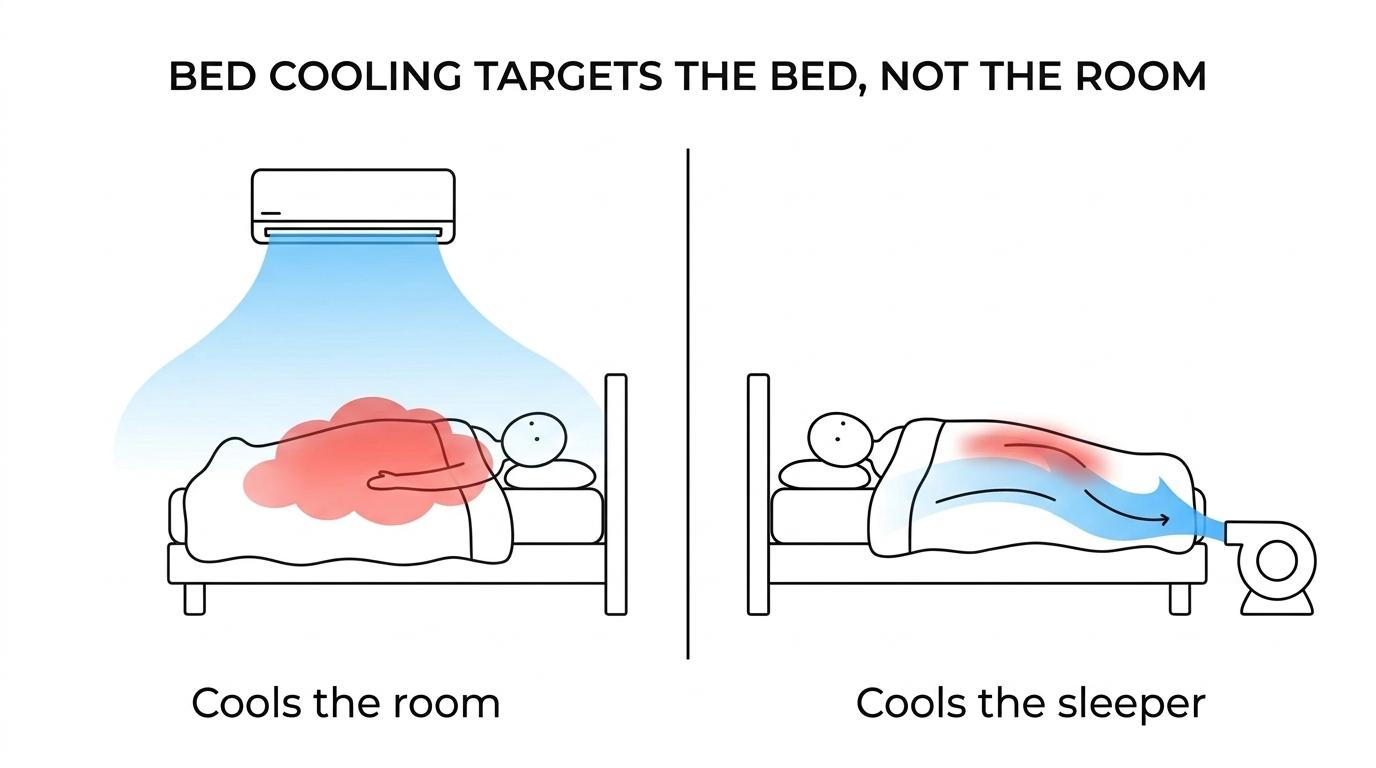
That difference affects both comfort and cost. Sleep experts often recommend a bedroom temperature around 60°F to 67°F. Many people find that when under-sheet airflow is working well, they can raise the room temperature by about 5°F and still sleep cool because the bed itself no longer feels heat-locked.
If your room is muggy or in the upper 70s, targeted airflow may not be enough on its own. That is also why a room device and a bed blower solve different problems: as Hazmarket’s overview of air purifiers for bedrooms makes clear, bedroom appliances often address the overall room environment, while under-cover airflow is aimed specifically at heat trapped around the sleeper.
If your room is muggy or in the upper 70s, targeted airflow may not be enough on its own. If the room is already close to your comfort zone and your bedding still feels hot, that is where a bed blower has the clearest advantage over a ceiling fan.
The trade-off is straightforward. AC gives whole-room cooling but uses much more energy. A bed blower cools a person, not a house. That is why some sleepers use both together: moderate AC for the room, targeted airflow for the bed.
A bed blower and BedJet both use room air, while water-based systems cool through the mattress surface. bFan Bed Fan is relevant here because it represents the under-sheet airflow approach, which differs from conductive mattress cooling in feel, setup, and energy use.
The first major comparison is mechanism. Neither BedJet nor a standard bed blower cools the air itself. They move room-temperature air. Water-based systems, by contrast, can actively regulate the temperature of the mattress pad or surface, which is why recent PubMed research and another sleep cooling study focus on temperature-controlled bed surfaces and conductive body cooling.
The second comparison is price and complexity. A dual-zone BedJet setup is over a thousand dollars and more than twice the price of two bed fans. Water-based systems can cost even more, and they often bring extra tubing, maintenance, or setup considerations. A common mistake is assuming higher price automatically means better sleep. It may simply mean a different cooling method.
History matters too. The original bed fan concept came to market around 2003, several years before BedJet was even thought of, so under-cover airflow is not a copycat category. It is an older, simpler solution that still fits a lot of sleepers well.
"bFan Bed Fan says its adjustable top fits beds 19 to 37 inches tall, which matters because bed height affects how well under-sheet airflow reaches the sleeper."
Yes, it can help manage nighttime heat and sweat episodes, though it does not treat the medical cause. For menopause, vasomotor symptoms, or medication-related overheating, a bed blower addresses the sleep disruption piece by keeping heat from building up under the covers.
The National Institutes of Health notes that hot flashes at night are called night sweats and may disrupt sleep on its menopause page. That is why bed cooling can matter even when the underlying issue is hormonal, medication-related, or stress-related. The goal is not to fix estrogen levels, serotonin effects, or corticosteroid side effects. The goal is to help you stay asleep when those issues make your body feel too hot.
A realistic example: one woman in her early 50s, recently started on a medication that made her sweat at night, found that lowering the thermostat helped only a little and made her partner cold. What changed things was moving airflow into the bed itself, then lowering the fan speed after the first few hours so she stayed dry without waking chilled.
Step 1 is to identify your pattern. If the overheating happens right after you fall asleep, timer settings and stronger initial airflow may be enough. If it peaks around 2 a.m. or 4 a.m., you may need steady lower airflow all night.
Step 2 is to control moisture and trapped heat together. Lightweight sleepwear, a tighter-weave sheet, and under-cover airflow usually work better than simply piling on moisture-wicking fabrics without ventilation.
Step 3 is to monitor whether this is just discomfort or a symptom pattern that needs medical review. If you have new night sweats plus fever, weight loss, swollen lymph nodes, or medication changes, do not assume the fix is only bedding.
"bFan Bed Fan says its current blower uses about 12 watts on average even at the highest setting, so targeted bed cooling can use far less electricity than dropping whole-room AC all night."
Talk to a clinician when night sweats are new, frequent, severe, or paired with red flags. A cooling device can help symptoms, but persistent night sweats can also relate to menopause, infections, thyroid disease, obstructive sleep apnea, blood sugar swings, cancer treatment, or other medical issues.
Start by tracking timing and triggers for one to two weeks. Note room temperature, bedding, alcohol, spicy food, medication timing, menstrual changes, and whether the sweating wakes you up or leaves clothing or sheets damp. If then patterns help reveal the cause, your clinician gets better information fast.
Next, look for associated symptoms. Fever, cough, unplanned weight loss, enlarged nodes, chest pain, shortness of breath, or heavy daytime fatigue deserve prompt medical attention. People taking antidepressants, steroids, tamoxifen, thyroid medication, insulin, or stimulants should also review side effects with a prescriber.
Then decide what kind of help you need right now. If your main problem is trapped bed heat, a targeted cooling option may be worth trying while you also address the underlying cause. If you want a discreet airflow-based option, ask whether a bed blower that directs air under the sheets matches your bedding, bed height, and sleep habits.
You may also want to read:
If you are dealing with this tonight, focus on the smallest effective change first: cool the bed microclimate, not just the entire house. And if you need a practical next step, compare your bedding setup, bed height, and sleep pattern before buying. This article is for education only and is not medical advice, diagnosis, or treatment. Seek urgent medical care for night sweats with fever, unexplained weight loss, chest pain, trouble breathing, or other concerning symptoms.