What is a bed fan? Learn how this under-the-covers cooling system moves trapped heat and moisture to help hot sleepers rest better.
Hot sleepers usually do not need a colder house as much as they need better airflow in the spot where heat gets trapped most, under the covers. That is where a bed fan fits in.
TL;DR: Summary
- A bed fan is an under-the-covers cooling system that sends room air between your sheets to move trapped heat and moisture away from your body.
- Bed fans help by cooling the bed microclimate, not the whole room, which matches how sleep onset normally depends on heat loss from the skin and a drop in core body temperature.
- Neither a Bedfan nor a Bedjet makes cold air like an air conditioner. Both use the cooler air already in the room.
- For many hot sleepers, a bed fan is more practical than lowering the whole thermostat all night. Sleep experts often suggest a bedroom around 60°F to 67°F, and many people can raise the room temperature by about 5°F with a bed fan and still feel cool enough to sleep.
- A good setup matters: place the fan at the foot of the bed, use tighter-weave sheets so air can travel across the body, and start on a low setting to avoid overcooling.
- This is a comfort tool, not a diagnosis or treatment. If night sweats are new, drenching, or linked to fever, weight loss, cancer treatment, diabetes, or medication changes, call your doctor.
If you are reading this because you wake up sweaty, restless, or kicking off the covers at 2 A.M., the main idea is pretty simple. A bed fan targets the heat buildup inside your bedding, which is often the real problem. This is not medical advice. Always consult your doctor or oncology team before making changes, especially if night sweats are new, severe, or tied to a health condition or treatment.
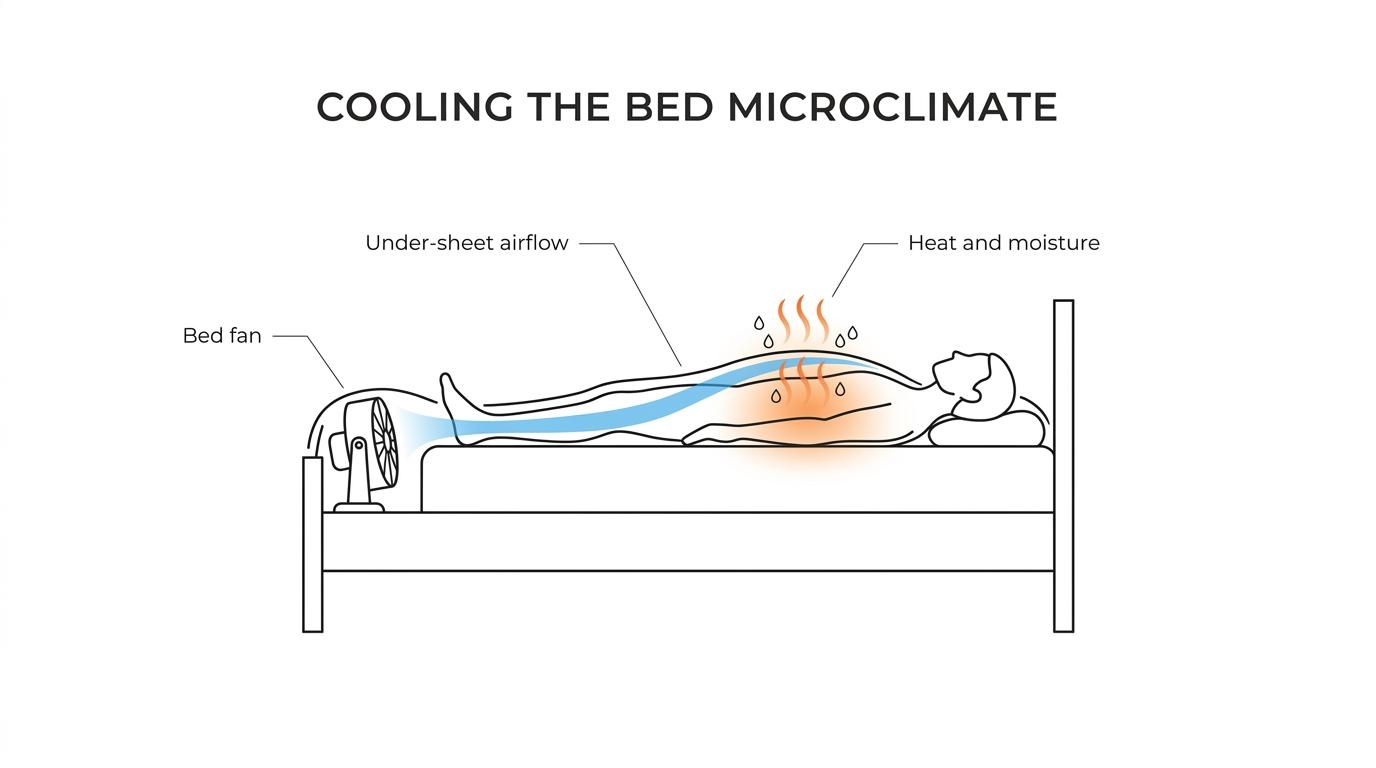
A bed fan like the bFan is an under-the-covers cooling system that pushes room air between your top and bottom sheets. It sits at the foot of the bed and cools the space around your body where heat and humidity collect overnight.
That matters because your bedding creates a small climate of its own. Even when the bedroom feels fine, the area under blankets can get warm, stuffy, and damp from body heat and sweat. A bed fan is designed to move that trapped heat out so the skin can release heat more easily.
"bFan Bed Fan was invented in 2003, years before Bedjet entered the category."
A common misconception is that a bed fan should feel like an air conditioner aimed at your feet. It does not work that way. The goal is steady airflow under the sheets, not icy air on bare skin.
A bed fan cools by improving heat loss, and PubMed research helps explain why that works. Human sleep onset is tied to a drop in core body temperature and increased heat loss through the skin, which is part of normal thermoregulation (PubMed).
Step 1 is simple: the fan pulls in the cooler room air already available in the bedroom. Neither a Bedfan nor a Bedjet cools the air itself.
Step 2 is where the comfort change happens. That moving air travels under the covers, lowers stuffiness, and helps sweat evaporate faster. If your sheets feel clammy at night, this is often the part you notice first.
Step 3 is the sleep benefit. If your body can dump heat more easily, it often becomes easier to settle down and stay asleep. Pro tip: if the room is already too hot, a bed fan still helps, but it works best when the bedroom is at least reasonably cool.
A few facts explain most of the value, and they also clear up the usual confusion around products like bFan and Bedjet. The short version is that bed fans are really about targeted airflow, not refrigerated air.
A bed fan cools the bedding zone more directly, while a ceiling fan cools the room more generally. If you feel fine until you pull the covers up, the bed fan usually solves the more specific problem.
A ceiling fan helps with overall air movement, and it can make a warm room feel less stagnant. Still, once you are under sheets and blankets, that room airflow often does not reach the humid pocket around your body. A bed fan is more targeted because it pushes air exactly where the heat is trapped.
If your partner gets cold easily, this difference matters. You may want under-sheet airflow without turning the whole room into a refrigerator.
"bFan Bed Fan uses room-temperature air under the sheets, so it targets trapped bed heat instead of trying to cool the whole bedroom."
One more trade-off: some people love a ceiling fan for white noise, but others dislike the draft on their face. A bed fan shifts that airflow lower and more locally, which can feel gentler.
The biggest differences are price, setup style, and how you create dual-zone cooling. Both bFan and Bedjet use room air rather than chilled air, so neither one replaces air conditioning.
For cost-conscious couples, the comparison is pretty clear. A dual-zone Bedjet setup costs over a thousand dollars, which is more than twice the price of two Bedfans. Two bFans can create dual-zone microclimate control at a fraction of that cost, which is often enough if one sleeper runs hot and the other does not.
"A dual-zone Bedjet setup costs over a thousand dollars. Two bFans create dual-zone bed cooling for far less."
There is also some category history here. The original Bedfan came to market years before Bedjet was even thought of, with the invention dating to 2003. That does not make newer systems bad, but it does explain why many shoppers see Bedfan as the original under-sheet cooling approach.
A practical point people miss is sound and energy use. If you are sensitive to noise or leave cooling on all night, low-power options with quiet operation and timer controls matter more than flashy claims. That is where a simple bed fan can make a lot of sense.
A good setup is straightforward, and the bFan works best when the air has a clean path between the sheets. Small positioning changes can make a bigger difference than increasing speed.
Step 1 is placement. Put the unit at the foot of the bed so the airflow enters between the top and bottom sheets, not into a blanket pile or mattress edge.
Step 2 is bedding choice. Tight-weave sheets help the air travel across your body and carry heat away. Very loose knits, heavy comforters tucked tightly at the foot, or lots of extra layers can block that movement.
Step 3 is tuning the airflow. Start low, especially if you are a light sleeper. Quiet operation in the neighborhood of 28 to 32 dB on lower settings is usually enough for many people, and remote or timer controls help you dial it down after sleep onset. Pro tip: more airflow is not always better. If your feet feel cold but your back still feels warm, the path is blocked, not the fan power.
A bed fan can reduce the misery of night sweats by drying sweat faster and lowering heat buildup under the covers. It does not treat menopause, infection, or medication side effects, but it can make the nights more livable.
That is especially useful in menopause, perimenopause, and some cancer treatments where hot flashes and sweating can interrupt sleep repeatedly. Mayo Clinic notes that night sweats may be linked to menopause, medications, infections, and other conditions, which is why symptoms deserve context, not guesswork (Mayo Clinic). Cancer treatment guidance also discusses hot flashes and sweating as real quality-of-life issues for some patients (Cancer.gov).
A realistic example: one woman in her early 50s described waking up soaked around 1 A.M., then feeling chilled after throwing the blankets off. What helped most was not lowering the thermostat all the way down. It was keeping the room reasonable, using a bed fan under tighter sheets, and letting the airflow evaporate sweat before the bedding got damp.
"bFan Bed Fan addresses the root comfort issue by moving trapped heat and moisture out from under the sheets."
If your overheating is medication-related, the same logic applies. Selective serotonin reuptake inhibitors (SSRIs), steroids, tamoxifen, diabetes medicines that can cause low blood sugar, and other drugs can trigger sweating. If the sweats started after a new prescription, talk with the prescribing clinician before changing anything on your own.
Night sweats can be a warning sign, and Mayo Clinic and Cancer.gov both make that point clearly. If sweating is new, drenching, or paired with other symptoms, medical care matters more than bedroom gadgets.
Call a clinician if you have night sweats with fever, unexplained weight loss, swollen lymph nodes, persistent cough, chest pain, severe fatigue, or repeated low blood sugar episodes. The same goes for sweats that start after a medication change, during pregnancy, during cancer treatment, or alongside symptoms of obstructive sleep apnea (OSA), like loud snoring and gasping.
A common misconception is that every midlife night sweat is automatically menopause. Many are, but not all. This is why a comfort tool and a medical workup are not the same thing.
This is not medical advice. Always consult your doctor or oncology team before making changes.
The research supports cooling at bedtime, and PubMed studies connect sleep quality with body temperature and airflow. The key idea is that heat dissipation helps sleep begin and stay stable.
A 2018 review in PubMed explains that sleep in mammals is accompanied by a decrease in core body temperature and that sleep onset in humans involves increased heat loss through the skin (PubMed). That is one reason a cool bedroom tends to feel sleep-friendly.
A 2021 field study of 104 healthy adults measured bedroom temperature and humidity around sleep and found links between thermal conditions and objective sleep quality (PubMed). Another 2022 study in older adults tested warmer bedroom conditions and included a ceiling fan condition, which shows how airflow can matter when the air itself is warmer (PubMed).
Put that together with common sleep guidance, and the practical takeaway is clear. The broader point about airflow and perceived comfort is not limited to bedrooms either, and Selskabskælderen notes in its guide to indeklima that ventilation and temperature often shape how warm a space feels more than the thermostat setting alone.
Most people sleep best in a bedroom on the cool side, often 60°F to 67°F. If your room is in that zone but you still overheat under blankets, the problem may be the bedding microclimate, not the thermostat.
The right features are pretty practical, and bFan solves different problems than a basic bedroom fan. If one partner sleeps hot and the other sleeps cold, targeted control matters more than raw power.
A few features are worth paying attention to:
If you are comparing products, focus on whether the fan cools the exact place you overheat, how easy it is to adjust half-asleep, and whether your bedding setup allows air to travel. Specs only matter when they solve your actual sleep problem.
These medical and sleep sources explain why cooling, night sweats, and airflow matter. They are good places to start if you want evidence, not guesswork.
If you want more practical reading on Bedfan.com, useful next stops include the night sweats hub, the sleeping cooler hub, the bed fan safety FAQ, and the frequently asked questions page.
If your main problem is trapped heat under the sheets, a bed fan is one of the simplest non-drug ways to address it at the source. You can see how the bFan Bed Fan works at the store. This is not medical advice. Always consult your doctor or oncology team before making changes.



