DIY BedJet setups may feel cooler, but hot sleepers should know the 5 biggest risks: fire, weak cooling, moisture, noise, and missed causes.
A DIY BedJet usually means trying to push room air under your sheets with a box fan, inline duct fan, dryer hose, or another improvised setup. bFan Bed Fan matters here because it sits in the same under sheet cooling category, and it highlights the part many hot sleepers miss: airflow can help, but the way you deliver that airflow changes comfort, safety, and sleep quality.
TL;DR: Summary
This is not medical advice. Always consult your doctor or oncology team before making changes, especially if night sweats are new, severe, or tied to medication changes, menopause, infection, cancer treatment, or unexplained weight loss.
A lot of people search for sleeping hot because sleeping hot feels urgent, personal, and expensive to solve. The good news is that you do not need to guess. If you understand the tradeoffs first, you can tell whether a homemade setup is a clever experiment, or a noisy fix that creates new problems.
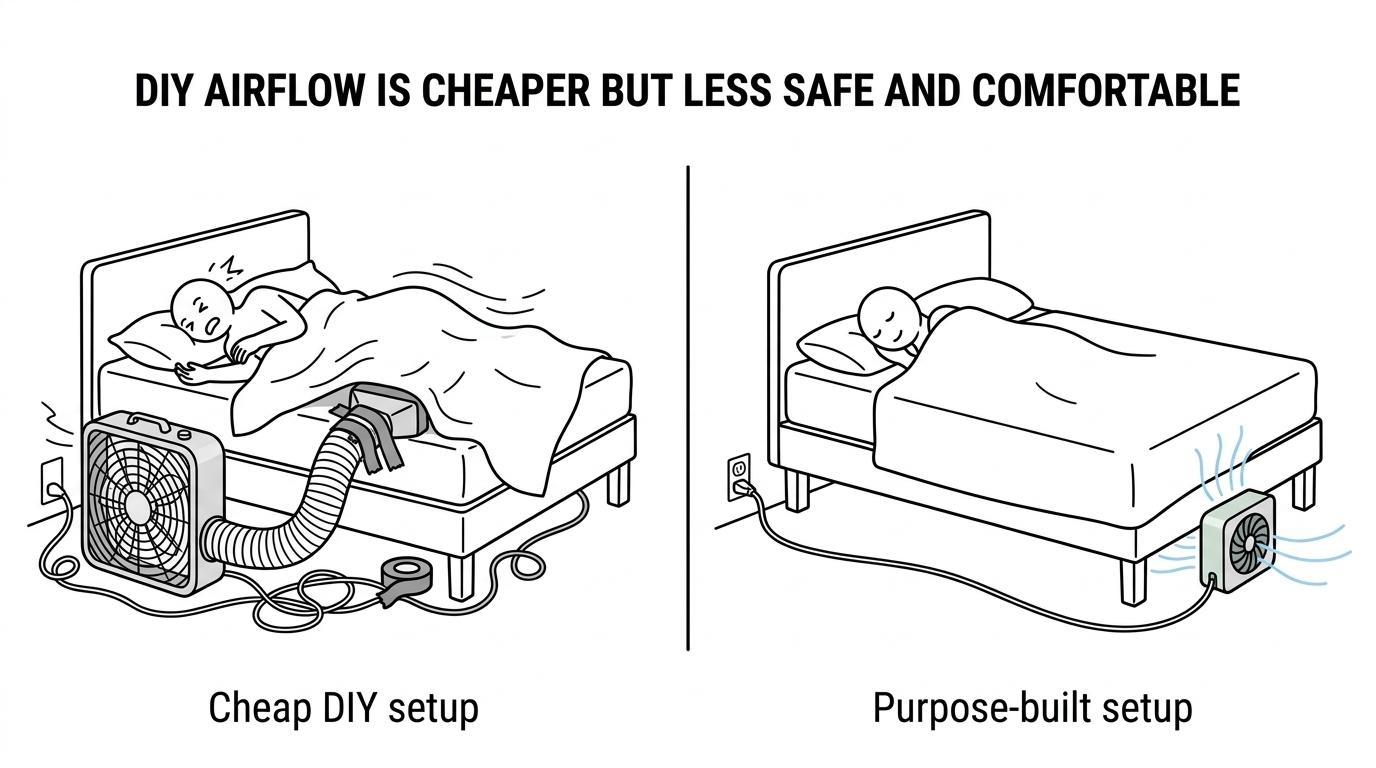
Yes, you can improvise under sheet airflow with a box fan and ducting, but it will not behave like a BedJet or bFan. Most DIY builds move room air, not refrigerated air, so results depend on bedroom temperature, sheet fabric, fan placement, and noise tolerance.
That last point matters more than most people expect. Many people assume a stronger fan means a colder bed. It does not. Airflow only helps if the room air is already cool enough to carry heat and sweat away from your skin.
Sleep experts often recommend a bedroom temperature around 60°F to 67°F for better sleep. If your room is much warmer than that, a homemade rig may feel good at first but still leave you waking up sweaty at 3 A.M. By contrast, many bed fan users find they can raise the room thermostat by about 5°F and still feel cool enough to sleep, because the airflow targets trapped heat right under the covers.
A common misconception is that these systems “make cold.” They do not. DIY fans, BedJet, and purpose built bed fans all rely on the cool air already in the room.
They usually fail because comfort is more than airflow. Temperature, humidity, sheet weave, fan noise, pressure under the blanket, and safe electrical use all matter at the same time.
Hot sleepers often start with the obvious problem, feeling overheated under the blanket. Then they solve only one piece of it. They add a fan, but the room is still 78°F. Or they lower the fan to reduce noise, but now the airflow never reaches the torso. Or they use loose knit bedding that leaks the air before it can move across the body.
If you use a bed fan, a tight weave top sheet usually works better than a loose or highly porous fabric. That is counterintuitive for some people. A very open sheet can let the air escape too quickly, while a tighter weave helps the airflow travel across your skin and carry heat away.
The five biggest risks are fire, weak cooling, excess moisture, sleep disruption, and delayed medical care. Those risks show up whether you use a box fan, inline blower, improvised hose, or a humidified cooling hack.
After the basic airflow problem, here are the most important risks to weigh:
Start with measurement, not shopping. A simple room thermometer or hygrometer tells you whether the problem is mainly heat, humidity, or trapped bedding airflow.
First, check your room temperature at bedtime and again around 3 A.M., when many hot sleepers wake up. If your room is already in the 60°F to 67°F range, the issue may be trapped microclimate heat under the sheets. If the room is in the mid 70s or higher, no DIY airflow hack will fully compensate.
Next, run your usual bedding setup for two or three nights and write down three things: room temperature, whether you woke up sweaty, and where you felt hottest, feet, torso, neck, or whole body. That pattern tells you whether airflow placement matters more than raw fan power.
Then test a low cost version before you build anything permanent. Aim a small fan toward the foot of the bed and slightly lift the top sheet to create a path for air. If that helps within ten minutes, under sheet airflow may be worth pursuing. If it does not, look harder at room temperature, mattress heat retention, and humidity.
Use a hygrometer, your windows, and your nose. If relative humidity is high or you see condensation, a DIY cooling idea that adds moisture can backfire.
First, place a hygrometer near the bed for several nights. CDC guidance says home humidity should be no higher than 50% all day to help prevent mold growth: CDC mold and health overview. If your room is already at 55% or 60%, adding moisture to “cool” the air is a bad trade.
Next, inspect windows, exterior walls, and metal bed frames first thing in the morning. If you see dampness, fogging, or wet spots, your room is already flirting with condensation. That is your warning sign, not a minor detail.
Then ask a simple if then question. If your DIY idea uses ice, water, mist, or evaporative cooling, and your room already runs humid, skip it. For many people, dry airflow under the sheets works better than wet airflow into the room.
One anonymized scenario I hear a lot goes like this: a 52 year old woman in perimenopause tried a bucket of ice in front of a fan and felt cooler for an hour, then woke up clammy with damp bedding and a stuffy room. Once she switched to dry airflow and lighter bedding, the sleep quality improved more than the “coldest” setup ever did.
A purpose built option like bFan Bed Fan is usually quieter and simpler than PVC, inline fans, or taped ducts. The difference is not magic cooling, it is safer airflow delivery under the covers with fewer cords, edges, and improvised parts.
The practical question is not whether DIY can work. It can. The real question is what you are willing to manage every night. Homemade setups often take more adjusting, make more noise, and look bulkier around the bed. A purpose built system is easier to repeat night after night, which matters when you are exhausted.
“One bFan Bed Fan testimonial says a user raised the thermostat from 72°F to 82°F and still slept better.”
There is also a comfort issue people underestimate. Gentle airflow usually helps sleep more than a blast of air. If the sensation makes you keep pulling the sheet on and off, the setup is too aggressive.
Pro tip: test with your actual top sheet, not just an exposed mattress. Under sheet airflow behaves very differently once fabric pressure is involved.
The biggest differences are price, complexity, and how the airflow or cooling is delivered. BedJet, two Bedfans, and the Eight Sleep Pod 5 all target hot sleep differently, but they do not carry the same tradeoffs.
Neither BedJet nor a bed fan cools the air itself. They both use the cool air already in the room. That means your thermostat setting still matters, even if the bed feels cooler.
“The original bFan Bed Fan dates to 2003, which means the category existed years before BedJet was even thought of.”
Here is the simplest way to compare the options:
If you share a bed, dual zone control is not a luxury. It is often the difference between one person sleeping and two people arguing over the thermostat. If one sleeper runs hot and the other feels cold, separate airflow zones solve a real problem.
Start with room temperature, dry airflow, and bedding changes. Those three moves address the root causes of trapped heat without turning your bedroom into a DIY engineering project.
First, lower the room temperature if you can. Even a few degrees matters. If your AC cost is the issue, try a fan based microclimate approach that cools the body under the covers rather than the whole house.
Second, strip the bed back to the essentials for one night. Use a lighter comforter, moisture wicking sleepwear, and a tighter weave top sheet so airflow can travel across the body instead of escaping straight up.
Third, direct airflow from the foot of the bed rather than at your face or chest. Most people tolerate that better, and it mimics how purpose built under sheet systems work. If the air feels harsh, reduce speed before you abandon the idea.
A quiet setup matters more than you think. Some hot sleepers can fall asleep with strong airflow, then wake to noise, vibration, or sheet flutter. That is where timer controls and low speed operation become useful rather than fancy.
Night sweats can be benign, but they can also signal menopause, infection, medication effects, thyroid disease, sleep apnea, or cancer treatment issues. If symptoms are new or drenching, comfort tools should sit beside medical care, not replace it.
Call your clinician sooner if the sweating is paired with fever, cough, weight loss, swollen lymph nodes, chest pain, shortness of breath, or a new medication. The same goes for people with diabetes, thyroid disease, a cancer history, or obstructive sleep apnea (OSA).
Another common blind spot is medication timing. Antidepressants, steroids, hormone therapies, and some pain medicines can all trigger nighttime overheating.
This is also where a low risk cooling tool can help while the medical workup happens. Better comfort can make the waiting period easier, but it should never delay evaluation.
All links have been checked and are currently active and accessible.
Yes, but only by moving room air. A DIY setup can help evaporate sweat and move trapped heat out from under the covers, which often feels cooler fast. What it cannot do is create cold air on its own, so results rise and fall with your room temperature, humidity, and bedding.
Usually yes, if it is only moving air and the wiring is safe. The risk jumps when people add heating elements, overloaded extension cords, or motors pressed against fabric. CPSC guidance is clear that portable heaters should stay away from bedding and should never be left on while people sleep.
Because bedtime comfort and overnight sleep quality are not the same thing. Your skin may feel cooler for a while, but if the room stays too warm, if humidity stays high, or if the airflow never reaches your core, your body can still accumulate heat and wake you later in the night.
Tighter weave sheets often work better than very open or loose fabrics. That surprises people, but it makes sense once you think about airflow path. You want the air to move across the body and carry heat away, not leak out instantly before it does any useful work.
It depends on your budget and how much trial and error you can tolerate. BedJet offers strong airflow and features, but a dual zone setup costs over one thousand dollars. That is more than twice the price of two Bedfans, while DIY is cheaper upfront but less predictable night to night.
Often yes, within limits. Local airflow can help many people feel cool enough to raise the thermostat by about 5°F and still sleep well. That said, there is a floor below which you cannot compromise. If the room is already too warm, no airflow product can fully replace proper bedroom cooling.
Call sooner if the sweating is new, drenching, or comes with fever, weight loss, cough, swollen nodes, chest symptoms, or medication changes. Night sweats are sometimes just a comfort problem, but they can also reflect infection, menopause, thyroid issues, OSA, or treatment side effects that deserve proper medical attention.
If DIY feels fiddly, loud, or unreliable, you may do better with a simpler under sheet airflow approach that targets trapped body heat directly. You can compare practical cooling options at bedfan.com, and if you manage content on the site, helpful related internal links from this page would include menopause night sweats, medication related night sweats, cancer treatment night sweats, sleeping cooler in summer, and sheet fabric guides for better airflow.
This is not medical advice. Always consult your doctor or oncology team before making changes. If your night sweats are new, severe, or medically unexplained, comfort tools should support care, not replace it.