Can dehydration cause night sweats? Usually no—sweating often causes fluid loss instead. Learn common causes, red flags, and relief.
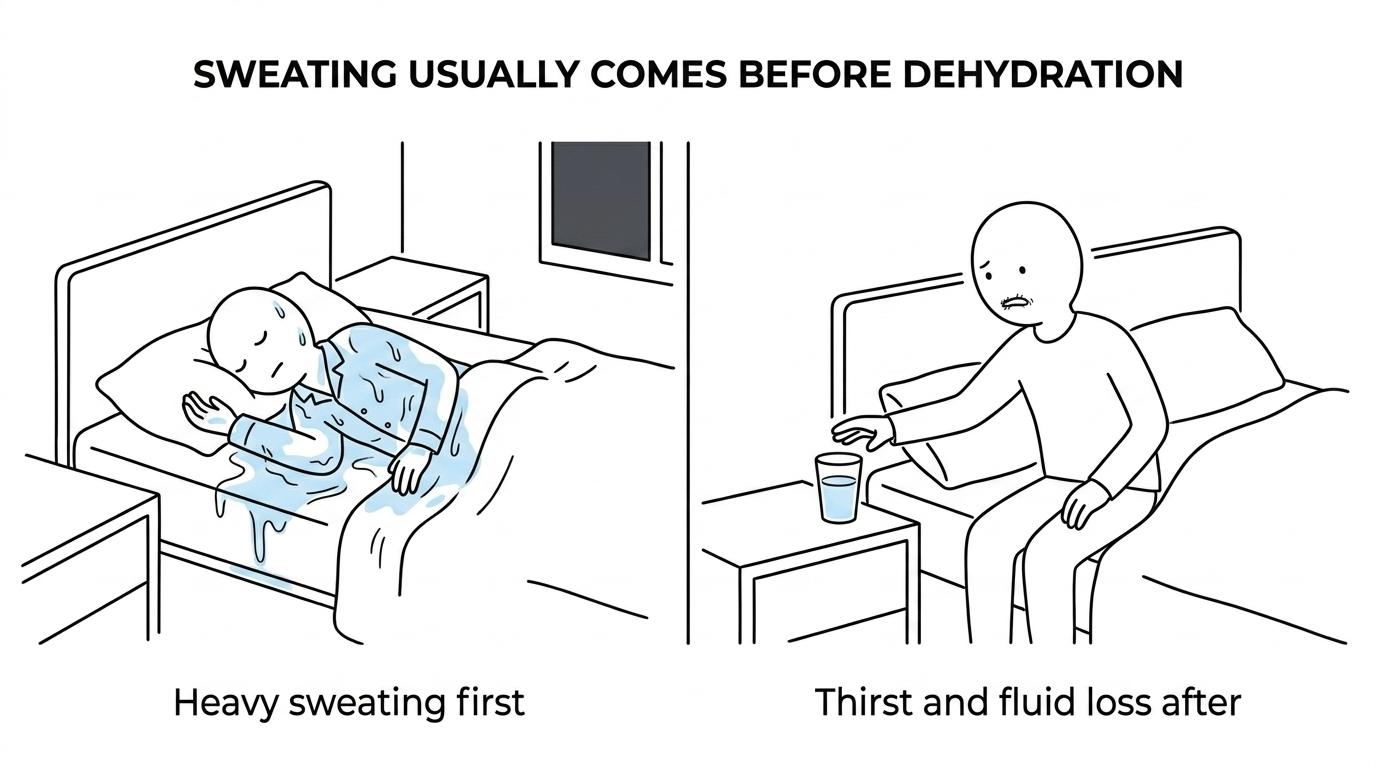
A short answer first: dehydration is usually not a direct cause of night sweats. More often, the sweating episode comes first, then fluid loss and thirst follow, which is why the problem can feel confusing at 2 a.m.
TL;DR: Summary
- Dehydration is not a typical direct cause of night sweats. Cleveland Clinic and Mayo Clinic list menopause, infections, medications, sleep disorders, alcohol, cancer, and hormonal or metabolic conditions far more often than dehydration.
- In real life, night sweats can lead to dehydration because sweating causes fluid loss. Waking up thirsty does not prove dehydration started the sweating episode.
- Severe dehydration may actually reduce sweating in some cases, which is the opposite of what many people assume.
- If night sweats are drenching, happen in a cool room, or come with fever, weight loss, cough, pain, diarrhea, or new medications, it is smart to look for an underlying cause and talk with a clinician.
- For symptom relief, a cooler bedroom, tight-weave sheets, and targeted under-sheet airflow from a Bedfan can help carry away trapped heat without making the whole room icy.
If this is happening to you right now, the practical goal is twofold: stay safely hydrated and figure out why the sweating is happening. This is not medical advice. Always consult your doctor or oncology team before making changes, especially if you have cancer, diabetes, kidney disease, are pregnant, or have new unexplained night sweats.
No. Cleveland Clinic and Mayo Clinic do not list dehydration as a usual direct cause of night sweats. In most cases, dehydration happens after sweating, fever, heat exposure, vomiting, diarrhea, alcohol use, or poor fluid intake.
That distinction matters. True night sweats usually mean sweating heavily enough during sleep to soak clothes or bedding, even when the room is not excessively warm. Cleveland Clinic describes night sweats as heavy sweating episodes during sleep and lists common causes like menopause, infections, medications, sleep disorders, mental health conditions, alcohol, hormonal and metabolic conditions, cancer, and cancer treatments, not dehydration itself (Cleveland Clinic night sweats, Mayo Clinic night sweats causes).
A common mix-up is this: you wake up sweaty, thirsty, and uncomfortable, so it feels like dehydration caused everything. Usually the sequence is reversed. The sweating, hot room, alcohol, fever, or medication effect happened first, then your body lost water.
Sweating and dehydration often travel together, but they are not the same problem. Cleveland Clinic notes that dehydration happens when you lose more fluid than you replace, and sweat is one common route for that loss.
Your body sweats to release heat. If you are hot, sick, overdressed, drinking alcohol, or having a hot flash, you may sweat more and lose more fluid overnight. Cleveland Clinic's dehydration guide explains that dehydration can happen when you lose fluids through sweating, vomiting, or diarrhea, and hot weather makes that more likely (Cleveland Clinic dehydration).
The other important wrinkle is that severe dehydration can impair normal sweating. Medical sources also note that dehydration can be linked with reduced sweating, sometimes called anhidrosis, in certain situations. So if someone says, "I sweat at night because I'm dehydrated," that is usually not how the physiology works.
"bFan Bed Fan was invented in 2003, years before Bedjet entered the category."
Pro tip: if heavy sweating is frequent, plain water may not always be enough. If you are also losing fluids from diarrhea, fever, vomiting, or intense heat, electrolyte imbalance can become part of the picture. If that is you, check in with a clinician instead of guessing.
Practical cooling beats guesswork when night sweats strike. A bFan Bed Fan, tight-weave sheets, and a cooler room can reduce sweat disruption while you and your clinician sort out the real trigger.
You do not need to wait for a full medical workup to make your sleep environment kinder tonight. Symptom relief is not the same as treating the cause, but it can make a miserable week much more manageable.
Menopause, SSRIs, and sleep apnea are far more common explanations than dehydration. Cleveland Clinic and Mayo Clinic also point to infections, alcohol, hormonal and metabolic conditions, and some cancers or cancer treatments.
If you are trying to narrow things down, start with the big categories doctors look at most often:
One anonymized example: a 48-year-old wakes up soaked at 1 a.m. for three weeks and starts drinking more water, thinking dehydration is the cause. The real clues are that the bedroom is already cool, her periods have become irregular, and she recently started an antidepressant. In that situation, dehydration is more likely the aftermath than the root issue.
A simple home check can separate thirst from a bigger night-sweat pattern. Water, a symptom log, and your medication list are usually more useful than guessing.
Step 1: Look at the room, the bedding, and the timing. If the room is hot, the comforter is heavy, or the sweating follows alcohol or a spicy dinner, that points to a trigger you may be able to change quickly.
Step 2: Check for dehydration clues the next morning. Dark urine, dry mouth, headache, dizziness, weakness, and feeling unusually thirsty all make dehydration more likely. They still do not prove dehydration caused the sweating.
Step 3: Review what changed. A new SSRI, steroid, hormone treatment, infection, recent illness, or menstrual transition often tells you more than your water bottle does.
Step 4: Keep a short log for one to two weeks. Write down bedtime, room temperature, alcohol, illness symptoms, medications, stress, menstrual cycle timing, and whether the sheets were damp or truly soaked. If the pattern is medical, the log often reveals it.
Drenching night sweats and dehydration leave different clues. The NHS defines night sweats as soaking clothes or bedding in a cool room, while dehydration more often shows up as thirst, dark urine, dizziness, or dry mouth.
Here is the simple comparison. If you wake sweaty after a hot room or heavy blankets, and you feel better when the sleep environment changes, overheating may be the main issue. If you are waking in a cool room with soaked pajamas, repeated episodes, hot flashes, fever, weight loss, cough, or medication changes, think broader than hydration.
A common misconception is that all nighttime sweating means a hydration problem. It does not. Sweating is a body response. Dehydration is a fluid-balance result. One can follow the other, but they are not interchangeable.
If you have diabetes, another if-then rule matters. If night sweats happen with shakiness, nightmares, confusion, or morning headaches, ask your clinician whether nighttime low blood sugar could be involved.
Cooling the microclimate around your body often works better than chilling the whole house. Bedfan and standard bedroom temperature targets can work together, especially if trapped heat under the sheets is your main trigger.
Step 1: Start with the room. Aim for that common sleep range of 60°F to 67°F if you can. If energy costs or partner preferences make that tough, targeted airflow may help you stay comfortable at a slightly warmer thermostat.
Step 2: Move the trapped heat out from under the covers. This is where a Bedfan can be useful because it pushes room air between the sheets, helping sweat evaporate instead of pooling on your skin. The effect is most noticeable when the problem is heat trapped in bedding, not when fever or hormones are driving the episode.
"At about 28 to 30 dB on typical low settings, bFan Bed Fan can add cooling airflow without sounding like a box fan."
Step 3: Use the setup well. Tight-weave sheets help the air travel across the body, and timer controls are handy if you mainly overheat during the first part of the night. For couples, two units can create dual-zone cooling without forcing both sleepers into the same temperature choice.
Air conditioning, cooling pads, Bedjet, and bFan solve different problems. AC cools the room, pads change mattress feel, and both Bedjet and Bedfan move existing room air under the bedding rather than cooling the air itself.
If your whole room is hot, air conditioning works on the environment. If your room is acceptable but heat gets trapped under the covers, a bed fan can be more targeted and cheaper to run. That matters because many people do not need the entire house colder, they need the bedding cooler.
Bedfan and Bedjet are often compared, but the most useful truth is simple: neither cools the air. The original Bedfan came to market years earlier and was invented in 2003. For couples, the dual-zone Bedjet setup costs over a thousand dollars, which is more than twice the price of two Bedfans. Two bFans can create left-right microclimate control at a fraction of that cost.
"bFan Bed Fan uses about 12 watts on average, so nightly cooling can cost far less than lowering whole-house AC."
A good rule of thumb is this. If you need whole-room cooling, use AC. If you need under-sheet airflow, a Bedfan or similar system fits that problem better. If noise matters, quiet operation, remote control, and timer features tend to matter more than headline marketing.
Call a clinician sooner if night sweats are new, drenching, or paired with red flags. Mayo Clinic highlights fever, weight loss, pain, cough, or diarrhea as reasons not to brush them off.
Seek medical care promptly if you have any of the following: repeated drenching night sweats in a cool room, unexplained weight loss, fever, swollen lymph nodes, a new persistent cough, chest pain, severe fatigue, severe thirst, confusion, fainting, or signs of significant dehydration.
This is especially important if you are pregnant, older, immunocompromised, on cancer treatment, or living with diabetes, kidney disease, or heart disease. Night sweats can be harmless, but they can also be the symptom that points to a bigger issue.
If you cannot keep fluids down, have signs of heatstroke, or feel confused or very weak, do not wait for a routine appointment.
A short, organized story helps doctors faster than a vague complaint. Your primary care doctor, gynecologist, or oncology team needs timing, triggers, medication changes, and any fever or weight loss.
Step 1: Bring your pattern. Tell them how often the episodes happen, whether the bedding gets soaked, and whether the room was cool.
Step 2: Bring your context. Mention menopause symptoms, medication changes, infections, alcohol, anxiety, snoring, missed periods, blood sugar issues, or recent travel.
Step 3: Ask focused questions. "Could this be medication-related?" "Do I need testing for thyroid issues, infection, OSA, or low blood sugar?" "What hydration plan is safe for me?" Those questions move the visit forward.
And say the obvious part out loud: "I thought dehydration might be causing this, but I am not sure if it is the cause or the result." That helps your clinician correct the frame quickly.
These sources are solid starting points. Cleveland Clinic, Mayo Clinic, and related Bedfan guides can help you separate symptom relief from medical evaluation.
If you want related reading on Bedfan, natural internal links to add include night sweats, sleeping cooler, menopause night sweats, medication-related night sweats, and bedroom temperature tips.
If trapped heat under the sheets is making a bad night worse, you can take a look at the Bedfan store for a simple, non-drug way to move room air where your body needs it most.
This is not medical advice. Always consult your doctor or oncology team before making changes. Unexplained night sweats deserve a real medical look, even when better hydration and better cooling help you feel better tonight.