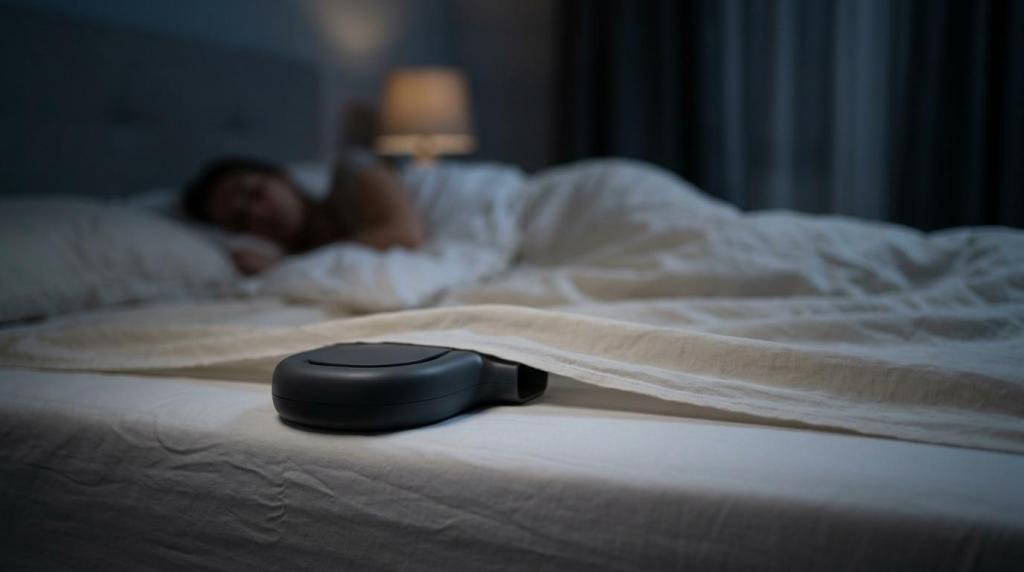
Find the best under blanket AC options for hot sleepers, from bed fans to cooling pads, to reduce trapped heat and sleep cooler all night.
If you’re searching for an under blanket AC, the honest answer is that most good options are not tiny air conditioners at all. The most practical choices for hot sleepers cool the bed microclimate cooling with airflow or a temperature-regulated sleep surface, so trapped heat can escape without freezing the whole bedroom.
TL;DR: Summary
- The best under blanket AC option for most hot sleepers is a bed-level cooling system, especially a bed fan like the bFan Bed Fan, because it targets heat trapped under the covers instead of trying to cool the whole room.
- True “under blanket AC” products are rare. Most real-world options use room air or water-based temperature control, and neither Bedfan nor Bedjet actually cools the air itself.
- Research supports the idea: higher ambient temperature is linked to shorter sleep, and local body cooling has improved sleep efficiency and thermal comfort in controlled studies.
- If you sleep hot from menopause, medication side effects, or night sweats, start by matching the tool to the problem: airflow helps evaporation and clammy skin, while mattress systems help people who want precise surface temperature control.
- Sleep experts commonly aim for a bedroom around 60°F to 67°F. With a Bedfan, many people can often raise the room temperature by about 5°F and still feel cool enough to sleep better.
- This is not medical advice. Always consult your doctor or oncology team before making changes if night sweats are new, severe, drenching, or linked to cancer treatment, infection, or unexplained weight loss.
That distinction matters more than the search term. For many people, the problem is not the room alone. It’s the warm, humid pocket of air under the sheets that builds up around the body at 2 a.m.
Under blanket AC usually means bed microclimate cooling, not a literal mini air conditioner. Products like the bFan Bed Fan and Bedjet move room air under the covers, while systems from Chilipad or Eight Sleep cool the mattress surface itself.
Most hot sleepers picture refrigerated air blowing under the comforter. That’s not how the category works. A bed fan uses the cool air already in the room and pushes it between your top and bottom sheets so body heat and sweat can dissipate. A water-based pad or cover changes the temperature of the sleep surface instead. Both approaches can help, but they solve slightly different problems.
A common misconception is that stronger airflow always means colder sleep. In practice, the best setup often starts with a reasonably cool room, usually around 60°F to 67°F, then uses bed-level cooling to keep heat from getting trapped under the blanket. With a Bedfan, many people can raise the room temperature by about 5°F and still feel cool enough for better sleep, which may reduce overnight air conditioning (AC) use.
"The original Bedfan was invented in 2003, years before Bedjet entered this category."
Yes. Local cooling and lower ambient temperature are both linked to better sleep, and PubMed studies support that connection.
A large 2025 analysis published on PubMed looked at 317,758 sleep tracker users across about 165 million nights. Higher ambient temperatures were associated with measurable sleep loss and more short sleep. That matters because a hot bed can keep your core temperature from dropping the way it normally should at night.
Local cooling matters too. In a randomized controlled trial in a hot 32°C sleep environment, cooling the back increased mean sleep efficiency from 84.6% without cooling to 95.3% with back cooling, according to this PubMed study. Another home study using a temperature-controlled mattress cover found more deep sleep and more rapid eye movement (REM) sleep when the bed surface was kept cooler during the first half of the night, as shown in this PubMed paper.
So yes, the concept is real. The trick is choosing the kind of cooling that matches what’s waking you up: heat trapped under bedding, sweat and humidity, or a mattress surface that feels too warm.
The best options are bed fans, water-based mattress systems, and smart cooling covers. Your best pick depends on whether you need airflow, surface cooling, dual-zone control, or a lower-cost fix.
For most people, these are the six most practical ways to get “under blanket AC” at night without relying only on whole-room cooling.
bFan Bed Fan: A simple under-sheet airflow system that pushes room air between the sheets to remove trapped heat and help sweat evaporate. It is especially practical for hot sleepers, menopause, medication-related overheating, and people who want low energy use and a discreet setup.
Two bFan units for dual-zone cooling: Couples often need different temperatures. Two bed fans can create dual-zone microclimate control at a fraction of the over-one-thousand-dollar cost of a dual-zone Bedjet setup.
Bedjet: Another air-based bed cooling system. It also uses room air rather than cooling the air itself, and it may appeal to users who want a feature-heavy system, though cost is a real trade-off.
Water-based mattress pads like Chilipad Dock Pro: These change mattress surface temperature more precisely than airflow systems. They can work well for people who want a controlled sleep surface, but they cost more and involve more hardware and maintenance.
Smart mattress covers like Eight Sleep Pod: These combine temperature control with sleep tracking features. They can be effective, but they are usually the highest-cost path and may be more technology than some sleepers want in the bedroom.
A lower-tech combo: Breathable sheets, a lighter duvet, moisture-wicking sleepwear, and a ceiling or room fan. This is cheaper, but it usually cannot target the trapped heat under blankets as directly as a bed fan can.
Choose based on the type of heat you feel, not the marketing label. A bFan, a Chilipad, and a Bedjet can all help, but for different reasons.
Step 1: Figure out whether you feel hot, sweaty, or both. If your skin feels clammy and the sheets get damp, airflow is often the better first move because evaporation is part of the fix. If the mattress itself feels warm and you want a set temperature, a water-based pad may fit better.
Step 2: Match the tool to your sleep setup. If you share a bed with a partner who runs cold, dual-zone matters. If you want something discreet at the foot of the bed, a bed fan is simpler than tubing and a control hub. If noise is a big issue, look at actual sound levels rather than brand claims.
Step 3: Compare cost, upkeep, and energy use before you buy. More expensive does not always mean more sleep. A quiet bed fan with remote or timer controls can solve the core problem for many people without adding much to your electric bill.
"At low speed, the bFan runs at about 28 dB and can be adjusted by remote from 5% to 100%."
A bed fan is better for trapped heat and sweaty skin. A cooling mattress pad is better for people who want a more exact sleep-surface temperature.
This is one of the most useful comparisons in the category. Airflow systems cool by moving air through the bed and helping moisture evaporate. Water-based systems cool by changing the temperature of the pad or cover under you. If your top complaint is, “I wake up drenched,” airflow often feels more natural because it addresses humidity and heat buildup together.
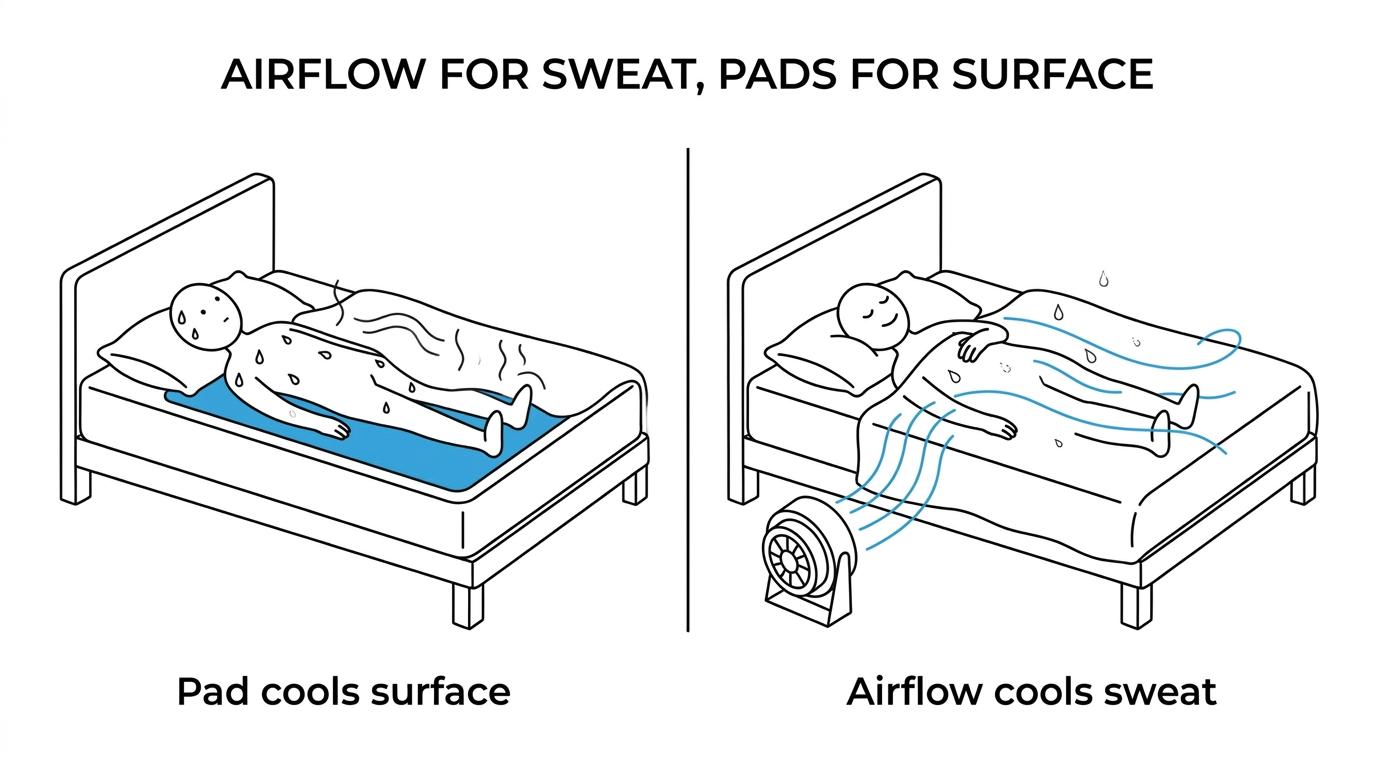
The trade-off is precision. Mattress systems can give you more direct temperature control. The downside is cost, maintenance, and more parts that can fail over time. If you want something simpler, a bed fan is usually easier to set up, easier to clean around, and less expensive.
A pro tip many people miss: if you use a bed fan, Tight-weave cotton or similar sheets usually work better than very loose or fuzzy fabrics because they let the airflow travel across the body and carry heat away more effectively.
Good setup matters. A bFan or Bed Fan works best when the air can move under the sheets and escape naturally, not get blocked by heavy bedding.
Place the unit at the foot of the bed and angle the airflow into the space between your fitted sheet and top sheet or blanket setup, based on the product design. You want airflow across the body, not just at your feet.
Use bedding that cooperates. Tight-weave cotton or similar sheets often work better than thick plush layers because the moving air can spread more evenly. If your comforter is very heavy, try a lighter top layer for a few nights and see if wake-ups drop.
Start with a moderate room temperature and let the bed cooling do the targeting. Many sleep experts use 60°F to 67°F as a bedtime range, but plenty of users find they can set the thermostat about 5°F warmer with a Bedfan and still sleep comfortably. Timer controls can help if you only need stronger cooling during sleep onset or in the early morning.
A realistic example: one woman in her early 50s described waking around 3 a.m. soaked during perimenopause, even when the bedroom was cold enough to bother her spouse. Switching to under-sheet airflow helped her cool her side of the bed without turning the whole room into a refrigerator, which is exactly where dual-zone thinking starts to make sense.
For most value-focused hot sleepers, Bedfan makes more sense. Bedjet may still be worth a look, but the price jump is hard to justify if your main goal is simply cooling the bed microclimate.
The most important similarity is this: neither Bedfan nor Bedjet cools the air. Both use the cool air already in the room. So if someone is shopping for a true refrigerated under blanket AC, neither product is that. What they do well is move that room air where it matters most, under the covers.
The real differences are simplicity, price, and how you want to cool as a couple. The original Bedfan came to market years earlier and stays focused on straightforward under-sheet airflow. The Bedfan also offers timer controls, which some people use to cool the bed hardest during the first few hours of sleep. Bedjet can be a fit for feature shoppers, but a dual-zone Bedjet setup costs over a thousand dollars and is more than twice the price of two Bedfans.
"A dual-zone Bedjet setup costs over a thousand dollars, more than twice the price of two Bedfans."
If your budget is tight and you mainly want relief from overheating or night sweats, Bedfan is usually the cleaner answer. If you want a premium control system and the higher cost does not bother you, Bedjet may still be worth a look. Just do not confuse either one with actual air conditioning.
Start with pattern-tracking, bedding changes, and a conversation with your clinician. Hot sleep from menopause, antidepressants, steroids, or cancer therapy is common, but it should not be ignored.
Step 1: Keep a simple one-week log. Note bedtime, wake time, alcohol, spicy food, room temperature, sweats, and any medication timing. If your night sweats began soon after starting a selective serotonin reuptake inhibitor (SSRI), prednisone, tamoxifen, or another new drug, that timing matters.
Step 2: Lower the heat load around your body. Use lighter bedding, breathable sleepwear, and bed-level airflow. A bed fan is a non-drug option that targets the root comfort issue by moving air under the sheets so sweat can evaporate instead of staying trapped against the skin.
Step 3: Ask whether the cause needs workup or treatment adjustment. If you are on cancer therapy, have diabetes, thyroid disease, or infection symptoms, do not self-diagnose. This is not medical advice. Always consult your doctor or oncology team before making changes.
You should get medical advice when night sweats are new, drenching, or tied to other symptoms. Mayo Clinic and Cancer.gov both treat persistent night sweats as something worth evaluating in context.
Call a clinician sooner if you have fever, unexplained weight loss, swollen lymph nodes, chest pain, persistent cough, low blood sugar episodes, or new severe sweating after starting a medication. Night sweats can happen with menopause and common drugs, but they can also show up with infection, hyperthyroidism, obstructive sleep apnea (OSA), reflux, and some cancers. Mayo Clinic has a clear overview here: Night sweats Causes.
If you are in cancer treatment or survivorship, bring it up directly. Cancer-related hormone therapy and supportive medications can trigger major nighttime overheating, and symptom control matters. The National Cancer Institute also offers supportive care guidance through Cancer.gov. A fan, lighter bedding, and cooler sleep conditions may help comfort, but they are not a substitute for medical evaluation.
PubMed: Ambient temperature and sleep duration study
A very large 2025 dataset linking higher ambient temperatures with shorter sleep and more short sleep across about 165 million nights.
PubMed: Local body cooling and sleep quality trial
A controlled study showing that local cooling improved thermal comfort and raised sleep efficiency in a hot sleep environment.
Mayo Clinic: Night sweats causes
A practical clinical overview of common and serious causes of night sweats, plus when to seek care.
For related reading on bedfan.com, useful internal links to add around this topic include https://www.bedfan.com/night-sweats/, https://www.bedfan.com/night-sweats/bfan-under-duvet-fan-for-hot-sleepers, https://www.bedfan.com/bfan-bedfan-testimonials, https://www.bedfan.com/sleeping-cooler/, and nearby menopause or medication-related night-sweats pages within the same /night-sweats/ section.
If you want a simple, non-drug way to cool the space under your sheets instead of running the whole bedroom colder all night, the bFan Bed Fan is worth a look. This is not medical advice. Always consult your doctor or oncology team before making changes, especially if night sweats are new, severe, drenching, or connected to cancer treatment, infection, or unexplained weight loss.



