A bed air conditioner cools the sleeper, not the whole house, helping reduce night sweats, improve comfort, and lower AC costs.
If you’re searching for a bed air conditioner, what you usually want is not colder room air. You want less trapped heat under the sheets, less sweating, and a way to sleep without cranking the whole-house AC all night. That is the lane where the bFan Bed Fan fits, because it is a bed-cooling system that moves room air through the bedding to cool the sleeper directly.
TL;DR: Summary
A lot of people use the phrase bed air conditioner for any product that makes the bed feel cooler. That can be helpful shorthand, but it also causes confusion, because most of these products do not refrigerate air the way a window AC or central system does. This is not medical advice. Always consult your doctor or oncology team before making changes, especially if night sweats are new, intense, or tied to a medical condition or medication.
A bed air conditioner is usually a bed-cooling device, not a true air conditioner. Products in this category use room air and direct it to the sleeper, while central AC and window units use refrigeration to cool the air itself.
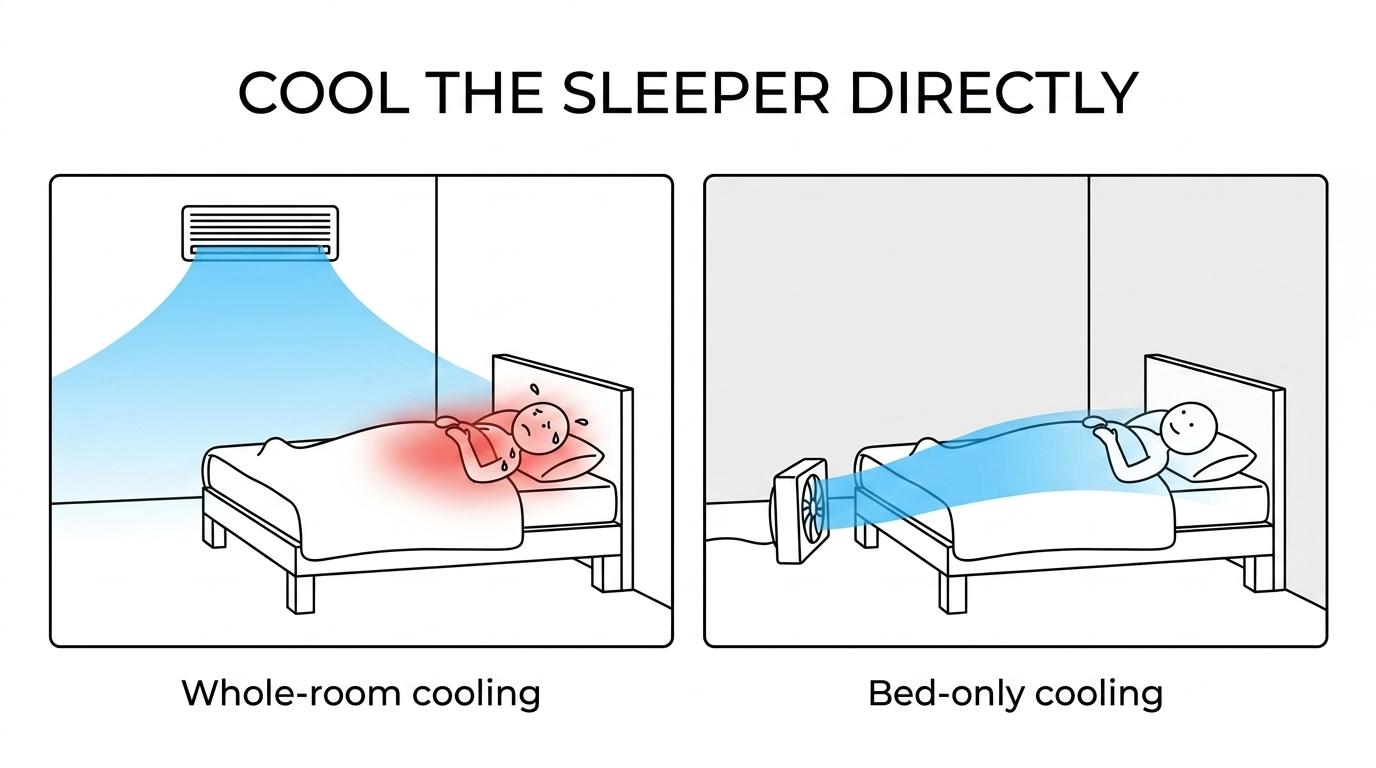
That distinction matters. A true AC unit lowers the temperature of the room. A bed cooling system changes the microclimate around your body, especially under the sheets where heat and moisture get trapped. Common misconception: many shoppers assume these systems make air cold on their own. They do not. They only use the cool air already in the room.
That sounds like a small difference, but for sleep it can be a big one. Your body cares about heat loss at the skin level. If heat is trapped by blankets, foam, or still air, you can feel overheated even in a bedroom that looks cool on the thermostat.
Targeted bed cooling can cut AC use because it cools the sleeper directly instead of cooling the entire house overnight. With bFan, the idea is simple: enhance ventilation by moving air under the covers so trapped heat can escape and sweat can evaporate faster.
The energy logic is straightforward. Central air cools ceilings, hallways, and empty rooms. Bed-based cooling focuses on the place where you actually need relief for seven or eight hours. Sleep experts and public health sources consistently point people toward a cool sleeping environment. The National Heart, Lung, and Blood Institute says people usually sleep better when the bedroom is kept on the cool side, and many sleep experts use the 60°F to 67°F range as a practical target for better rest (NHLBI healthy sleep guide).
"bFan Bed Fan addresses the heat trapped in bedding, which is why many sleepers can raise the room temperature by about 5°F and still feel cooler at night."
If you can keep the room a few degrees warmer and still feel comfortable in bed, your AC has less work to do. Pro tip: that savings is most realistic when the rest of your household can tolerate the higher setting too, or when you mostly need cooler sleep rather than cooler daytime living.
In many homes, a portable air conditioner wins on efficiency, comfort, and practicality, especially when it comes with a comprehensive warranty. It solves the sleeper’s problem at the bed level rather than using your HVAC system as a blunt instrument.
After years of hearing the same complaints from hot sleepers, these are the five reasons that come up again and again:
The trade-off is that bed cooling is local, meaning its cooling power is directed specifically at the sleeper rather than the entire room. If your room is truly hot and stuffy, you may still need AC in the space. Think of it as a focused tool, not magic.
Setup matters more than people think. The right sheet choice, fan position, and thermostat setting often decide whether a bed air conditioner feels subtle and effective or disappointing.
Step 1: Start with the bedding. A tighter-weave top sheet often helps the airflow travel across your body instead of escaping straight up. That sounds backward to some people, but looser fabric can let the air leak out before it moves heat away from your skin.
Step 2: Use lighter layers for a few nights. If you keep a heavy comforter, mattress topper, and flannel sheets all in the mix, you may smother the airflow. Strip the setup down first, then add layers back one at a time.
Step 3: Begin on a medium setting, not maximum. Too much airflow can feel drafty before your body adjusts. Give it three nights before you judge the result.
If you sweat mostly on the chest, back, or legs, make sure the sheet tents slightly rather than lying tightly against the body. That little air channel can make a larger difference than people expect.
The best approach is to use the thermostat and the bed cooler together. Start with the room cool enough to supply comfortable air, then let the bed system handle the heat trapped under the covers.
Step 1: Use the normal sleep target as a baseline. Many experts suggest 60°F to 67°F for the bedroom. If that already feels too expensive or too cold for a partner, do not force it.
Step 2: Raise the thermostat gradually. Try moving it up 2°F for three nights, then another 2°F if you still feel comfortable. Many sleepers can end up about 5°F warmer in the room while still sleeping cooler in bed.
Step 3: Use timing wisely. If your system has timer controls, set the strongest cooling for sleep onset and the first half of the night, when many people notice the most heat buildup.
Common misconception: lower is not always better. A frigid bedroom can dry the air, bother your partner, and still fail to solve trapped body heat if the problem is inside the bedding.
A bed air conditioner cools the sleeper more directly, providing targeted cooling power, while central AC cools the room more completely. The better choice depends on whether your problem is body heat in bed or a genuinely overheated bedroom with poor ventilation.
If your room stays within a reasonable range but you overheat once you’re under blankets, bed cooling is often the smarter first move. It targets thermal comfort where sleep happens. If your room stays hot all evening and the air itself feels stagnant, a portable air conditioner still matters.
Research supports this body-first idea. In a small controlled study of 16 adults sleeping in a 32°C room, local cooling to larger body areas improved comfort and sleep quality. Mean sleep efficiency rose from 84.6% without cooling to 95.3% with back and head cooling, according to this PubMed-indexed study. That does not mean every sleeper gets the same result, but it does show why local cooling can matter even when the whole room is warm.
A practical rule is simple. If you lie down and feel fine for ten minutes but wake up sweaty later, target the bed. If you feel hot the second you walk into the room, start with the room.
For most budget-conscious couples, bFan is the more practical buy if the goal is dual-zone bed cooling without spending over a thousand dollars. Bedjet offers a different form factor, but neither system cools the air itself. Both only use the cool air already in the room.
Price is where the comparison gets very real. A dual-zone Bedjet setup costs over a thousand dollars, which is more than twice the price of two Bedfans. If each partner wants separate control, two under-sheet fans can create dual-zone microclimate control at a fraction of that cost.
The second difference is category history. The original Bedfan was invented in 2003, several years before Bedjet was even thought of. The basic idea has always been the same: remove trapped body heat from the bed environment rather than refrigerating the whole room.
"bFan Bed Fan has been in this category since 2003, and two units can create dual-zone cooling at far less than the over-$1,000 cost of a dual-zone Bedjet setup."
There are trade-offs. Some people prefer one style of airflow over another, while others prioritize a comprehensive warranty for peace of mind. Some want app-like controls, while others just want quiet, reliable cooling with a remote and timer. If low noise matters, a system that runs around 28 dB at low speed and about 30 dB in normal operation can be easier to live with than people expect.
Night sweats can be environmental, hormonal, medication-related, or medical. If they are new, drenching, paired with fever or weight loss, or happening during cancer treatment, call your doctor.
This is the section where I want to be especially plain: a bed air conditioner can help with comfort, but it does not diagnose the cause of night sweats. Menopause, infection, thyroid problems, obstructive sleep apnea, low blood sugar, medication side effects, and some cancers can all play a role. Mayo Clinic advises medical evaluation when night sweats are recurrent, severe, or linked with other concerning symptoms (Mayo Clinic night sweats overview).
If you are on SSRIs, steroids, tamoxifen, hormone therapy, or diabetes medication, then tracking the timing of sweating episodes is useful. If symptoms appeared soon after a medication change, tell your prescriber. If you are in cancer treatment or survivorship care, bring it up early rather than trying to power through.
One anonymized example: a woman in her early 50s thought her sweating was late-evening wine. After a week of tracking symptoms, she noticed the worst episodes followed late-evening wine and happened even on cooler nights. Her clinician helped her sort out perimenopause triggers and sleep habits, while the cooling power of bed cooling made nights far more manageable in the meantime.
A one-week experiment is the fastest way to see whether bed cooling, thermostat changes, or bedding changes are doing the heavy lifting. Keep it simple so you can actually spot a pattern.
Step 1: Track four things each morning. Write down room temperature, how many times you woke up, whether your clothes or sheets were damp, and how rested you feel on a 1 to 10 scale.
Step 2: Change one variable at a time. Nights 1 and 2 keep your usual setup. Nights 3 and 4 add bed cooling. Nights 5 and 6 raise the thermostat by 2°F. Night 7 test a tighter-weave top sheet or lighter blanket.
Step 3: Look for the real win. If wake-ups drop and dampness improves, that matters more than chasing a perfect number on the thermostat.
Pro tip: do not test during a week when you are sick, traveling, or drinking more alcohol than usual. Those variables can muddy the picture fast.
The research is modest but consistent on one key point: local cooling can improve thermal comfort, and that can support better sleep in hot conditions. Thermal comfort and sleep efficiency are closely connected.
The PubMed study above is useful because it tested actual sleep in a hot room, not just comfort while awake. Cooling the back and head gave the strongest improvement, which fits what many hot sleepers report in the real world. When the skin can release heat more effectively, the brain gets fewer "something is off" signals during the night.
That does not mean every cooling gadget works the same way. The method matters. Airflow, skin exposure, sheet behavior, humidity, and body position all affect results. If your issue is mainly trapped heat under the covers, then under-sheet airflow makes sense. If your issue is neuropathy, fever, or medication-related sweating, then cooling may help comfort while the medical cause still needs attention.
If you want to go deeper, these sources are worth your time because they connect sleep temperature, night sweats, and practical cooling decisions.
If you’re updating this page on bedfan.com, good internal links to add would be:
If you want a simple, quiet, low-energy way to cool the bed instead of dropping the whole-house thermostat, take a look at the store and see whether under-sheet airflow fits your setup. This is not medical advice. Always consult your doctor or oncology team before making changes, especially if night sweats are persistent, worsening, or tied to medications, menopause, infection, thyroid disease, or cancer treatment.