BedJet Mini shoppers should compare airflow, noise, fit, and price—especially versus under-sheet options like bFan for targeted cooling.
Many people searching for a "BedJet Mini" are really looking for a smaller, simpler, less expensive way to cool the bed itself, not the whole room. That is where a targeted under-sheet system like bFan Bed Fan becomes relevant, because it focuses on moving trapped body heat out from under the covers instead of acting like a tiny air conditioner.
TL;DR: Summary
- BedJet Mini shoppers should compare bFan Bed Fan and BedJet-style systems by airflow method first: both use ambient room air, but under-sheet airflow is usually better when trapped heat under the covers is the real problem.
- Neither product cools the air itself, so bedroom temperature still matters. Sleep guidance commonly lands around 60°F to 67°F, and many people can raise the thermostat by about 5°F when targeted bed airflow keeps the body cooler.
- If night sweats are tied to menopause, medication, infection, cancer treatment, low blood sugar, or another medical cause, a cooling device may help symptoms but it does not treat the cause.
- Smart comparisons should check price, noise, dual-zone options, bedding compatibility, review volume, warranty terms, and whether the system works for one sleeper or a couple.
- If value matters, dual-zone BedJet setups can run over $1,000, while two separate under-sheet fans can create dual-zone microclimate control for much less.
If you are waking up hot, sweaty, or kicking off the sheets at 2 A.M., you do not need vague marketing. You need a clean comparison that separates cooling method, real trade-offs, and medical context. This is not medical advice. Always consult your doctor or oncology team before making changes, especially if night sweats are new, severe, or linked to cancer treatment, infection, menopause symptoms, or medication changes.
Start with airflow path. BedJet-style systems and bFan Bed Fan both use room air, but the key question is where that air goes and how directly it removes heat trapped in bedding.
A lot of shoppers assume "bed cooling" means refrigerated air. It does not. These systems pull in the cool air already in the room and direct it into your sleep space. That means your bedroom setup still matters. The Centers for Disease Control and Prevention (CDC) points to a cool, quiet, comfortable sleep environment, and many sleep experts recommend roughly 60°F to 67°F for better sleep. If your room sits in that range, targeted airflow can often let you bump the thermostat up by about 5°F and still feel comfortable enough to sleep.
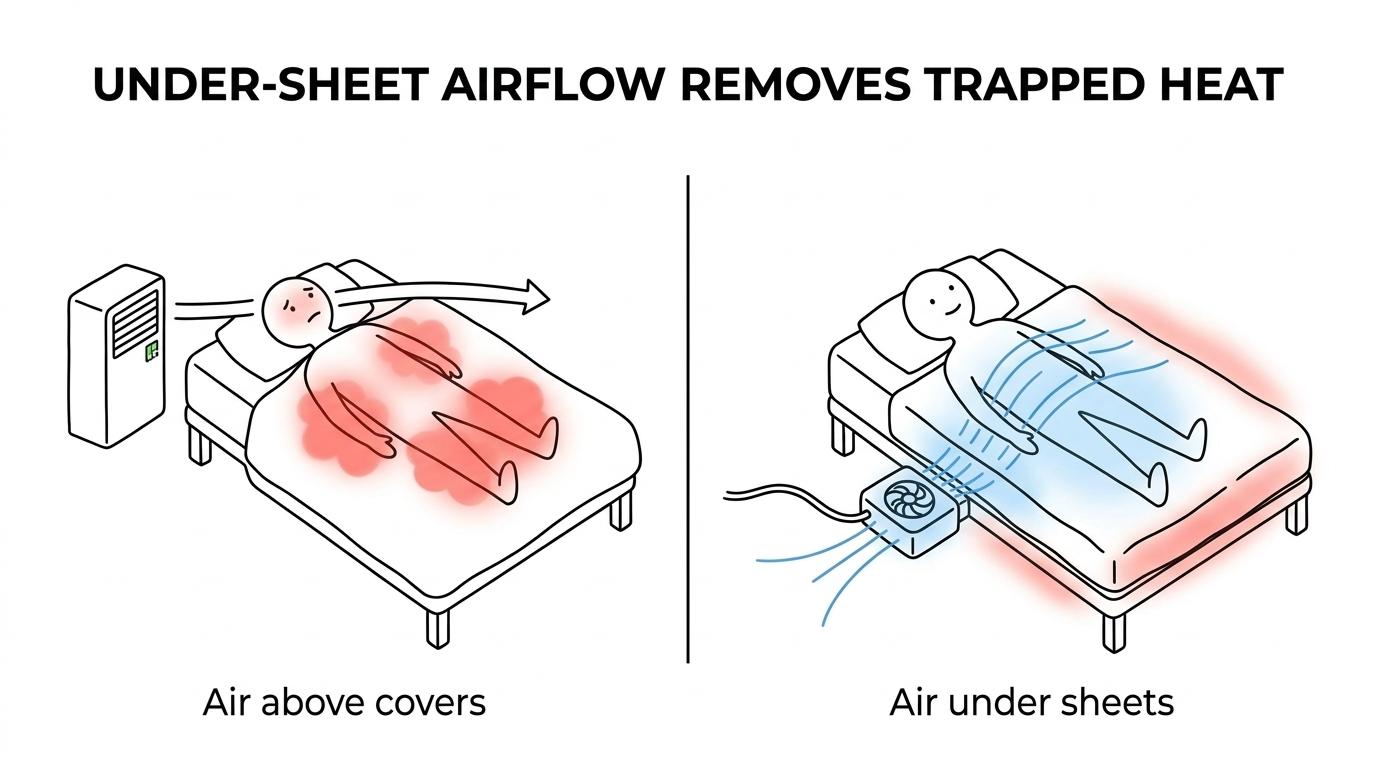
When the main issue is trapped heat under the sheets, a system that sends air directly between the top and bottom bedding layers often feels more focused. If your problem is broader climate control preferences, feature mix may matter more than raw cooling comfort.
"bFan Bed Fan uses an average of 12 watts and relies on ambient room air under the sheets, so bedroom temperature still sets the ceiling for how cool the bed can feel."
No. Both move ambient air, but they deliver it differently, and that changes how the bed feels, how the airflow spreads, and what setup quirks you may notice.
A common misconception is that every bed-cooling product solves the same problem the same way. It does not. Under-sheet fans are built around microclimate control, meaning they push air where body heat gets trapped most. Other systems may emphasize a broader stream or a different attachment method. If you are sweating mostly on your torso, hips, and legs under the covers, under-sheet airflow often feels more targeted.
Another practical point is sheet behavior. Tight-weave sheets usually help air travel across the body better than very loose or heavy bedding. If the air cannot move across the skin and carry heat away, the best motor in the world will not perform at its best.
The best comparison is not about hype. It is about airflow location, fit, noise, price, and whether your overheating is simple heat buildup or a symptom with a medical cause.
Before you click buy, compare the stuff that actually changes sleep quality. Fancy wording is easy. Cooling comfort at 3 A.M. is the real test.
Test airflow against your own sleep problem. Cooling comfort depends on heat source, room temperature, sheet type, and whether you wake up hot everywhere or mostly under the covers.
The easiest way to compare performance is to think in steps, not slogans.
Pro tip: do not judge any bed-cooling system on the first 10 minutes. Judge it on whether you wake less often and whether the sheets feel less damp by morning.
Look at total sleeping cost, not sticker price alone. A cheaper setup that uses little power and lets you raise the thermostat can outperform a more expensive one over time.
Start with the use case. If one person sleeps hot and the other does not, a targeted single-side approach may be enough. If both sleepers want different airflow levels, compare dual-zone cost honestly. Dual-zone BedJet setups can cost over $1,000, which is more than twice the price of two Bedfans.
Then check electricity use. A low-energy device running nightly can be easier to justify than dropping the whole home's air conditioning (AC) temperature for eight hours. If targeted airflow lets you raise the thermostat around 5°F and still sleep well, that can change seasonal cooling costs.
A final pricing detail many buyers skip is durability support. Warranty language matters. A replacement-oriented warranty can be more useful than polished marketing if something goes wrong during regular use.
Focus on bed height, floor clearance, stability, and daily friction. The best system is the one you will actually keep using after the first week.
First, measure the bed. If a unit needs foot-of-bed access, confirm that your frame, bench, rug thickness, or storage drawers do not interfere. The current product information for this category notes an adjustable top for beds about 19 to 37 inches tall, which gives you a useful benchmark when comparing fit.
Second, think about stability. A system that shifts when you move around at night becomes annoying fast. Floor placement, base design, and how the device interacts with the mattress edge are more important than most spec sheets admit.
Third, check maintenance reality. Dust buildup, remote batteries, and sheet compatibility are boring topics until they affect airflow. Common misconception: more features automatically means easier ownership. Often the opposite is true.
Treat night sweats as a symptom first. Comfort tools can help a lot, but they should not replace medical evaluation when the sweating is new, intense, or paired with other symptoms.
The National Cancer Institute (NCI) defines night sweats as episodes of excessive sweating during sleep and notes that they can be severe enough to soak sheets and wake the sleeper. NCI also lists menopause, infection, cancer, low blood sugar, hormone disorders, neurologic conditions, medicines, alcohol, caffeine, tobacco, and drug use among possible causes: National Cancer Institute night sweats definition. The National Institute on Aging (NIA) also notes that hot flashes that happen at night are called night sweats and recommends lowering bedroom temperature when they interrupt sleep: National Institute on Aging guidance on hot flashes and night sweats.
One woman I spoke with in a support-group setting, age 52, thought she just needed "better cooling." Her actual pattern was cyclical hot flashes tied to perimenopause, and once she talked with her clinician, she combined a cooler room, lighter sleepwear, and targeted under-sheet airflow with a treatment plan that made the nights more manageable. That is the sweet spot. Symptom relief plus proper medical follow-up.
"The original Bedfan was invented in 2003, which matters because this category has had years to prove one basic truth: moving room air under the sheets can help, but it does not replace medical care."
Red flags deserve prompt care. Talk to a clinician soon if night sweats come with fever, unexplained weight loss, swollen lymph nodes, chest pain, severe fatigue, or low blood sugar symptoms. The same goes for people on cancer therapy, steroids, antidepressants, or medicines that changed recently.
It depends on whether both sleepers run hot and whether they want the same cooling level. Couples often care more about independence, noise profile, and cost than maximum airflow alone.
If one partner sleeps cold, whole-bed cooling can become a relationship problem. Two separate under-sheet units can create dual-zone microclimate control, which is a fancy way of saying each side gets its own airflow. That approach can be far less expensive than a dual-zone setup priced above $1,000.
Noise matters, too. A low steady sound is often easier to sleep through than inconsistent airflow surges. If you are sound-sensitive, pay attention to real-world use settings, not just peak specs. A quiet range around 28 dB to 32 dB at lower operation can be much more relevant than a maximum-speed number you never plan to use.
Bedroom temperature stays central no matter what you buy. Neither BedJet nor an under-sheet fan cools the air itself. If your room is too warm, both systems have less cool air to work with.
Small changes usually beat gadget swapping. Start with your room, your sheets, and your bedtime temperature rhythm before assuming you need the most expensive device.
These adjustments are boring, but they work for a lot of people:
Pro tip: if you wake clammy rather than just warm, lay out a backup sleep shirt and pillowcase before bed. That tiny bit of preparation can keep one wake-up from becoming a full sleepless hour.
Be specific. Doctors can sort this out faster when you describe timing, severity, triggers, medication changes, and any other symptoms that show up with the sweating.
Bring a simple one-week log. Write down bedtime, room temperature, alcohol or caffeine use, medication timing, wake-ups, soaked clothing or sheets, and symptoms like palpitations, fever, weight loss, or snoring. If you suspect obstructive sleep apnea (OSA), reflux, menopause, or low blood sugar, say so directly.
A common misconception is that night sweats are always "just hormones." Sometimes they are. Sometimes they are not. If symptoms started after a new antidepressant, steroid, diabetes medication, or cancer treatment, that timing matters.
This is not medical advice. Always consult your doctor or oncology team before making changes to treatment, sleep aids, hormone therapy, or home symptom-management routines.
Use trusted medical guidance for symptoms, and use product pages only for product-specific fit, setup, and warranty details.
Here are solid places to start:
If you are browsing bedfan.com and want related reading, these internal links would make sense in this topic cluster:
If your main issue is trapped heat under the covers, a targeted under-sheet cooling approach may be the simpler and more cost-conscious place to start. You can look at a practical store option here: see the under-sheet bed cooling system. This is not medical advice. Always consult your doctor or oncology team before making changes, especially if night sweats are frequent, drenching, or tied to treatment or other symptoms.