bfan reviews show a simple, budget-friendly under-sheet fan that helps with trapped heat, but cooling, noise, and fit depend on setup.
If you are scanning bFan reviews to figure out whether this thing really helps, the short answer is yes, for the right problem. The bFan is best seen as an under-sheet fan that removes trapped body heat from your bedding, not as a device that refrigerates or chills the bed below room temperature.
TL;DR: Summary
- bFan reviews point to a simple, lower-cost bed cooling option that works by pushing ambient air under the sheets, so it is most useful when trapped heat in bedding is the main issue.
- Independent coverage from SlumberLab listed bFan at $195, gave it a 6.5 overall score, and rated it 9.5 for value for money and 9.5 for ease of use.
- The main trade-off is cooling method: bFan can improve comfort and sweat evaporation, but it does not actively cool the air, so results depend on your room temperature, bedding, and sleep setup.
- Company specs matter for fit and comfort: the current bFan page shows adjustable height for beds 19 to 37 inches, a fully controllable blower, and quieter, higher-pressure airflow than earlier versions.
- Public customer-review volume is very small. In the source set, Trustpilot showed 2 reviews split between one 5-star and one 1-star review, which is too little data to treat as a clear verdict.
- If you have drenching night sweats, fever, weight loss, medication changes, or cancer treatment side effects, comfort tools can help, but they should not replace medical care.
This is not medical advice. If your night sweating is new, severe, or tied to menopause treatment, infection, cancer care, blood sugar swings, or a medication change, talk with your doctor or oncology team before you change your routine.
Yes. bFan can feel meaningfully cooler when your main problem is heat trapped under the covers, because it moves room air across the body and helps sweat evaporate.
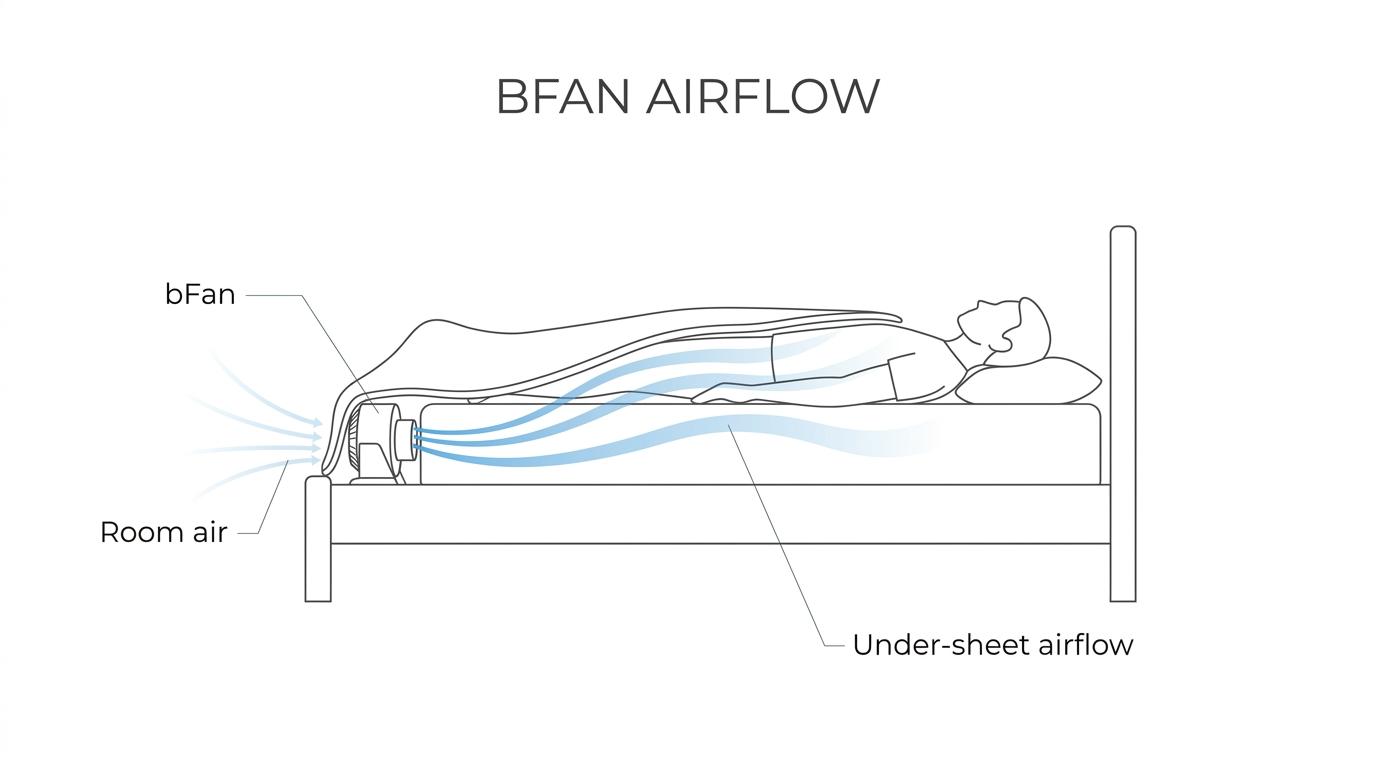
That last point matters. Reviews and company materials are pretty consistent here: bFan is an under-sheet fan, not a mini air conditioner. SlumberLab’s review says it uses ambient air and will not lower the bed temperature below room temperature, which is the right way to set expectations: https://slumber-lab.com/review/bfan-bedcooler/.
“SlumberLab gave bFan a 9.5 for value for money and 9.5 for ease of use, while noting that it relies on ambient air rather than active refrigeration.”
If your bedroom is already within the usual sleep-friendly range of 60°F to 67°F, many people find that targeted airflow under the sheets is enough to sleep better. A Bedfan can also let some sleepers raise the room thermostat by about 5°F and still feel cool enough, because the air is reaching the part of the body that is overheating, not just the room in general. A common misconception is that any bed fan should feel icy. That is not the goal. The goal is better evaporation, less trapped heat, and fewer wake-ups.
They mostly agree on value, simplicity, and limits. SlumberLab and the company’s own product details both point to easy setup, targeted airflow, and ambient-only cooling as the core story.
Where reviews get thin is on large-sample customer sentiment. In the source set for this topic, Trustpilot showed bedfan.com with only 2 reviews and a 2.9 out of 5 TrustScore, split 50 percent 5-star and 50 percent 1-star. That is not enough volume to call the product broadly loved or broadly unreliable. It is enough to say the public review pool is sparse, and that sparse data should make you read more carefully, not panic.
The stronger signals come from what is being reviewed. SlumberLab scored bFan highly for value for money and ease of use, while the product page highlights practical details like adjustable height, improved static pressure, and a fully controllable blower. If you want a simple airflow device, those details matter more than flashy language.
The big takeaways are straightforward. Buy bFan for targeted airflow and lower cost, not for refrigerated cooling.
After reading the main sources, five points stand out:
Start with this. bFan noise is likely acceptable for many sleepers at low to medium settings, but the right test is whether the sound fades into the background after 15 to 20 minutes in your own room.
Step 1 is to separate motor noise from airflow noise. The company describes a brushless, digitally controlled DC motor, and company context places normal operation around 30 dB, with low speed around 28 dB and high speed much louder. Many people think they are judging “fan noise” when they are really hearing moving air against sheets.
Step 2 is to test with your real bedding. Tight-weave sheets usually work better because they help the air travel across the body instead of leaking straight out. Pro tip: if the top sheet is too loose, too open, or constantly kicked off, even a good blower can seem weaker than it is.
Step 3 is to use controls strategically. A remote and timer can matter more than people expect, especially if you fall asleep cool but wake up hot at 2 A.M. Lower speed at bedtime, then a timed bump later in the night, often feels better than blasting airflow from the start.
“The current bFan page highlights an ultra quiet, fully controllable blower and improved static pressure over earlier Bedfan versions.”
No. bFan fits many beds, but not every bed, and sheet choice can make or break the experience.
The current bFan product page shows an adjustable top that works with beds 19 to 37 inches tall. That gives you a decent window, but you still need to think about bed frame design, footboard clearance, and whether your mattress sits unusually low or high. If your bed has a closed footboard or bulky bench at the end, airflow placement gets trickier.
Step 1 is to measure from the floor to the top of the mattress. Step 2 is to check clearance at the foot of the bed, not just height. Step 3 is to look at your bedding stack. Heavy comforters and very loose blankets can let the air escape before it cools you.
A common mistake is focusing only on mattress size. Twin, queen, or king matters less than the airflow path. If the air cannot move under the covers and across your body, the fan has no room to do its job.
bFan and Bedjet solve a similar problem, but they do it with different hardware and very different price expectations. Neither one cools the air. Both use the cool air already in the room.
That means the core physics are the same. If your room is 74°F, neither device turns that into 60°F air. What they do is move that air where it counts. bFan sends airflow under the sheets from the foot of the bed. Bedjet uses a powered air unit with its own accessory ecosystem.
Price is where the gap gets hard to ignore. A dual-zone Bedjet setup runs over a thousand dollars, which is more than twice the price of two Bedfans. If you and your partner both want separate cooling zones, two bFans can create dual-zone microclimate control at a fraction of that cost.
“Bedfan says the first Bedfan became available around 2003, and the current bFan page shows adjustable height for beds 19 to 37 inches.”
The trade-off is feature style. Bedjet buyers may want a more gadget-heavy approach. bFan buyers usually want simpler airflow, low energy use, and less sticker shock. If that is your lane, the older Bedfan lineage matters too. The original Bedfan came to market around 2003, several years before Bedjet was even thought of.
bFan is more targeted than a room fan and much cheaper to run than lowering AC all night. It changes the bed microclimate instead of trying to cool every cubic foot of the room.
A ceiling fan helps some people, but it often misses the heat trapped under the blanket. A box fan moves more air overall, yet it still may not reach the zone between your body and the covers. That is where night sweating and sticky wake-ups tend to happen.
If your room is already fairly cool and your complaint is “I get hot only after I am under the covers,” bFan has an advantage. If your whole bedroom is uncomfortably warm, AC still matters more. The company states the bFan uses only an average of 12 watts, so it is a tiny energy draw compared with air conditioning.
This is where the 60°F to 67°F guidance becomes practical. If your room is near that range, or even about 5°F warmer, targeted airflow may still keep you comfortable enough to sleep. If your room is genuinely hot, no bed fan can fully rescue that.
They tell you to stay balanced. A tiny review sample can flag possible issues, but it cannot give you a statistically solid picture of long-term satisfaction.
In the source set, Trustpilot had just 2 reviews for bedfan.com, split between one 5-star and one 1-star review. The negative review complained about backorder timing, response delays, and a shipment marked sent before pickup. That is worth noting because service problems matter, especially for people buying relief during menopause, medication side effects, or cancer treatment.
It is also easy to overread that kind of data. Two reviews are not a broad product consensus. They are two experiences. A common misconception is that a sparse TrustScore proves product quality one way or the other. It does not. It mainly tells you to check current shipping terms, return policy, and communication expectations before ordering.
Use a short home trial mindset. The smartest test is a 5 to 7 night check of symptoms, setup, and room conditions, not a one-night emotional verdict.
Step 1 is to log what is actually happening. Note the room temperature, when you wake up hot, whether the sweating is mild or drenching, and whether it is linked to hormones, medication timing, or stress.
Step 2 is to set the fan up with a tight-weave top sheet and a realistic bedroom temperature. Keep in mind that neither bFan nor Bedjet cools the air itself. They only use the cool air already in the room. If your room is too warm, the trial is not fair.
Step 3 is to watch for practical wins. Did you wake up less often? Did you throw the covers off less? Did the sweat dry faster? One anonymized scenario that comes up a lot is a perimenopausal sleeper who is comfortable at bedtime, wakes drenched at 3 A.M., then cannot settle again. In that kind of pattern, timed under-sheet airflow can help because the problem is trapped heat during the second half of the night.
Sometimes right away. New or severe night sweats can be linked to menopause, infection, medication effects, cancer treatment, endocrine problems, or other conditions that need medical review.
This is not medical advice. Always consult your doctor or oncology team before making changes. Mayo Clinic notes that night sweats can be tied to many causes, and medical evaluation matters when sweating is persistent, unexplained, or paired with other symptoms like fever or weight loss: https://www.mayoclinic.org/symptoms/night-sweats/basics/definition/sym-20050768.
If you are in menopause or perimenopause, hot flashes and night sweats are common, but that does not mean every case should be shrugged off. MedlinePlus has a useful overview of menopause symptoms and treatment options here: https://medlineplus.gov/menopause.html. If you are on an SSRI, tamoxifen, steroids, diabetes medication, or hormone therapy, tell your clinician exactly when the sweating started and what changed around that time.
bFan is a strong fit for heat-trapped sleepers, but a weak fit for buyers expecting refrigerated air or total-room cooling.
It tends to make the most sense for people who say things like, “The room is okay, but under the covers I feel suffocated,” or “I wake sweaty even though the thermostat is not high.” It also makes sense for shoppers who want a non-drug option with low energy use, a small footprint, and less cost than premium bed-cooling systems.
It is a weaker match if you sleep in a very warm room, dislike any airflow on your legs or feet, have a bed setup outside the 19 to 37 inch height window, or want a highly integrated app-style system. If you and a partner need separate cooling, two bFans can create dual-zone control, and two are still far less expensive than a dual-zone Bedjet setup over a thousand dollars.
If you want to read beyond bFan reviews, these sources help separate symptom relief from medical red flags.
Suggested internal links to add on bedfan.com for readers dealing with night heat:
If you want a simple, under-sheet cooling option that targets trapped heat without a premium-system price, you can see the current bFan here: https://www.bedfan.com/bfan. This is not medical advice. Always consult your doctor or oncology team before making changes, especially if your night sweats are new, drenching, or linked to cancer treatment, infection, or medication changes.