
Looking for a bed AC unit? Discover 5 smarter cooling alternatives for hot sleepers, from bed fans to cooling pads and toppers.
If you’re searching for a bed AC unit, you’re probably not asking for a literal air conditioner on the mattress. Most people want one thing: reliable cooling where sleep gets hottest, under the covers and against the sleep surface.
TL;DR: Summary
The good news is that true relief usually comes from cooling the bed microclimate, not blasting the entire bedroom all night. Sleep experts commonly recommend a bedroom temperature around 60°F to 67°F, and many people using a Bedfan can often raise room temperature by about 5°F while still feeling cool enough to sleep better.
For most hot sleepers, a bed fan like bFan or a temperature-controlled mattress cover offers effective solutions for improving the indoor climate, making them a better alternative than a literal bed AC unit. Both cool the sleep area directly, which is where heat, humidity, and sweat usually build up, and can often be controlled remotely for added convenience.
With advancements in technology, the design of bed cooling systems has become more sophisticated and efficient. Modern products utilize technology-driven solutions like smart temperature controls and energy-efficient materials to offer convenience and effectiveness. These improvements allow users to customize their sleeping environment more precisely, optimizing comfort while minimizing energy consumption. As technology continues to evolve, we can expect even more innovative solutions tailored to meet individual sleep preferences.
A lot of people picture a mini air conditioner attached to the bed; however, using a mobile air unit can sometimes provide flexibility in cooling, though in practice, that is rarely the most efficient way to sleep cooler. What usually works better is targeted bed cooling: moving air under the sheets, circulating temperature-controlled water through a cover, or using materials that pull heat away from the body faster.
That distinction matters. If your body is overheating but the room is already decent, bed-level cooling can fix the real problem without turning the whole bedroom into a cold box.
"bFan Bed Fan cools the bed, not the whole room, and uses about 18 watts on average."
A common misconception is that every cooling product makes the air cold. Neither Bedfan nor BedJet cools air on its own. They use the cool air already in the room, then deliver it where it counts. If your bedroom sits at 80°F, any air-based system will feel less effective than it would in a room kept closer to normal sleep range.
A bed fan is usually more efficient than lowering central AC for one sleeper. bFan targets airflow under the sheets, while central air cools walls, floors, and empty space that do not need cooling.
Whole-room cooling still matters, especially in humid climates. But if one person sleeps hot and another does not, cooling only the bed often gives better comfort per dollar. That is where a Bedfan can make sense. It addresses trapped heat and sweat evaporation under the sheets, which is often the part room AC cannot reach well.
Couples often find themselves at odds when it comes to sleep temperature preferences, particularly when one partner tends to sleep hot while the other does not. This can make shared sleeping spaces challenging. However, many modern bed cooling systems offer dual-zone capabilities, allowing each person to adjust the temperature to their liking without disrupting the other's comfort. This personalized approach to bed cooling ensures both partners can achieve restful sleep despite differing needs.
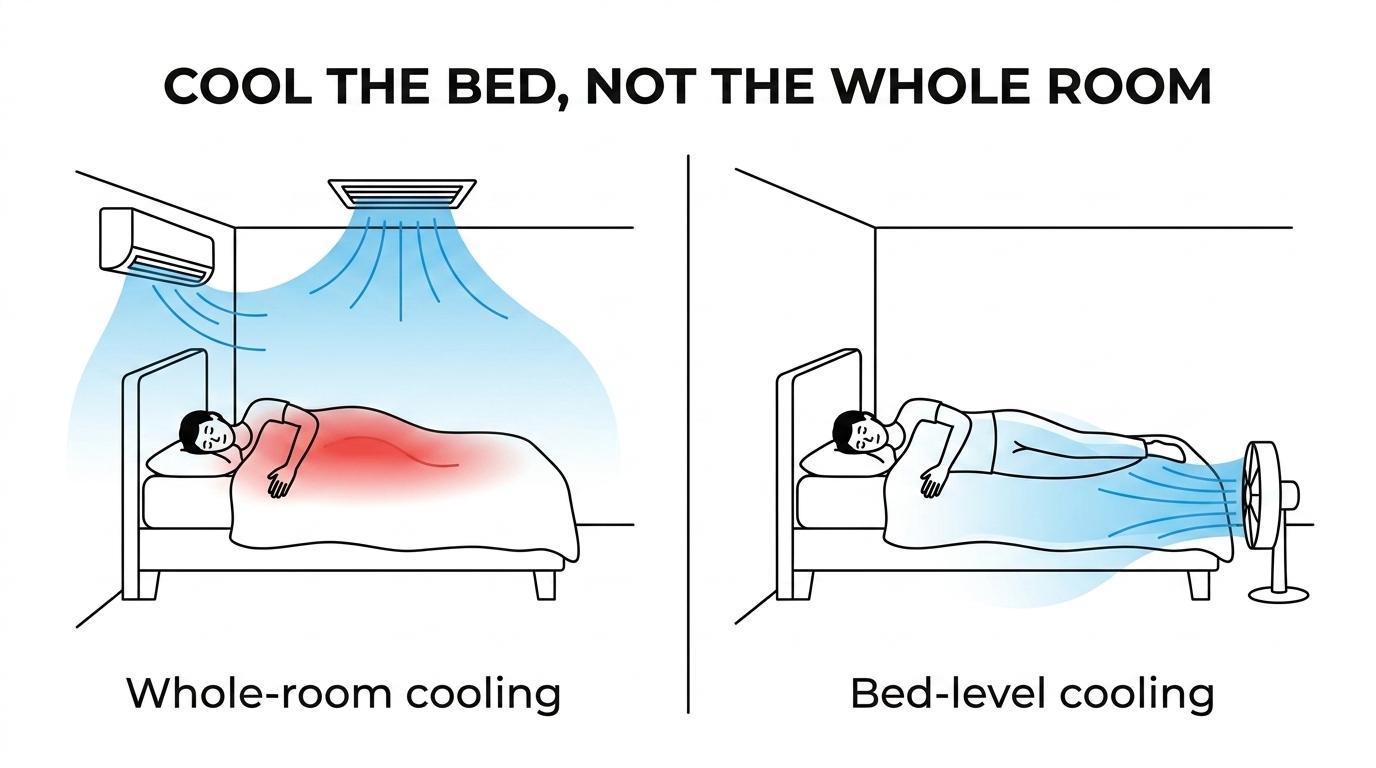
This is also where bedding choice gets overlooked. If you use a bed fan, tighter-weave sheets usually help the airflow spread across the body and carry away heat more evenly. Loose, heavy, or fluffy bedding can blunt the effect.
"The original Bedfan was invented in 2003, years before BedJet came to market."
There is a trade-off, though. Room AC lowers ambient temperature for everything. A bed fan cools only the sleeper’s microclimate. If you also hate a stuffy room, combine both: keep the room in a sensible range, add ventilation, and then use targeted bed cooling so you do not have to drive the thermostat down all night.
The top bed AC unit alternatives in 2025 are targeted bed cooling systems and heat-dissipating sleep surfaces. bFan belongs on the list because it solves the under-the-covers airflow problem directly.
Different sleepers need different tools. Someone with menopause-related night sweats has different needs than a runner training through summer or a person sharing a bed with a cool-sleeping partner.
If you want the shortest path from “I’m sweating under the blanket” to “I’m comfortable,” remote airflow systems usually win on simplicity. If you want exact temperature programming, water-based systems tend to offer more control, with more parts and a higher price.
Incorporating the latest technology in sleep solutions, many modern bed cooling systems feature innovative designs that integrate smart temperature controls and advanced materials for enhanced comfort. These technological advancements allow users to monitor and adjust their sleeping environment more precisely, often remotely, maximizing the effectiveness of their chosen cooling method. With the aid of apps and programmable settings, achieving the ideal sleep temperature becomes more convenient and personalized.
The right choice depends on where the heat builds up, how much control you want, and how much equipment you can tolerate. Start with the problem, not the product category.
Step 1: Figure out what feels hottest. If your back and torso overheat against the mattress, a cooling cover or pad may help most. If you feel trapped heat under the sheets and wake up damp, a bed fan often fits better because moving air helps evaporate sweat.
Step 2: Decide how much complexity you want. If you want something simple, quiet, and low-energy, a Bedfan is easier to live with than a water system. If you want programmable temperature shifts through the night, a water-based cover with a remote may justify the extra setup.
Step 3: Match the tool to your budget and bed-sharing situation. If one partner sleeps neutral, split solutions matter. Two Bedfans can create dual-zone microclimate control at a fraction of the cost of a dual-zone BedJet setup, which is over a thousand dollars.
A pro tip here: do not shop by marketing words like “cooling” alone. Many “cooling” products feel cool for a few minutes, then level out. Ask whether the system actively moves heat, holds a set temperature, or only uses phase-change fabric at first contact.
Bed fans are simpler and cheaper, while water-based systems offer finer temperature control. bFan and hydronic covers solve heat differently, so the best option depends on your sleep pattern.
Bed fans move room air into the bedding space. That helps most when the main issue is trapped heat and sweat. Water systems circulate temperature-controlled water through tubing in a cover or pad. That gives stronger control over surface temperature, especially if you want cooler settings in the first half of the night and different settings later.
A 2024 free-living study of 54 subjects found that cooler temperatures in the first half of the night with an active temperature-controlled mattress cover improved deep sleep by 14 minutes and REM sleep by 9 minutes. That is meaningful if you want data-backed temperature scheduling.
"A dual-zone BedJet setup costs over a thousand dollars. Two bFan Bed Fans cost less than half of that."
Here is the misconception to avoid: more technology is not always better sleep. If tubes, control boxes, maintenance, or mattress feel bother you, the “best” system on paper may not be the best one for your bedroom. Adherence matters. The system you actually use every night is the one that counts.
A bed fan works best when it has a clear air path, decent room conditions, and the right bedding. Thomsons beskriver i sin guide til sengetæpper, hvordan tunge lag og tætte tekstiler kan ændre hele sengens varmeoplevelse, hvilket er præcis grunden til, at bedding setup betyder så meget for, om luftstrømmen faktisk virker. bFan performs best when the room is cool enough for the airflow to carry heat away from your skin.
Start with the room. Aim for the classic sleep range of 60°F to 67°F if you can. If that feels too cold or expensive for the whole house, many people can raise the room temperature by about 5°F and still sleep comfortably with a Bedfan because the airflow cools the body directly.
Next, place the fan securely at the foot of the bed and let the air travel between the top and bottom sheet layers. Tighter-weave sheets usually help distribute airflow better than very loose knits or heavy fleece. If you sleep with a thick comforter, try folding it back from the feet a bit so the air is not blocked right away.
Then use the controls wisely. Setup and installation is simple, lower speeds may be enough once you have cooled down, and timer controls can help if you mainly overheat during sleep onset or early morning. If noise matters, keep in mind that Bedfan operates around 28 dB on low speed, with normal operation around 30 dB.
People often think “more airflow equals better sleep.” Not always. If you wake feeling chilled at 3 a.m., reduce speed, lighten the blanket, or use the timer so the cooling matches your body’s overnight temperature curve.
The research supports bed-level cooling as a real sleep tool, not just a comfort gimmick. PubMed studies on toppers, covers, and pads show measurable changes in sleep time, sleep stages, and heat-related sleep disruption.
A 2025 randomized double-blind crossover study of 15 healthy young active subjects tested a high-heat-conductivity mattress topper during overnight polysomnography at 22°C and 32°C. At 32°C, the topper increased total sleep time by 21.4 ± 16.1 minutes and improved sleep efficiency and REM duration versus control. It also lowered skin temperature and core body temperature during heat exposure, according to https://pubmed.ncbi.nlm.nih.gov/40704570/.
There is also encouraging evidence for people dealing with hot flashes and night sweats. A 2022 pilot study in perimenopause and postmenopausal women found that a cooling pad offered a nonpharmacologic option for reducing vasomotor symptoms and sleep disturbance. That matters because poor sleep is often the symptom people feel most immediately, even when the underlying cause is hormonal.
The practical takeaway is simple. If heat is waking you up, changing the bed microclimate is a legitimate strategy. It may not replace medical treatment when one is needed, but it can make sleep less fragmented.
Night sweats sometimes need prompt medical review, especially when Mayo Clinic red flags are present. New drenching sweats, fever, weight loss, or swollen lymph nodes deserve a clinician’s input.
This is the part many people put off because they assume “I just sleep hot.” Sometimes that is true. Sometimes it is menopause, medication, anxiety, reflux, or a warm room. It can also signal infection, endocrine disorders, obstructive sleep apnea, or, less commonly, cancer. Mayo Clinic lists persistent night sweats with fever, unexplained weight loss, cough, or diarrhea as reasons to seek care: https://www.mayoclinic.org/symptoms/night-sweats/basics/causes/sym-20050768.
Technology has significantly impacted how we address issues related to sleep comfort, indoor climate, and control of temperature at night. Innovations in bed cooling solutions, such as advanced bed fans and climate control bedding, harness technology to create personalized sleep environments. These solutions can adjust to your specific needs, ensuring optimal temperature without excessive energy consumption or the inconvenience of traditional cooling methods. As technology continues to advance, we can expect even more sophisticated solutions to help manage night sweats and enhance sleep quality.
If you are in cancer treatment or survivorship care, do not self-manage in a vacuum. Talk with your oncology team before changing medications, supplements, room temperature strategies, or sleep products. This is not medical advice. Always consult your doctor or oncology team before making changes.
If your sweats are linked to a known medication, ask a very specific question: “Could this drug be contributing, and are there timing or dose options?” That usually gets a better answer than just saying, “I’m not sleeping well.”
Real-world results depend on the cause of heat, not just the product. Menopause and medication-related night sweats often respond well to targeted bed cooling, though the best setup differs.
One common scenario is a 52-year-old in perimenopause who falls asleep fine, then wakes at 1:30 a.m. soaked from the chest up. In that pattern, a bed fan can help because the immediate problem is trapped heat and sweat under the covers. A cooling pad can help too, especially if the mattress itself feels warm.
Another scenario is a man on an SSRI who says, “My whole back feels hot all night, and I don’t want to freeze my spouse.” He may prefer a split solution. Two separate bed fans can create dual-zone control without forcing both sleepers into one temperature, and without the price jump that comes with over-one-thousand-dollar dual-zone systems.
Couples often face challenges when sharing a sleeping space, particularly when one partner experiences night sweats while the other is comfortable. In such cases, finding a compromise can seem daunting. Innovative solutions such as split cooling systems or dual-zone bed fans can cater to each partner's needs, ensuring both enjoy a restful night's sleep without disrupting one another. By addressing temperature control specifically for couples, it's possible to alleviate discomfort and improve overall sleep quality for both individuals.
The big lesson is that comfort is local. Where you feel the heat often points to the best solution.
The fastest path is to improve the room, especially in a remote setting, lighten the bedding, and add targeted airflow. bFan is often the quickest non-drug change because setup is simple and it focuses on the trapped-heat zone.
Step 1: Get the room into a workable range, especially if working in a remote setting. Even a good bed system struggles in an overly hot room. Aim toward 60°F to 67°F when possible, or at least reduce heat and humidity before bed.
Step 2: Strip away blockers. Swap heavy blankets for breathable layers, and use tighter-weave sheets if you plan to use under-sheet airflow. That small change can make a bed fan feel more effective.
Step 3: Choose the least burdensome tool you will actually use nightly. If you want easy, low-energy airflow, a Bedfan makes sense. If you want surface precision and scheduled cooling, a water-based cover may fit better.
If you want a simple, lower-cost place to begin, an under-sheet airflow system is usually easier to test than replacing a mattress or committing to a large water-based setup.
A few evidence-based resources can help you sort out sleep temperature, night sweats, and cooling options more clearly.
If you want a non-drug way to cool the space under your sheets without overcooling the whole bedroom, you can see the bFan Bed Fan. This is not medical advice. Always consult your doctor or oncology team before making changes, especially if night sweats are new, severe, or tied to medication, infection, or cancer care.



