Learn what a bed AC really is, how it cools hot sleepers, and when targeted under-sheet airflow works better than lowering room temp.
Most people who search for a “bed AC” are not looking for a true air conditioner inside the bed. They usually mean a bed-cooling device that moves air around the body, and that distinction matters because products like the bFan Bed Fan work by pushing room air under the sheets rather than refrigerating the mattress itself.
TL;DR: Summary
- A bed AC usually is not a real air conditioner. It is typically a bed-cooling device that uses under-sheet airflow or water-based temperature control to cool your sleep microclimate.
- The main benefit is targeted cooling. You can cool the bed without making the whole bedroom uncomfortably cold for a partner.
- The bFan Bed Fan is one example of a bed-cooling fan. It uses under-sheet airflow, not refrigerated air, so it works best when the room is already reasonably cool.
- If you have night sweats, the cause may be menopause, medication, cancer treatment, infection, or another medical issue, not just room temperature.
- Comparison matters: fan-based bed coolers are usually simpler and cheaper than full dual-zone systems, while true room AC units still do a better job if the whole bedroom is hot.
- This is not medical advice. Always consult your doctor or oncology team before making changes, especially if night sweats are new, severe, or unexplained.
If you wake up sweaty at 2 A.M., what you need is not always more air conditioning. Sometimes you need better heat removal right where your body is trapped under bedding, and sometimes you need a medical evaluation because night sweats can be tied to hormones, medications, infection, or cancer treatment.
A bed AC usually means a bed-cooling system, not a miniature HVAC unit. In practical terms, it is most often a fan-based bed cooler or a water-based mattress pad that changes the temperature around your body while you sleep.
This is the first thing many hot sleepers get wrong. A true air conditioner removes heat from a room using refrigeration components like a compressor and refrigerant. A bed-cooling fan does not do that. It takes the cooler air already in the bedroom and moves it where you need it most, usually under the top sheet, so sweat can evaporate and trapped body heat can escape.
Common misconception: if your bedroom is 78°F and stuffy, no bed cooler will feel like central AC. Fan-based systems depend on the room air you already have. They can make that air feel much more effective, but they do not generate cold air on their own.
"bFan was invented in 2003, years before Bedjet entered the category, and it cools with under-sheet airflow rather than refrigerated air."
A bed AC works by changing your sleep microclimate. The simplest models use airflow, while hydronic systems use temperature-controlled water.
Here is the basic process hot sleepers should picture:
That targeted approach is why a bed cooler can help even when your thermostat is already set reasonably low. Sleep experts commonly recommend a bedroom temperature between 60°F and 67°F (15.5°C to 19.5°C) for better sleep. A bed-cooling fan can let many people raise the room temperature by about 5°F while still feeling cool enough under the sheets, which can lower air-conditioning use and cost.
A practical tip here: tighter-weave sheets often work better with under-sheet airflow because they help the air travel across the body instead of escaping immediately into the room.
The six most useful facts are about definitions, limits, setup, cost, health causes, and noise. If you know those, you can avoid most buyer mistakes.
If you share a bed, fact number 2 often matters most. Many couples do better with targeted bed cooling because one person can stay cooler without forcing the other person to sleep in a cold room.
No, a bed AC is not the same thing as a portable AC or a water-based mattress chiller. They solve different problems and use different methods.
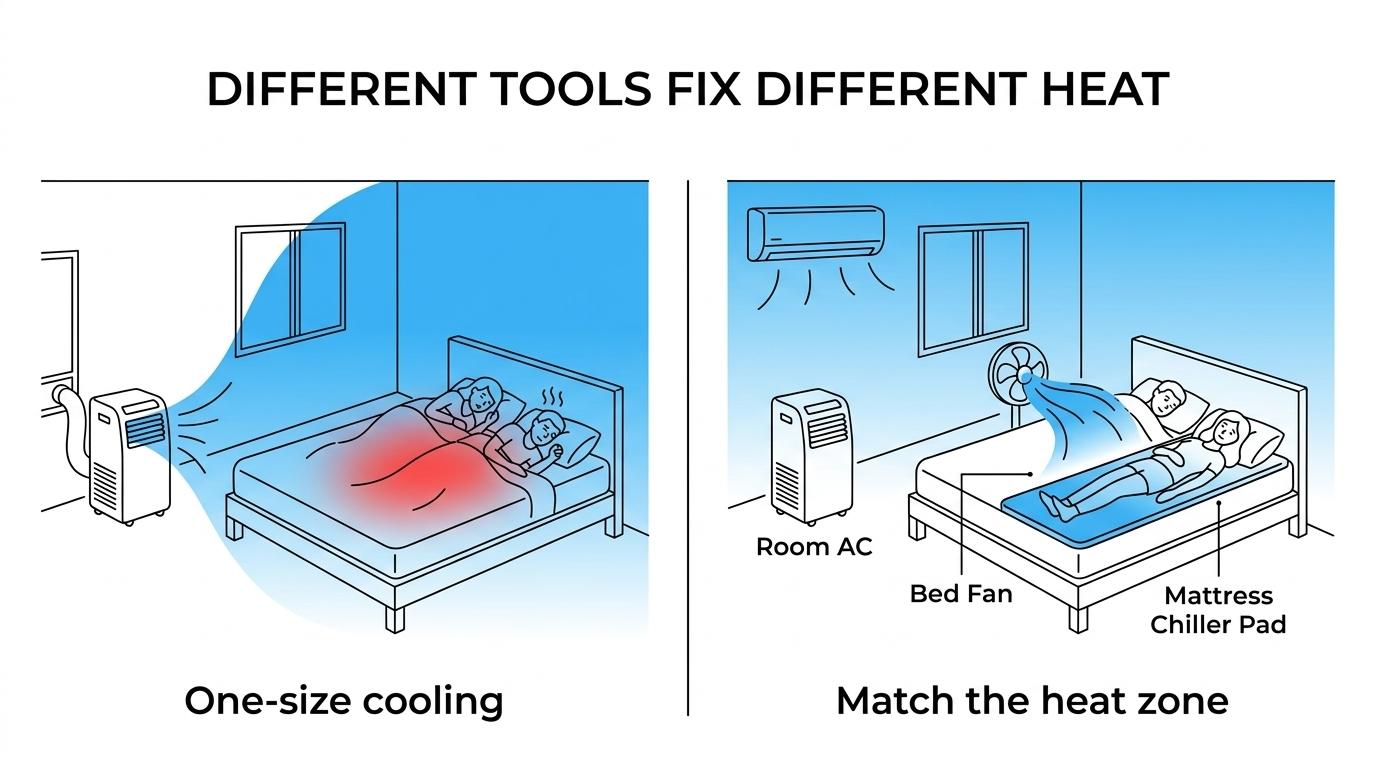
A portable AC lowers the temperature of the whole room. That is the right tool if the bedroom itself is hot, humid, and stagnant. The trade-off is noise, energy use, floor space, venting, and the fact that your partner may hate sleeping in a cold room.
A mattress chiller or hydronic pad changes the temperature of the sleep surface. That can feel very consistent, especially for people who want a cooler mattress rather than airflow on the skin. The trade-off is more components, tubing, cleaning, and usually a higher upfront price.
A fan-based bed cooler sits in the middle. It is usually simpler than a water system and more targeted than a room AC. Pro tip: if your problem is damp pajamas and trapped heat under covers, airflow often helps more than people expect because moving air improves evaporation.
bFan Bed Fan and Bedjet both rely on room air, not true air conditioning. The main differences are price, airflow style, and how you build dual-zone cooling for couples.
Both products are trying to improve the same thing: the microclimate under the bedding. Neither one cools the air the way a room AC does. Both are more about moving existing cool room air where the body can feel it.
Where the comparison gets practical is cost and flexibility. A dual-zone Bedjet setup costs over a thousand dollars. That is more than twice the price of two bed fans, which is why many couples look at split airflow rather than paying luxury-system pricing for dual control. The original Bedfan also came to market years earlier, having been invented in 2003.
"A dual-zone Bedjet setup costs over a thousand dollars, while two bFan units can create dual-zone microclimate control at a fraction of that cost."
Noise and controls matter, too. Some sleepers want something they can set and forget. A remote and timer controls help there, especially if you cool down after the first sleep cycle and do not want airflow running hard until morning.
Good setup makes a bigger difference than many people realize. A poorly positioned bed cooler can feel weak even when the device itself is fine.
Try this setup order:
If your feet overheat first, give the system 10 to 15 minutes before deciding it is not working. Cool air entering at the foot of the bed often needs a little time to spread under the bedding.
Common misconception: more speed is always better. Often it is not. Many people sleep better with a lower steady setting and a timer than with maximum airflow all night.
Night sweats can be a symptom, not just a comfort issue. Menopause, antidepressants, steroids, thyroid problems, infection, and cancer treatment are all well-established causes.
This is where it helps to separate “I sleep hot” from “something is happening in my body.” MedlinePlus notes that sweating is how the body cools itself, and excessive sweating can also be linked to menopause, fever, anxiety, low blood sugar, thyroid disorders, and nervous system issues. See the official overview here: MedlinePlus on sweating.
The menopause piece is especially common. CDC data from the Study of Women’s Health Across the Nation (SWAN) found that about 20% of women reported hot flashes and night sweats 5 to 10 years before the final menstrual period, with sharp increases near that transition point. The odds of hot flashes, night sweats, and trouble sleeping were also higher at seasonal peaks than seasonal minimums. Here is the source: CDC SWAN analysis of menopausal symptoms and sleep.
One woman I’ll call Maria, age 52, described this perfectly. Her room was already cool, but she kept waking drenched around 3 A.M. Lowering the thermostat further made her spouse miserable and did not fully solve the sweating. What helped was a two-part plan: she spoke with her clinician about perimenopause, then used targeted airflow under the sheets so she could stay cooler without freezing the whole house.
"For hot sleepers, bFan targets trapped heat under the sheets, which is different from trying to fix every wake-up with colder room air alone."
Cancer treatment is another important example. MedlinePlus explains that people treated for breast cancer or prostate cancer may have hot flashes or night sweats during or after treatment, and simple home measures include keeping fans running to move air through the home. See: MedlinePlus guide to hot flashes and sweats during cancer treatment.
This is not medical advice. Always call your doctor or oncology team if night sweats are new, severe, paired with fever, weight loss, chest pain, shortness of breath, swollen lymph nodes, or a recent medication change.
Yes, a bed AC can reduce AC use for many hot sleepers, but only if the room starts out reasonably comfortable. It is a targeted efficiency tool, not a substitute for cooling a truly hot bedroom.
Think of it this way. Your body cares about the air trapped under blankets more than the reading on the hallway thermostat. If that microclimate is the real problem, bed-level airflow may let you raise the thermostat by about 5°F and still feel cool enough to sleep.
A simple routine often works best:
If you live in a humid climate, remember the trade-off. Airflow helps evaporation, but high humidity can still blunt that effect. In that case, some dehumidification or baseline room cooling may still be necessary.
The best candidates are hot sleepers with trapped heat under bedding. People with severe room heat, major humidity problems, or urgent medical symptoms should not rely on bed cooling alone.
A bed-cooling fan tends to fit people who say things like, “My bedroom is okay, but once I get under the sheets, I overheat,” or “My partner is freezing and I’m sweating.” It can also make sense for people dealing with menopause, medication side effects, or mild night sweats who want a non-drug comfort tool while also talking with a clinician about the cause.
It is a poor fit if the whole room is sweltering, if you need active dehumidification, or if you are ignoring red-flag symptoms. If fever, drenching sweats, unexplained weight loss, or medication-related concerns are in the picture, get medically checked.
Start with official health sources, then compare them with practical sleep tools. That gives you a better chance of solving the right problem.
Here are strong places to start:
If you manage content on bedfan.com, good internal links to add from this page would include a menopause night sweats guide, a medication-related night sweats article, a cancer-treatment night sweats page, a sleeping-cooler bedroom temperature guide, and a sheet-selection article focused on airflow under bedding.
If your room is reasonably comfortable but your bed still feels like a heat trap, a targeted under-sheet cooling approach may be worth trying. You can see the bed-cooling store if you want a non-drug option that focuses on airflow where it counts. This is not medical advice. Always consult your doctor or oncology team before making changes, especially if night sweats are new, worsening, or tied to treatment or illness.