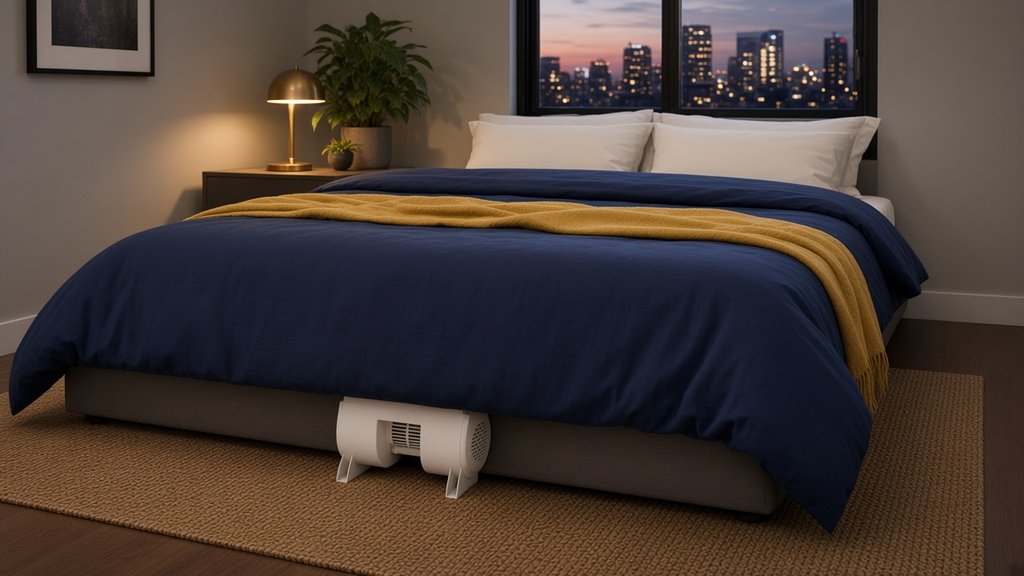
BedJet vs BedJet Mini: Compare coverage, size, airflow, and mattress fit to choose the right cooling system for hot sleepers and couples.
Choosing between BedJet 3 and BedJet Mini mostly comes down to coverage, footprint, and how much airflow you actually need under the sheets. For readers comparing under-sheet cooling systems, bFan Bed Fan is relevant because it sits in the same sleep-cooling category, but the BedJet vs BedJet Mini decision is mainly about full-bed versus smaller-bed or half-bed use.
TL;DR: Summary
- BedJet 3 is the better pick for whole-bed coverage, while BedJet Mini is the more compact choice for Twin, Twin XL, Full, or one side of a Queen or King.
- BedJet says the Mini is 43% smaller, lighter, and designed for smaller spaces, but that smaller footprint comes with lower output and more limited coverage.
- Neither BedJet 3 nor BedJet Mini, and neither bFan Bed Fan, actually cools the air. They use the cooler air already in the room to move heat away from your body.
- If you sleep hot alone on a smaller mattress, Mini is often enough. If you want even airflow across the entire bed, BedJet's own guidance points to the standard BedJet 3.
- Before buying, check under-bed clearance, mattress size, partner needs, and whether you want one-sided airflow or uniform coverage.
The details matter because "smaller" does not just mean easier to hide. It usually means lower airflow capacity, different placement constraints, and a narrower best-fit use case. If you are deciding quickly, start with your mattress size and whether one sleeper or two need cooling.
BedJet 3 is the whole-bed model, while BedJet Mini is the compact half-bed or smaller-bed model. BedJet's own fit guidance says Mini suits Twin, Twin XL, Full, or one side of a Queen or King, while BedJet 3 is intended for full-width coverage across any mattress size.
That distinction is the core answer. BedJet describes the standard unit as the full-size option for uniform climate control across the entire bed, while the Mini is positioned for people who do not need full-width airflow or who have limited under-bed space. If you sleep alone on a narrower mattress, the Mini may cover your needs. If two people share a bed and both want similar airflow, the full-size unit is the safer default.
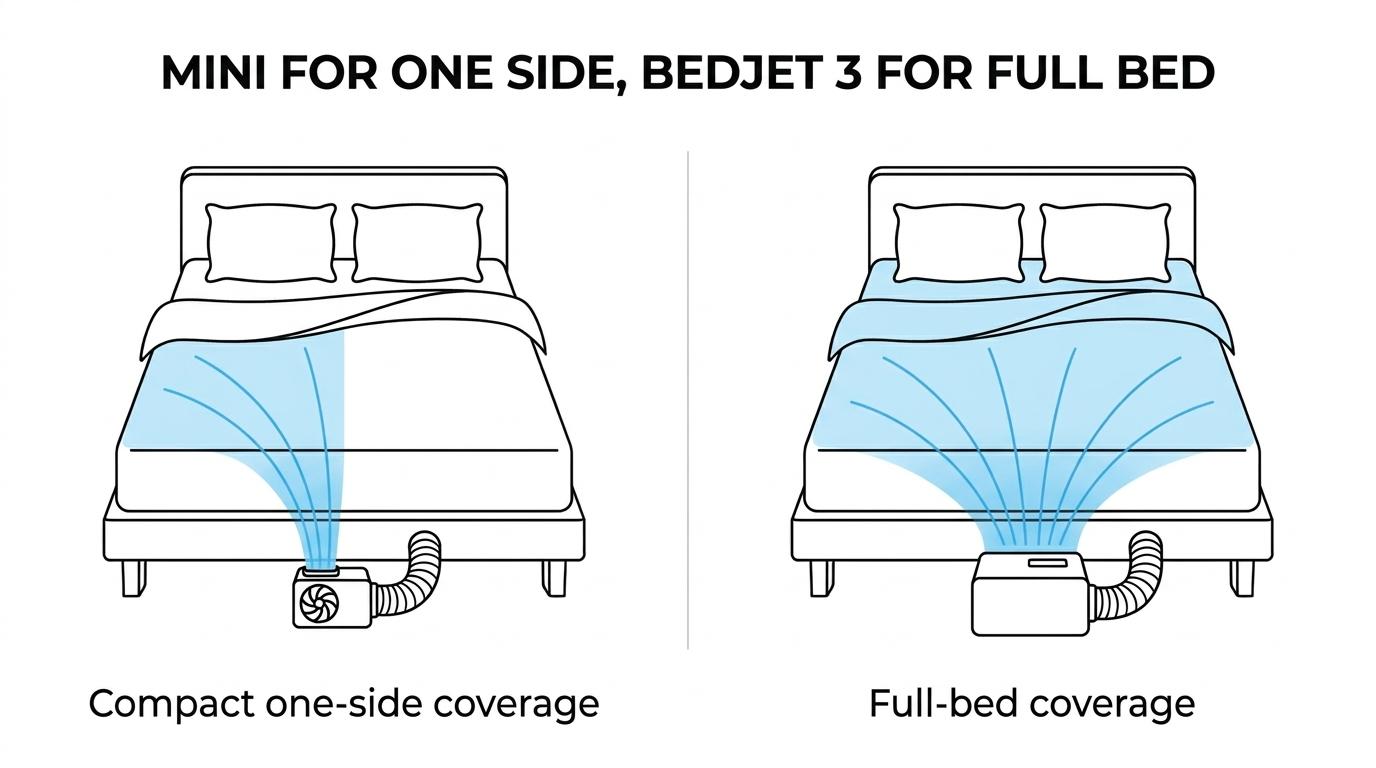
A common mistake is assuming the Mini is just a less expensive BedJet 3 with the same performance in a smaller shell. BedJet's own wording suggests a different use case, not just a different shape. The brand's Help Center says the Mini is for smaller beds or one side of a larger bed, while BedJet 3 is for whole-bed coverage on any mattress size (BedJet Help Center).
BedJet Mini is notably smaller and lighter. BedJet lists BedJet 3 at 15.5 x 10.5 x 5.75 inches and 9 lb, while BedJet Mini is listed at about 12.75 x 8.25 or 8.5 x 5 inches and 5 lb, depending on the source page.
Those numbers matter more than they look on paper. A unit that is 4 pounds lighter and several inches shorter is easier to slide under low beds, move between rooms, and store when not in use. BedJet also says the Mini is 43% smaller than the standard model, which supports the idea that it is built around footprint reduction first, not maximum reach.
BedJet's fit guidance also notes a minimum under-bed clearance of 6 inches for BedJet 3. If your bed frame sits low or has center supports, that can decide the purchase before airflow even enters the conversation. The Mini's smaller body may solve space problems, but you still need to confirm current placement guidance on the exact frame and mattress combination you have. BedJet's current Mini product page lists the unit at 12.75 x 8.5 x 5 inches (BedJet product page).
"bFan Bed Fan uses an average of 12 watts even at maximum speed, which gives shoppers a useful benchmark when comparing compact under-sheet cooling options."
If appearance and portability matter, the Mini clearly wins. If coverage matters more, the extra bulk of the standard BedJet 3 is usually the trade-off you accept.
The right choice depends on five practical factors. Mattress width, sleeper count, clearance, desired airflow spread, and budget will usually tell you more than marketing labels.
The useful test is simple. If your goal is "cool my side," the Mini makes sense. If your goal is "make the bed feel even from side to side," start by assuming you need the full-size unit unless space forces a compromise.
Start with the mattress, then work outward. Bed size is the fastest way to narrow the decision because BedJet already separates Mini from full-size use by coverage area.
Step 1 is width. Twin, Twin XL, and Full usually line up with the Mini's intended use. Queen and King require a second question: do you need one side cooled or the whole bed cooled?
Step 2 is partner pattern. If only one sleeper runs hot and the other dislikes airflow, half-bed coverage can be a good thing. If both sleepers want the same feel, the standard BedJet 3 is the safer bet. If each person wants independent control on a larger bed, compare the cost of a dual setup carefully. A dual-zone BedJet setup costs more than twice the price of two bed fans.
Step 3 is realism about expectations. A Queen bed with a single Mini is not the same experience as full-width airflow. That sounds obvious, but it is where many returns start.
No. BedJet 3, BedJet Mini, and bFan Bed Fan move room air under the sheets, but they do not lower the temperature of that air like an air conditioner.
This is one of the biggest misconceptions in the category. BedJet itself describes the Mini as a forced air climate comfort system in its regulatory filing, and the FCC ID listing identifies it under BedJet LLC as a Part 15 device, not a refrigeration appliance. That means performance depends heavily on the room you start with. If the bedroom is already hot and stale, the bed can only feel so cool.
Sleep experts often recommend a bedroom temperature around 60°F to 67°F for sleep. With a bed fan approach, some people can raise room temperature by about 5°F and still sleep cool because airflow helps remove trapped body heat from bedding rather than chilling the entire room. Pro tip: tighter-weave sheets usually work better because they help channel air across the body instead of letting it escape too quickly.
"bFan Bed Fan sends room air between the sheets to remove trapped body heat, so sheet weave and room temperature still affect results."
If your main goal is colder air, neither BedJet version is the right mental model. If your goal is better heat removal from the sleep surface, then airflow systems make more sense.
BedJet Mini uses less power in cool mode than a heating appliance, but its published heat settings show it is still a more powerful device than a simple fan. BedJet lists Mini power draw at up to 40W in cool mode, 150W to 550W in heat mode, and 775W in Turbo mode for 10 minutes maximum.
That breakdown helps explain the product split. Lower power in cool mode supports the Mini's smaller-bed role, while the heating modes show it is designed to do more than just blow ambient air. The trade-off is that smaller size and lower output usually mean a smaller effective coverage zone.
A common misconception is that lower wattage always means lower cooling quality. In airflow systems, the real question is whether the device can move enough room air to the part of the bed where heat gets trapped. On a Full mattress, Mini may be plenty. On a King, it may feel too localized unless that is exactly what you want.
Measure your bed frame before you choose. A few minutes with a tape measure can prevent the most expensive mistake in this category.
Step 1 is under-bed height. BedJet lists a minimum 6-inch clearance for the standard BedJet 3. If your bed frame, rug, or support rail cuts below that, you may have a fit issue even if the mattress size says BedJet 3 is ideal.
Step 2 is foot-of-bed access. Make sure there is clear room for the base unit and hose path without pressing against drawers, benches, or storage bins. Forced-air systems work best when the path is not cramped.
Step 3 is bedding behavior. If your comforter is very loose, very thick, or tucked unusually tight, airflow can behave differently. Pro tip: test how well your sheets hold a small pocket of air before committing to a whole-system purchase.
Usually not for shared, equal coverage. BedJet Mini makes more sense when one partner sleeps hot and the other does not, or when each person wants separate equipment for separate sides.
That is the nuance many comparison pages miss. Couples do not just need "more coverage." They also need agreement about feel, airflow direction, sound tolerance, and spending. If two sleepers both want a similar climate across the bed, the standard BedJet 3 is closer to the right starting point.
Consider a realistic scenario. A woman in perimenopause shared a Queen bed with a partner who slept cold. She did not need the whole bed cooled. She needed airflow on her side without starting a thermostat battle at 2 a.m. That is the kind of case where half-bed logic makes sense. If both sleepers had been waking up sweaty, the smaller unit would likely have felt too limited.
Yes. bFan Bed Fan is a targeted cooling option for people who want body-heat removal without paying for a larger climate system.
This is where category context matters. The original bed fan concept came to market several years before BedJet was even thought of, and the value proposition is still easy to grasp: move cooler room air between the sheets and carry away trapped heat. For shoppers who do not need heat mode, app-heavy controls, or whole-bed claims, a simpler bed fan can be the more rational buy.
bFan Bed Fan also uses only an average of 12 watts at maximum speed, which is far below the Mini's published heating figures. That does not mean it is the right fit for every person. It means the comparison should start with what you actually want the device to do. If you want targeted cooling and lower air conditioning use, a lighter-power bed fan may fit better than a more complex system. If you want added heating functions, then BedJet is operating in a different lane.
Treat persistent night sweats as a symptom first and a shopping problem second.
That is a useful line to keep, because broader health markers can matter more than bedroom gear when overheating becomes persistent, and Nordic Recover's review of ways to measure inflammation in the body underlines why ongoing symptoms deserve a medical lens rather than a product-only explanation.
If overheating is new, severe, or paired with other symptoms, talk to a clinician before assuming bedding is the whole answer.
Medication side effects, menopause, infection, hyperthyroidism, sleep apnea, low blood sugar, anxiety, and some cancers can all show up as night sweats. If the sweating is mild and predictable, airflow changes may help right away. If it is drenching, unexplained, or comes with fever, weight loss, chest pain, or shortness of breath, do not self-diagnose.
If you want more help sorting the sleep side of the problem, these related guides may help:
If you are choosing between BedJet 3 and BedJet Mini right now, map your bed size, measure clearance, and decide whether you need half-bed airflow or true whole-bed coverage before you buy. This article is general information, not medical advice, and it is not a substitute for diagnosis or treatment from a licensed clinician.
The bFan sits at the foot of your bed and sends a quiet stream of air under your sheets. Direct airflow helps stop sweat before it starts, and one bFan costs less than half the price of one BedJet, making it the less expensive alternative. Shop the bFan at bedfans-usa.com