
Discover how a bed cooling fan for tamoxifen night sweats can reduce trapped heat under covers for quieter, non-drug sleep support.
Tamoxifen can be a critical part of treatment, but the night sweats that come with it can wreck your sleep. bFan Bed Fan is built for this exact kind of nighttime overheating, using a discreet fan at the foot of the bed to move cool room air between your sheets, so trapped heat and humidity have somewhere to go.
If you’re on tamoxifen and waking up sweaty, uncomfortable, or wide awake after a hot flash, bFan Bed Fan gives you a non-drug way to make nights more manageable. As the inventor and manufacturer of the bFan Bed Fan, we focus on targeted bed cooling, not whole room overcooling, so you can cool the space around your body without blasting the entire bedroom.
This is not medical advice. Always consult your doctor or oncology team before making changes to your care, especially during or after cancer treatment.
Tamoxifen is well known for causing hot flashes and night sweats in some patients experiencing menopause during endocrine therapy due to its effects on estrogen levels. The National Cancer Institute specifically lists antiestrogens such as tamoxifen as a cause of hot flashes and night sweats during cancer treatment, and a PubMed indexed study notes that hot flashes are the most prominent side effect of tamoxifen. If that’s what’s been stealing your sleep, you don’t need a lecture on the category, you need a practical way to make the bed feel less suffocating when symptoms hit.
“bFan Bed Fan targets the bedding microclimate itself, and normal operation is around 28 to 32 dB, so you get cooling support without a loud bedside fan.”
bFan Bed Fan doesn’t cool the air itself, and neither does BedJet. These systems use the cool air already in your room, then direct that air under the covers where tamoxifen night sweats tend to feel the worst. That matters, because sweating is only part of the problem, the trapped heat inside bedding is what keeps the cycle going and makes it hard to settle back down.
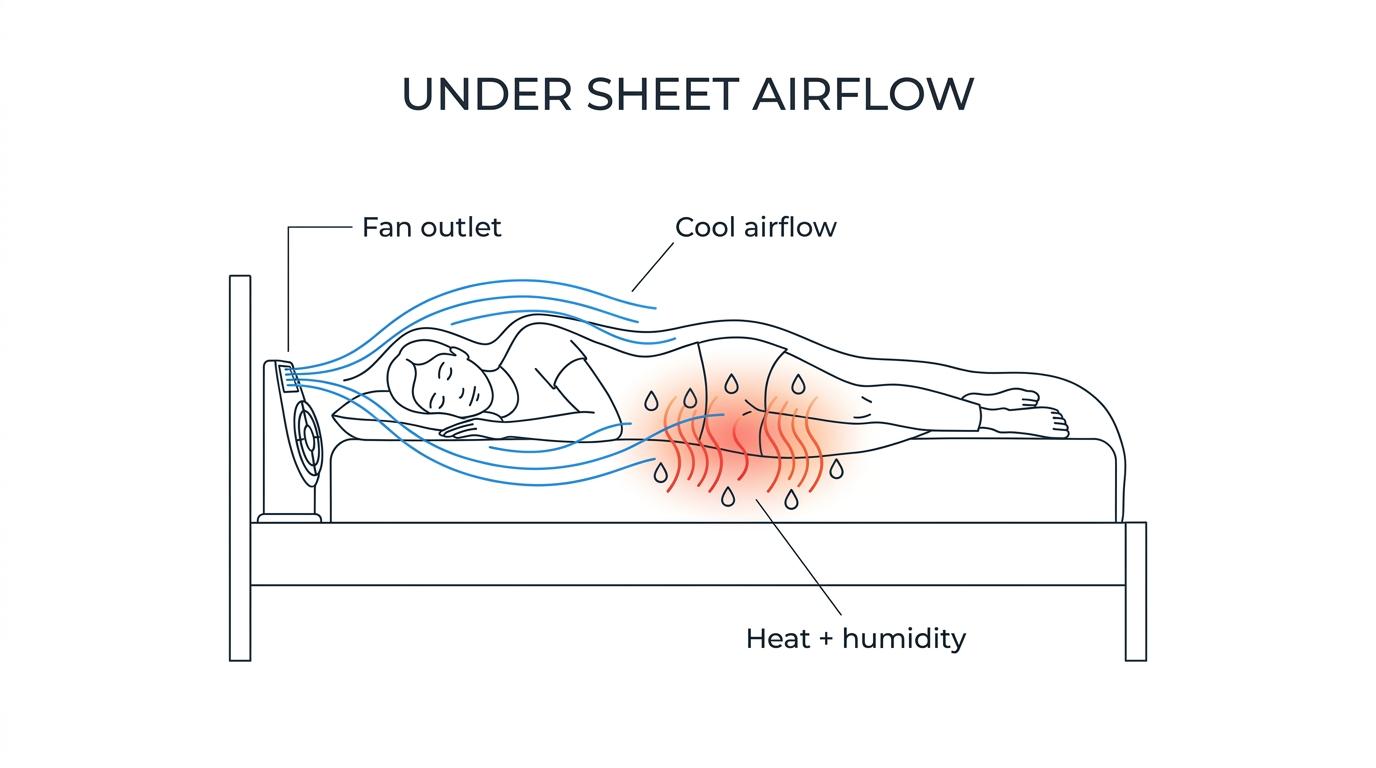
With bFan Bed Fan, the airflow goes between your top and bottom sheets instead of across the whole room. That means you’re cooling the place where your skin, pajamas, sheets, and moisture meet, which is often the exact spot that feels unbearable at 2 a.m.
Sleep and body temperature are closely linked. Research published in Nature found that heat loss at the skin level was strongly tied to how quickly people fell asleep, which supports a simple idea, when your body can release heat, sleep usually comes easier. bFan Bed Fan is designed around that principle by helping remove trapped warmth from the bed rather than forcing you to freeze the whole house.
“bFan Bed Fan was invented in 2003, years before BedJet was even thought of, and it works by moving the cool room air you already have through the bed.”
Sleep experts commonly recommend a bedroom temperature between 60°F and 67°F for better sleep. In real life, that can be hard to maintain, especially if other people in the home run cold or if air conditioning costs are climbing. Many people using a Bedfan can often raise the room temperature by about 5°F and still sleep cool, because the airflow is aimed where it matters most, under the sheets and across the body.
That targeted setup can be especially helpful during tamoxifen treatment, because the symptom often comes in waves. You may feel fine for a while, then suddenly overheat, sweat, wake up, and lose the rest of the night. A bed fan gives you ongoing airflow right where the episode happens, without adding another medication like antidepressants to the mix.
bFan Bed Fan is made to be simple when you’re tired and don’t want a complicated setup. It sits at the foot of the bed, stays mostly out of sight, uses a whisper quiet brushless DC motor, and lets you adjust airflow from 5% to 100% with a remote. The timer controls are useful if you want stronger cooling as you fall asleep, then less airflow later in the night.
“Two bFans can create dual zone microclimate control for couples, at a fraction of the over $1,000 cost of a dual zone BedJet setup.”
Noise and energy use matter more than people think when sleep is already fragile. bFan Bed Fan typically runs around 28 to 32 dB at normal operating speed, which is in the quiet range for bedroom use, and company product information describes power use at roughly 12 watts even at the highest setting. That gives you a targeted cooling tool you can run nightly without feeling like you’re operating another major appliance.
If you’re comparing options, this is where bFan Bed Fan stands out. The original Bedfan came to market years earlier and was invented in 2003. Even a single BedJet is more than twice the price of one bFan, and a dual zone BedJet setup is over a thousand dollars, more than twice the price of two Bedfans. For couples, two bFans create dual zone microclimate control, so each sleeper can manage their own side without paying premium pricing for a system that still does not actually cool the air.
bFan Bed Fan is a strong fit if your main problem is trapped heat under the covers, sudden nighttime sweating commonly associated with menopause and fluctuating estrogen levels, or waking up hot and unable to cool down again without resorting to antidepressants. It’s especially useful when you want relief that does not involve adding a pill, turning the AC down for the whole house, or sleeping with your legs and arms outside the blankets all night.
A very common scenario looks like this. A woman recovering from breast cancer treatment starts tamoxifen, then a few weeks later notices she’s waking up damp, throwing off the covers, then pulling them back on because she gets chilled. For someone like that, bFan Bed Fan doesn’t treat the underlying cause, but it can make the bed feel less muggy and help shorten the time it takes to settle back to sleep.
bFan Bed Fan may be a good fit for you if any of these sound familiar:
bFan Bed Fan is not the right tool for every problem. If your night sweats are new, severe, drenching, or happening with fever, weight loss, chest pain, shortness of breath, or other concerning symptoms, your oncology team needs to know. Tamoxifen can cause hot flashes and night sweats, but cancer patients can also have other medical reasons for sweating at night, and those need medical evaluation.
A bed fan works best when the airflow can move across your skin instead of escaping straight out of loose bedding. In practice, tighter weave sheets usually work better because they help the air travel along your body and carry away heat and moisture. If your sheets are very open, thin, or loosely woven, the airflow can leak out before it does much good.
It also helps to think in layers. Use breathable sleepwear, avoid heavy blanket piles if you tend to wake hot, and use the remote to fine tune the airflow instead of defaulting to maximum speed all night. The timer can be useful if your worst overheating happens in the first part of the night or around predictable hot flash windows.
If room temperature is part of the problem, start with the usual sleep guidance of 60°F to 67°F, then adjust from there. Many people find that with a Bedfan running under the sheets, they can raise the bedroom temperature by about 5°F and still feel cooler in bed, which can help reduce AC use without sacrificing sleep.
If tamoxifen night sweats are part of a bigger sleep issue, these pages on bedfan.com are a good next step:
Here are a few trustworthy sources worth reading if you want the medical background behind tamoxifen hot flashes and nighttime overheating:
If you want a practical, non-drug way to make tamoxifen nights less miserable, take a look at the bFan Bed Fan at bedfan.com. You’ll see a targeted bed cooling system built to remove trapped body heat from bedding, help reduce night sweats, and make sleep feel possible again without overcooling the whole room.
This is not medical advice. Always consult your doctor or oncology team before making changes to your treatment, symptom management plan, room temperature strategy, or sleep setup during cancer care.



