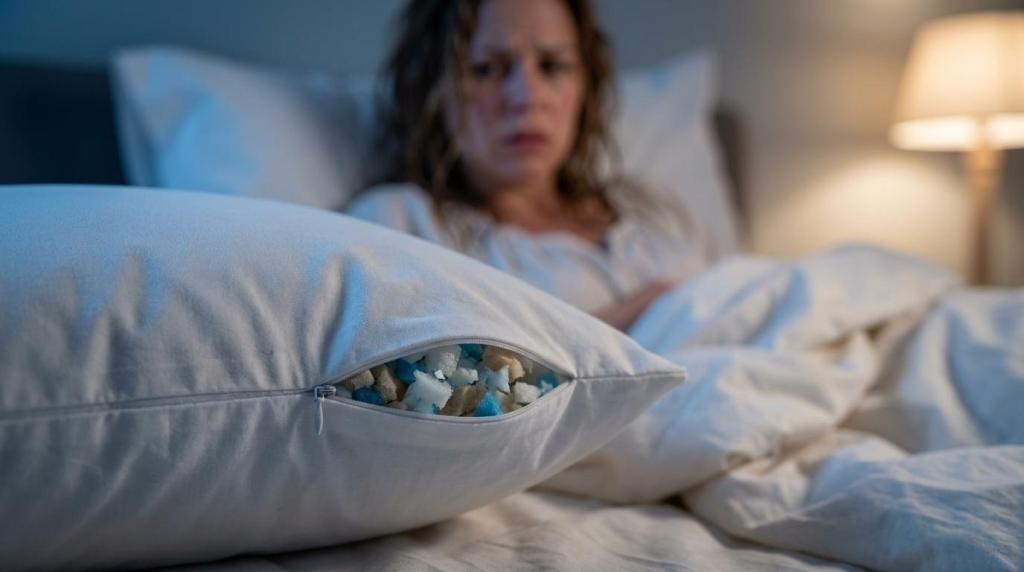
Find the best cooling pillow for hot sleepers: why breathable fills like shredded foam and latex stay cooler longer than gel options.
A cooling pillow can help, but the coolest pillow at 2:00 a.m. is usually not the one that feels icy for the first 5 minutes. It is usually the one that keeps air moving through the fill and does not trap heat once your head has been on it for an hour.
TL;DR: Summary
- The cooling pillow type that usually stays coolest at night is a breathable design with airflow-friendly fill, most often shredded foam, polyester fill, ventilated latex, or other loose fills that do not seal heat around your head.
- A cooling gel layer or gel pad may feel cold at first, but that effect often fades quickly and can become less breathable later in the night.
- Cooling performance depends on the whole sleep setup: pillow fill, loft, pillowcase, room temperature, hair moisture, mattress heat, and whether you overheat only at the head or across the whole body.
- If you wake hot from the neck down, a pillow alone may not fix it. Under-sheet airflow from a Bedfan or bFan can help evaporate sweat and remove trapped body heat using the cool room air already in the bedroom.
- This is not medical advice. Always consult your doctor or oncology team before making changes. If night sweats are new, severe, or linked to fever, weight loss, chest pain, or medication changes, get medical advice.
No pillow stays actively cold all night unless it has some outside source of cooling. That is why breathability matters more than marketing terms like “cool-touch,” “ice fabric,” or “gel-infused” in many real bedrooms.
If your main problem is a hot head, start with the pillow. If your chest, back, or legs also feel overheated, think about the full bed microclimate too, not just what is under your cheek.
Breathable pillows from Consumer Reports and PubMed-linked sleep studies point in the same direction: airflow-friendly fills tend to stay cooler longer than dense, solid foam cores. The best bet is usually shredded foam, polyester fill, ventilated latex, or another loose fill that lets heat escape.
The simple reason is heat storage. Your head gives off warmth all night, and a dense pillow can hold that heat close to the skin. A looser pillow lets air move through the fill, so less heat gets trapped in one spot.
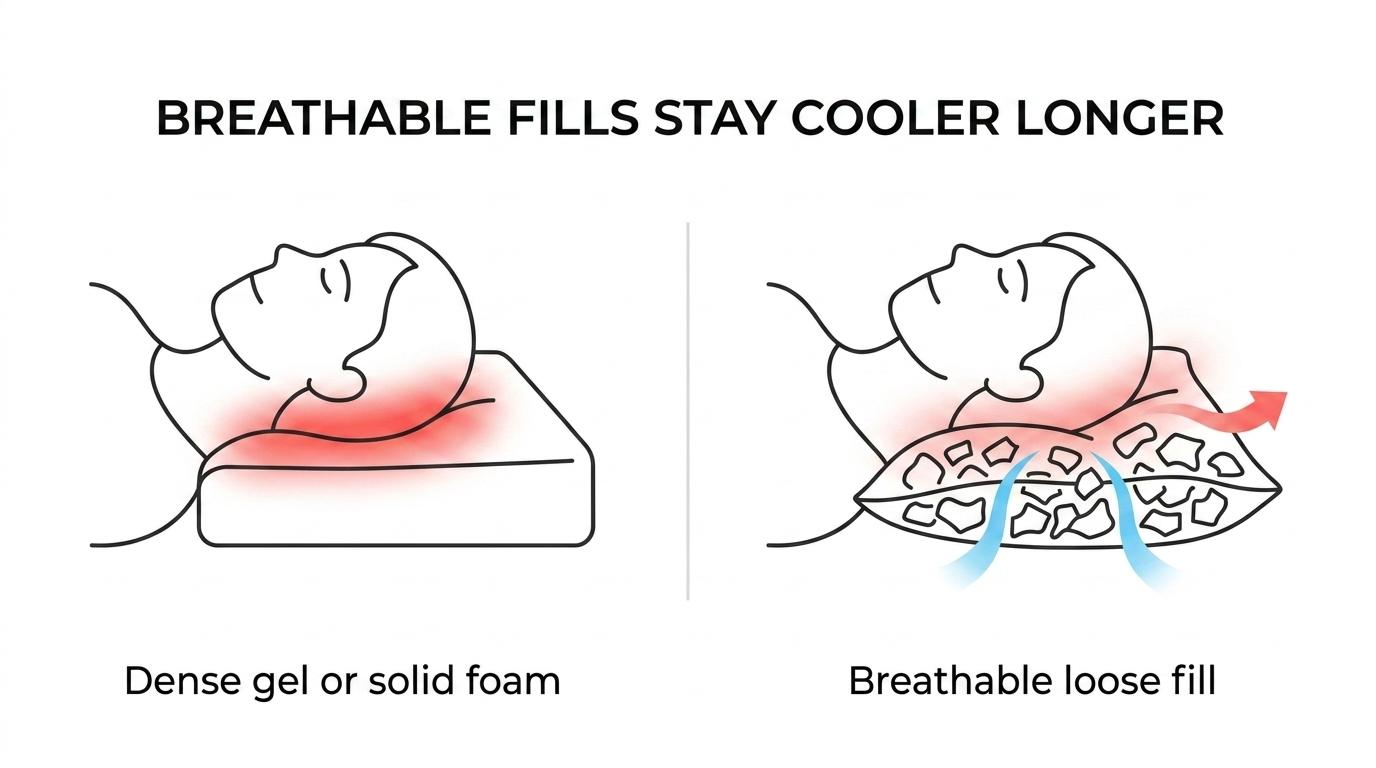
Consumer Reports said in its 2024 pillow guide that shredded foam and polyester tended to stay cooler than solid foam, and it warned not to rely on gel-only cooling features because they may trap heat and moisture later in the night: https://www.consumerreports.org/home-garden/pillows/buying-guide/. A smaller comparative study also found that pillow shape and content affected pillow temperature, comfort, and cervical curve, which means “coolest” and “best” are not always the same thing: https://pubmed.ncbi.nlm.nih.gov/25008402/.
Gel pads and solid foam are common examples of this short-lived cooling effect. They can feel refreshing on first contact, then lose that edge once they absorb your body heat and stop shedding it efficiently.
This is one of the biggest misconceptions in the category. A cool-touch cover is not the same as sustained cooling. Many sleepers confuse initial coldness with all-night temperature control, but those are different things. A pillow can feel amazing at bedtime and still turn into a warm brick by the second REM cycle.
Dense memory foam is the classic trade-off. It can contour well and ease pressure, but it often breathes worse than shredded foam or polyester fill. If you like foam support, look for cut foam pieces, perforations, or ventilated channels instead of a solid slab.
The coolest options are the ones that match both your sleep position and your heat pattern. If your head runs hot, start with a breathable pillow. If your whole body overheats, combine that pillow with broader bed cooling.
Here is the practical ranking most hot sleepers should start with:
One more thing people miss: pillowcase fabric can make or break the result. A breathable fill inside a thick waterproof protector may still sleep hot, while the same pillow in a lighter cotton or percale case can feel very different.
A 3-night check with one pillow, one pillowcase, and one thermostat setting will tell you more than any product label. Keep the test boring on purpose so you can isolate what changed.
Step 1 is to hold the rest of your setup steady. Use the same sheets, the same room temperature, and the same bedtime for a few nights. If you change the thermostat, duvet, and pillow all at once, you will not know what worked.
Step 2 is to notice when the heat shows up. If the pillow feels warm within 15 minutes, the cover or top layer may be holding heat. If it feels fine at first but hot by 2:00 a.m., the fill may be too dense or the room may be too warm.
Step 3 is to check the pillow after you get out of bed. If the underside is damp or very warm, you are likely dealing with trapped moisture and poor airflow, not just a lack of “cooling technology.” That is where loose fill and better room airflow usually beat gimmicks.
Shredded fill usually wins for overnight cooling, while gel memory foam often wins only for first-touch coolness. Consumer Reports has been fairly clear on this point in its testing.
A cooling gel layer is basically a buffer. It can absorb some warmth at first, which feels nice, but once it warms up, the benefit can taper off fast. In older Consumer Reports testing, gel-pad pillows were refreshing at first but quickly lost the effect and ranked among the least breathable designs.
Shredded foam and polyester fill are not glamorous, but they often do the thing hot sleepers actually need. They let air circulate. If you are choosing between a solid gel memory foam pillow and a breathable shredded-fill pillow, the second option is usually the safer bet for staying cooler past bedtime.
The trade-off is support consistency. Solid foam can feel more stable for neck support. If neck pain is your main issue, you may need to balance cooling with alignment instead of chasing the coldest pillow on the shelf.
Side sleepers, back sleepers, and stomach sleepers need different loft first, then cooling second. A pillow that sleeps cool but strains your neck can still wreck your night.
Step 1 is to pick the right height. Side sleepers usually need more loft to fill the shoulder gap. Back sleepers often do best with medium loft. Stomach sleepers usually need a lower pillow, or no pillow, to avoid neck extension.
Step 2 is to match the support feel. If you want structure, try ventilated latex or a shaped orthopedic pillow with airflow channels. If you want adjustability, shredded foam is easier to fine-tune by adding or removing fill.
Step 3 is to notice morning symptoms. If you wake with shoulder numbness, neck stiffness, or headaches, the pillow may fit poorly even if it feels cool. That lines up with research showing pillow choice affects comfort, waking symptoms, and sleep quality: https://pubmed.ncbi.nlm.nih.gov/22379258/.
A common mistake is buying the thinnest pillow because “thin equals cooler.” Not always. A pillow that is too flat can increase pressure points and keep you tossing around, which ends up feeling hotter.
A cooling pillow can help mild overheating, but night sweats from menopause, medications, cancer treatment, infection, or endocrine issues often need more than a cooler spot under your head. If the sweating is body-wide, the pillow is only part of the answer.
A realistic example: one sleeper in her early 50s described feeling fine at bedtime, then waking sweaty at the scalp, chest, and lower back around 3:00 a.m. She swapped a solid memory foam pillow for shredded fill and felt less heat around the face, but the bigger improvement came when she also cooled the bed environment and stopped trapping warmth under heavy bedding.
That pattern is common. If your pajamas, sheets, and torso are damp, the root problem is not just the pillow. A breathable pillow can reduce head heat, yet under-sheet airflow may be what finally helps evaporate sweat and move trapped warmth away from the body.
"The original Bedfan was invented in 2003 to solve trapped body heat under the sheets, which is a different problem from a warm pillow surface."
This is not medical advice. Always consult your doctor or oncology team before making changes. If night sweats are new, severe, or linked to fever, unexplained weight loss, medication changes, or cancer treatment, talk with your clinician promptly.
A cooling pillow is better for local head heat. A Bedfan or bFan is better for whole-body overheating, damp sheets, or heat trapped from the chest down.
Think in if-then terms. If your ears, scalp, and neck are the only hot areas, fix the pillow first. If your legs, belly, back, or under-breast area feel hot too, a pillow may never be enough because the real problem is the warm air pocket under the covers.
Bedfan and Bedjet both use the cool air already in the room. Neither cools the air itself. They move that room air into the bed space so sweat can evaporate and trapped heat can escape. Sleep experts often recommend a bedroom around 60°F to 67°F (15.5°C to 19.5°C). With a Bedfan, many people can raise the room temperature by about 5°F and still feel cool enough to sleep because the airflow is directed at the body, not the whole room.
"A dual-zone Bedjet setup costs over a thousand dollars. Two bFans create dual-zone microclimate control for more than twice less than that."
Price and use case matter. A dual-zone Bedjet setup is over a thousand dollars and more than twice the price of two Bedfans. If you want separate cooling for each side of the bed, two bFans can create a dual-zone setup at a much lower cost. Tight-weave sheets also help Bedfan airflow spread across the body instead of leaking out too quickly.
The next fixes are usually your pillowcase, pillow protector, room setup, and how much heat the mattress is holding. Hot pillow complaints are often partly a bedding-system issue.
Step 1 is to strip back the barriers. A thick quilted protector, flannel case, or heavy satin cover can trap heat even if the pillow fill is breathable. Try a lighter cotton percale or another crisp, tighter-weave case that does not hold as much warmth.
Step 2 is to look below the neck. If your mattress topper is heat-retaining, your pillow may feel hotter because your whole body is already running warm. In waterbeds, Wacore’s heating elements keep a steady surface temperature through the night, underscoring how the base layer’s thermal profile can dominate whatever your pillow is doing. That is where a bed-level fix can outperform another pillow purchase.
Step 3 is to adjust your cool-down timing. Some people need extra cooling only for the first half of the night. In that case, a Bedfan with timer controls can help cool the bed as you fall asleep without running all night, and low sound levels matter if noise wakes you up easily.
"At low speed, the Bedfan runs at about 28 dB, which is quiet enough for many light sleepers who need cooling without extra bedroom noise."
One more pro tip: do not judge a pillow right after coming in from a hot shower or drying your hair with a lot of residual heat. A warm scalp can overwhelm even a decent cooling pillow.
The research says pillow materials matter, but the evidence is still thinner than the marketing. Strong claims about one “best” cooling material are not well supported.
A 2012 review article in PMC noted that cool pillow design can reduce sweating and whole-body temperature, and that thermal behavior is linked to the materials used: https://pmc.ncbi.nlm.nih.gov/articles/PMC3315854/. That supports the basic idea that pillows can affect thermal comfort.
At the same time, a 2024 systematic review found surprisingly limited bedding-specific evidence under warm conditions, including only one study on bedsheets and pillowcases in hot environments, with missing material and temperature details in several studies: https://pmc.ncbi.nlm.nih.gov/articles/PMC11596996/. So yes, materials matter. No, the science does not support every cooling label you see online.
That is why the most useful rule is still the least flashy one. Favor breathability, fit, and repeatable overnight performance over buzzwords.
Suggested internal links for Bedfan.com editors:
If you are deciding between another “cooling” pillow and a fix for heat trapped under the covers, start with the pattern of your symptoms. If your whole body runs hot, take a look at the Bedfan store for a simple under-sheet airflow option that works with the cool air already in your room. This is not medical advice. Always consult your doctor or oncology team before making changes.