
Before period night sweats may stem from hormone shifts before menstruation. Learn common causes, warning signs, and cooling tips.
If you wake up drenched a day or two before your period, you are not imagining it. A lot of people notice a predictable pattern: sleep is fine most of the month, then the nights right before bleeding starts feel warmer, sweatier, and more restless.
This is not medical advice. Always consult your doctor or oncology team before making changes.
Before-period night sweats can be tied to normal hormone shifts across the menstrual cycle. Still, not every sweaty night is “just hormones.” The bigger picture matters, especially if you are soaking pajamas and sheets, waking repeatedly, or noticing other symptoms.
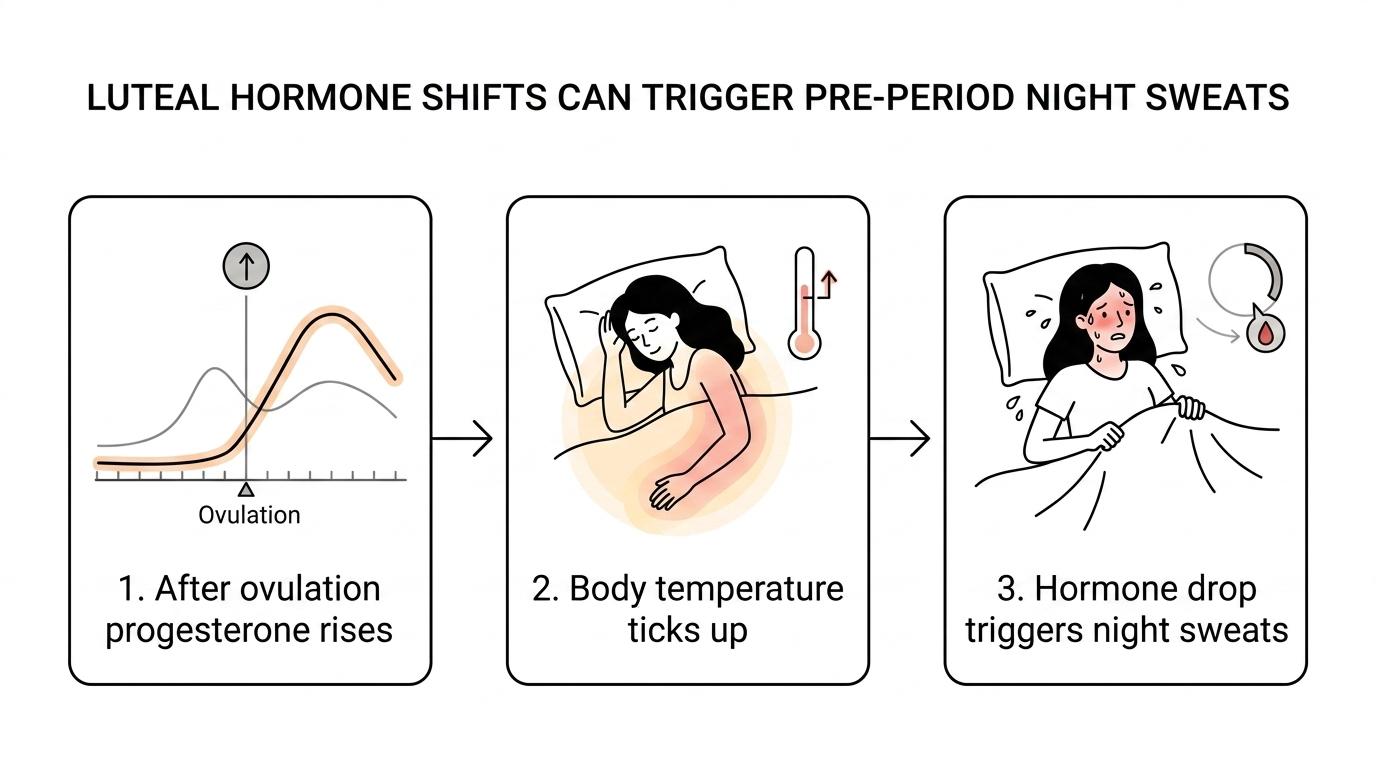
The most likely explanation is the hormone shift that happens after ovulation. During the luteal phase, progesterone rises. That post-ovulation change can push basal body temperature up a bit. According to the National Center for Biotechnology Information (NCBI) Bookshelf, basal body temperature often increases by about 0.5 to 1 degree Fahrenheit during the luteal phase, largely because of progesterone: https://www.ncbi.nlm.nih.gov/books/NBK546686/.
Then, as your period gets closer, both progesterone and estrogen drop. For some people, that hormonal swing affects the brain’s temperature regulation enough to trigger a hot, flushed, sweaty feeling at night. If you already run warm in bed, even a small shift can be enough to wake you up.
That is why these sweats often cluster in the same window every month. You may notice them two to five nights before bleeding starts, sometimes with other premenstrual syndrome (PMS) symptoms like bloating, irritability, breast tenderness, vivid dreams, or lighter sleep.
A common real-life pattern sounds like this: a woman in her early 30s sleeps comfortably most nights, but three nights before her period she wakes at 2:30 AM feeling clammy under the covers. Her room is not hot. She kicks off the blanket, cools down, then gets cold a few minutes later. That kind of timing does fit a hormone-related pattern.
Not every warm night is a true night sweat. That distinction matters.
Clinical sources often describe real night sweats as sweating that soaks night clothes and bedding even when the room is cool. The NHS uses that exact idea in its patient guidance on night sweats: https://www.nhs.uk/symptoms/night-sweats/.
If you mostly feel stuffy under thick blankets, or you sleep hot after alcohol, a heavy comforter, or a warm bedroom, that may be ordinary overheating rather than a medical symptom.
Some clues can help you tell the difference:
The line is not always sharp. Plenty of people have both. Hormone shifts can make you more heat-sensitive, and trapped heat under the covers can make that much worse.
The menstrual cycle changes sleep in subtle ways even before you factor in cramps or mood changes. The luteal phase is often linked with slightly warmer body temperature, lighter sleep, and more awakenings. If you are prone to sweating, the combination can be enough to turn a small temperature bump into a rough night.
That is one reason bedtime comfort matters so much before a period. Sleep experts commonly recommend a bedroom temperature between 60°F and 67°F for better sleep. If your body is already running a little warmer before menstruation, a room that feels “fine” at other times in the month may suddenly feel too warm.
Here is the practical twist. Most people do not need arctic air. They need heat to stop getting trapped under the sheets. A Bedfan can help by moving the cool air that is already in the room between the sheets, where your body is actually overheating. It does not cool the air itself. Neither does Bedjet. These systems use room air. The difference is that directed airflow can help sweat evaporate and carry heat away from your skin.
Many people can raise the room temperature by about 5°F and still sleep comfortably with a Bedfan because the body is being cooled where it counts. That can matter if your partner sleeps cold, or if you are trying to cut air conditioning costs without giving up decent sleep.
Hormones tied to your cycle are a plausible reason, but they are not the only one. Night sweats are also linked to perimenopause, medications, anxiety, alcohol use, low blood sugar, infections, and some endocrine issues.
The CDC notes that hot flashes and night sweats are among the most common symptoms of menopause, and sleep trouble often comes along with them: https://www.cdc.gov/womens-health/features/menopause-womens-health-and-work.html. If you are in your 40s or early 50s and your periods are getting less predictable, what seems like “before period night sweats” may actually be early perimenopause.
Medication side effects are another big one. Antidepressants, steroids, pain medicines, some diabetes drugs, and hormone-related treatments can all increase sweating. Anxiety can do it too. If your sweaty nights suddenly changed after starting a new prescription, that is worth bringing up with your clinician.
One anonymized scenario comes up often. A woman assumes her monthly night sweats are “just PMS,” but her cycles have also become shorter, then longer, and she is having daytime hot flashes. In that case, perimenopause becomes much more likely than a simple premenstrual symptom.
You do not have to wait for perfect hormone balance to sleep a little better. A few changes can lower the odds of waking up soaked and uncomfortable.
If your room is warm, start there. Keep the bedroom in the 60°F to 67°F range if you can. Then look at what is happening under the covers, because that is usually where the heat gets trapped.
A few practical steps help the most:
This is where a bed fan can make daily life easier without adding another medication. The The bFan sits at the foot of the bed and pushes air under the top sheet so sweat can evaporate instead of pooling on your skin. People tend to care about the details only when they fix a specific problem, and here they do. Quiet operation in roughly the 28 to 32 dB range matters if you are already a light sleeper. A remote and timer controls matter if you want cooling as you fall asleep but do not want to wake up cold at 4 AM.
If you share a bed with someone who likes very different temperatures, two Bedfans can create a practical dual-zone setup at a fraction of the cost of a dual-zone Bedjet. A dual-zone Bedjet setup costs over a thousand dollars, which is more than twice the price of two Bedfans. That does not mean everyone needs two fans. It just means you have options if one person sleeps hot and the other does not.
Patterns tell a better story than memory does. If you are trying to figure out whether your sweats are linked to your cycle, track them for two or three months.
Write down what night it happened, where you were in your cycle, whether the room felt cool, what you wore, and whether the sweat actually soaked your clothes or sheets. Also note new medicines, alcohol, stress, fever, or daytime hot flashes.
Bring these notes if the problem keeps going:
That record can help separate a likely hormone pattern from something that needs lab work or a medication review.
Please do not brush it off if the sweating is severe, new, or paired with symptoms that feel out of the ordinary.
See a clinician sooner if you have night sweats with fever, unexplained weight loss, cough, swollen lymph nodes, chest pain, fainting, or big menstrual changes. The same goes if you are soaking the bed regularly in a cool room, or if the sweats are not clearly tied to your cycle anymore.
If you are in the age range for perimenopause and your periods have become irregular, heavier, much lighter, longer, or shorter, that deserves a conversation too. Hormones may still be the answer. You just want the right hormone story.
If you want to keep reading, these are good internal pages to connect with this topic:
NCBI Bookshelf overview of menstrual cycle changes and basal body temperature
A clear medical reference on the follicular phase, luteal phase, progesterone, and how basal body temperature rises after ovulation.
NHS guidance on night sweats
Useful for the practical definition of true night sweats and a short list of common non-period causes.
CDC information on menopause symptoms and sleep
Helpful if you are trying to sort out whether monthly sweats may actually be early perimenopause or menopause-related vasomotor symptoms.
If trapped heat under the sheets is making pre-period nights harder than they need to be, a Bedfan is a simple, non-drug way to cool the body where the sweating happens and make sleep feel manageable again.
This is not medical advice. Always consult your doctor or oncology team before making changes. If you have persistent soaking sweats, new symptoms, or any concern that something more is going on, please get medical care.