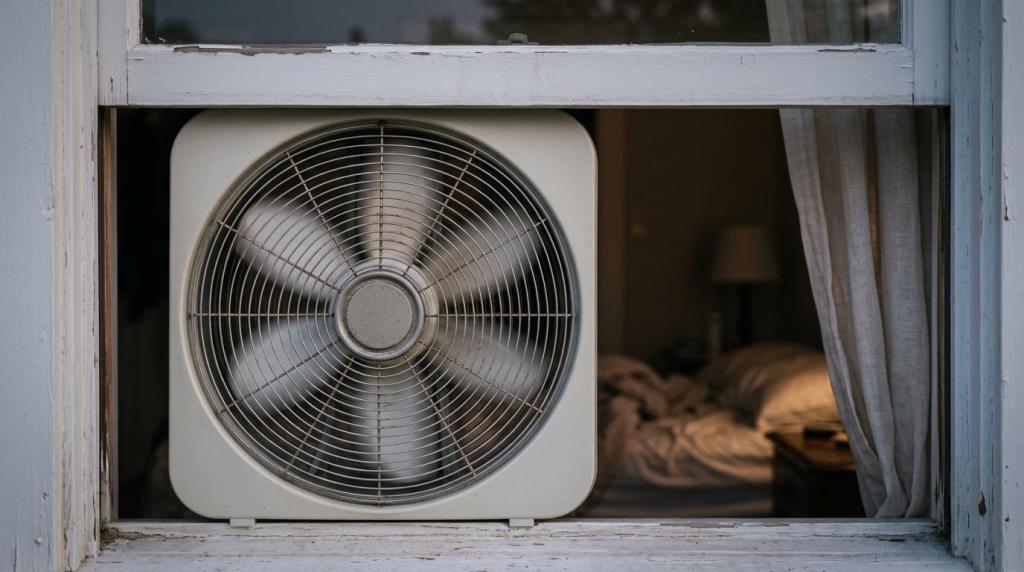
Discover the best ac alternative options for bedroom cooling, from bed fans to ceiling fans, cross-ventilation, and dry-climate coolers.
A bedroom AC alternative is any cooling method that improves sleep comfort without relying on full-time compressor-based air conditioning. That matters because excess heat does more than feel unpleasant: it delays sleep, increases awakenings, worsens night sweats, and can drive up summer utility costs fast. The core problem these options solve is inefficient cooling of the wrong space. Instead of chilling the whole room all night, the best alternatives cool the sleeper, remove stored heat, or boost airflow where it actually counts.
Yes. Options like a Hunter ceiling fan or The bFan cool the sleeper or the room without a compressor. They solve the same bedtime problem as AC: excess heat that interrupts sleep and forces higher energy use.
In practice, bedroom AC alternatives fall into four groups. Airflow devices move air across skin so sweat evaporates faster. Passive methods reduce heat gain or flush out hot air. Microclimate systems cool the bed itself. Moisture-based systems, like evaporative coolers, lower air temperature only when humidity is low enough.
That distinction matters. A ceiling fan and a bed fan do not reduce room temperature on a thermometer the way a window AC does. They improve thermal comfort. An evaporative cooler can reduce air temperature, but only under the right climate conditions. If you choose by the wrong metric, you can buy a powerful device that still feels disappointing at 2 a.m.
Targeted cooling wins for body heat, while room fans win for shared airflow. A bFan or Vornado personal fan cools the sleeper faster; a Hunter ceiling fan or Lasko tower fan helps the whole room feel less stagnant.
If your main complaint is, “I wake up sweating under the covers,” whole-room airflow is often too indirect. You are dealing with a hot bed microclimate, not just a hot room. Targeted systems work better because they push air where body heat is trapped: under sheets, near the torso, and around the legs.
If your room feels stale before you even get into bed, room-scale airflow is the better starting point. Ceiling fans distribute air broadly, cost little to run, and often last 15 to 20 years. Tower and pedestal fans are easier to move and cheaper up front, though they usually create more localized airflow and can get noisy at top speed.
Pro tip: room size matters less than many people think when the issue is night sweats. A large fan in the corner may move plenty of cubic feet per minute, yet still do less for comfort than direct airflow at the bed.
The best options balance heat relief, humidity, noise, and watts. For most bedrooms, The bFan, a ceiling fan, and cross-ventilation offer the strongest comfort per kilowatt, while evaporative coolers make the most sense in dry climates like Phoenix or Reno.
Different bedrooms need different tools. Couples with different temperature preferences often do better with targeted bed cooling than a colder thermostat. Dry-climate households may get excellent value from an evaporative cooler. People who want a near-zero running cost should start with passive ventilation and shading.
Start with the heat source, not the product category. A humid Gulf Coast bedroom, a dry Denver apartment, and a menopausal night-sweats case require different fixes.
Step 1 is to identify where the discomfort starts. If the room itself is hot before bedtime, focus on ventilation, shading, and room fans. If the room feels acceptable but the bed becomes hot after 30 to 60 minutes, choose bed-focused airflow or an active cooling pad.
Step 2 is to match the method to climate. If relative humidity is already high, skip evaporative cooling. Adding moisture can make the room feel heavier, not cooler. If nights drop significantly after sunset, prioritize cross-breezes and thermal purge.
Step 3 is to choose your trade-off. Low wattage options like ceiling fans and bed fans save the most electricity. Water-based mattress systems offer stronger temperature control, but they cost more, draw more power, and require more upkeep.
A common mistake is buying for peak afternoon heat instead of sleeping conditions. Bedrooms need quiet, directional cooling more than brute-force airflow.
A bed fan cools by increasing convective and evaporative heat loss. The bFan pushes about 100 CFM under the sheets while using roughly 12 watts, so it cools the bed microclimate rather than the entire bedroom.
This is the key misconception: comfort and air temperature are not the same thing. Human skin loses heat faster when moving air removes the warm boundary layer around the body. Under blankets, that warm layer builds quickly. A bed fan breaks it up and replaces it with room air.
If your bedroom is 76°F and your bedding traps heat, direct airflow can still feel dramatically cooler. That is why many users can raise the room thermostat several degrees and sleep better. The fan is not refrigerating the air. It is improving heat transfer where your body needs it most.
That targeted approach also helps couples. If one sleeper runs hot and the other does not, cooling only the bed zone often creates less conflict than lowering the whole house temperature.
An evaporative cooler beats a fan only in dry air. In Phoenix it can lower air temperature by about 5 to 10 C; in Miami a standard fan usually feels better because it does not raise humidity.
Evaporative cooling works by turning liquid water into vapor. That phase change absorbs heat from incoming air. The lower the ambient humidity, the more effective the process. In arid climates, this can feel impressive for a fraction of AC power. Some portable units test in the 26 to 87 watt range, far below a typical 1,000 watt room AC.
The trade-off is moisture. If your bedroom already feels sticky, extra humidity can reduce sweat evaporation and make sleep worse. That is why swamp coolers are climate tools, not universal AC substitutes.
Common misconception: evaporative coolers are not “portable air conditioners.” They do not use refrigerant, and their real-world results depend heavily on dew point and ventilation.
Cross-ventilation can outperform a room fan when nights cool down. Two windows, a box fan, and exterior shade can flush stored heat from walls, bedding, and surfaces with almost no operating cost.
Step 1 is to keep daytime heat out. Close blinds or curtains on sun-facing windows before the room overheats. Exterior shading works even better because it stops solar gain before glass gets hot.
Step 2 is to open the room strategically after outdoor temperatures drop. You want an intake path and an exhaust path. If you have windows on opposite sides, open both. If you have only one, use a fan to exhaust warm air outward and pull cooler air from the hallway or another room.
Step 3 is to purge heat before bedtime, not just after getting in bed. Twenty to sixty minutes of night flushing can remove a surprising amount of retained heat from walls and furniture.
Pro tip: opening windows all day in hot weather often backfires. Ventilation cools only when outside air is cooler than the air and surfaces inside.
Breathable textiles matter because insulation traps heat next to skin. Cotton percale, linen, and light moisture-wicking sleepwear often improve comfort faster than thicker “cooling” fabrics that still restrict airflow.
People often focus on gadgets first and ignore the thermal resistance of bedding. Yet your sheet, duvet fill, mattress protector, and pajamas define how much heat stays around the body. High loft and dense weaves can block airflow even if the room is reasonably cool.
A useful rule is simple: if air cannot move through the sleep system, fans do less work. That is why bed cooling performs best with lighter layers and lower insulation.
After you simplify the bedding stack, check these common pressure points:
Common misconception: “cooling” marketing does not always mean lower heat retention. Fabric structure, fill weight, and airflow matter more than labels.
Yes, targeted cooling can cut electricity sharply. A 50 watt fan uses about 0.4 kWh over eight hours, while a 1,000 watt room AC uses about 8 kWh over the same night.
That difference is why low-wattage cooling strategies are so attractive. You are not just comparing comfort. You are comparing how much energy it takes to cool air volume versus the person. Even when an alternative does not lower room temperature, it may still let you raise the thermostat and reduce total AC runtime.
Here is the energy picture in practical terms:
If a device lets you raise the thermostat by even 3 to 6°F, total savings can exceed the device’s own power cost many times over.
A layered setup works best for mixed conditions. Pairing a bFan or ceiling fan with breathable bedding and nighttime ventilation often delivers better sleep than relying on one loud device alone.
Step 1 is to reduce heat gain before sunset. Use blinds, curtains, or exterior shade on west-facing windows. If you skip this, every cooling device has to fight heat that should never have entered the room.
Step 2 is to purge the room in the evening when outside air drops. A short window-opening routine, plus a fan if needed, removes stored heat from surfaces and lowers the room’s starting point.
Step 3 is to cool the sleeper directly overnight. That can mean a ceiling fan for broad air movement, a tower fan for local airflow, or an under-sheet bed fan for the bed microclimate. If one partner sleeps cool and the other sleeps hot, direct bed cooling is usually the least disruptive choice.
If your climate is dry, you can add an evaporative cooler to this stack. If your climate is humid, avoid extra moisture and focus on airflow, bedding, and targeted cooling instead.