
Mirena IUD night sweats are usually not a listed side effect. Learn possible causes, perimenopause overlap, and when to call your doctor.
If you started waking up sweaty after getting Mirena, it makes sense to ask whether the IUD is to blame.
The short answer is usually no. Mirena is a hormonal intrauterine device (IUD) that releases progestin, and standard official side-effect lists do not usually name night sweats as a Mirena side effect. That said, the timing can still feel very real, and it is smart to look at the whole picture instead of brushing the symptom off.
This is not medical advice. Always consult your doctor, gynecologist, or oncology team before making changes. New or worsening night sweats deserve medical attention, especially if they come with fever, weight loss, pelvic pain, heavy bleeding, chest symptoms, or major sleep disruption.
Mirena is a long-acting hormonal IUD placed in the uterus. It releases levonorgestrel, which is a progestin. According to Mayo Clinic’s Mirena overview, common side effects include headache, acne, breast soreness, irregular bleeding, mood changes, cramping, and pelvic pain. Night sweats are not typically listed there.
That matters, because night sweats often get blamed on the newest thing in your life, even when the real cause sits somewhere else.
There is also a hormone clue here. Menopause-related night sweats are usually tied to shifting and falling estrogen levels. The FDA’s menopause page explains that during menopause the body gradually makes less estrogen and progesterone, and night sweats are a common symptom. Mirena contains progestin, not estrogen, so it does not fit the usual pattern for causing classic menopausal night sweats.
A lot of people get Mirena in the same years that perimenopause starts. That overlap creates confusion.
If you are in your 40s, or even late 30s, your IUD may be present at the exact time your hormones begin changing.
Mirena can also make periods much lighter or stop them altogether. That can be helpful, but it can hide one of the most obvious signs that perimenopause is starting. Without the clue of changing cycles, symptoms like waking hot at 2 a.m., tossing off the covers, or soaking a T-shirt can seem as if they came from the IUD itself.
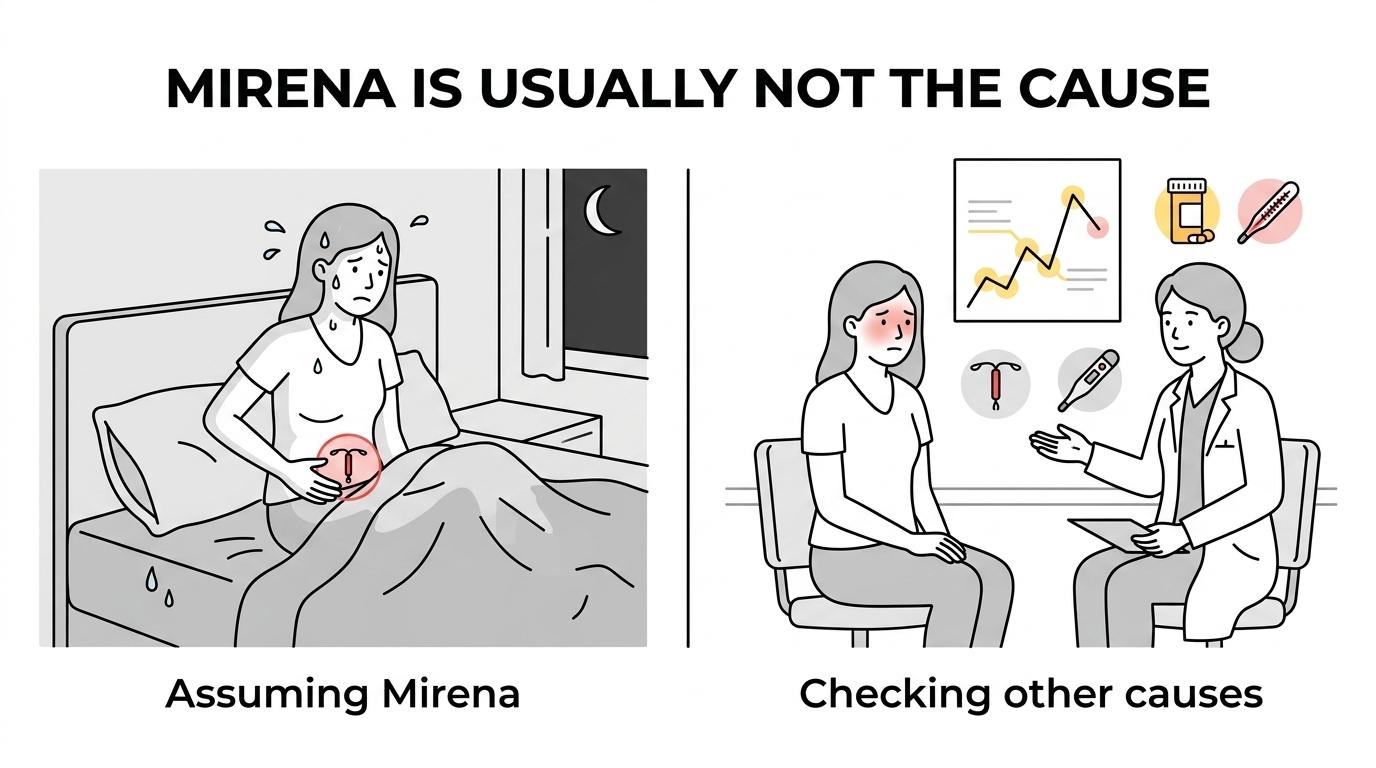
One anonymized example that comes up often in practice: a woman in her late 40s had a Mirena for more than a year with no major issues. Then she began waking up drenched several nights a week. She assumed the device had suddenly started causing problems. After stepping back and looking at the pattern, the bigger picture showed daytime hot flashes, sleep fragmentation, and vaginal dryness too. The IUD had not changed. Her hormones had.
Clinicians sometimes even use a hormonal IUD or intrauterine system (IUS) like Mirena as part of menopause care, because the progestin can protect the uterus when estrogen is prescribed separately. That does not mean Mirena treats night sweats by itself. It does show that Mirena is not generally viewed as the driver of vasomotor symptoms in the way dropping estrogen is.
If night sweats started after Mirena placement, do not assume cause and effect. The timing may be coincidence, or there may be another trigger that deserves attention. Mayo Clinic’s night sweats causes page lists several possibilities, including menopause, anxiety, infection, some medicines, low blood sugar, and thyroid problems.
Another anonymized scenario: a person in her 30s had a stable Mirena and then developed sweating a few weeks after starting an SSRI for anxiety. The IUD got blamed first because it was easy to point to. The medication timeline turned out to be the better fit.
A few possibilities worth thinking through with your clinician:
Night sweats caused by hormone shifts often have a certain rhythm. They may come with sudden heat in the chest, neck, or face, followed by sweating and then chills once the episode passes. Some people also notice a racing heart or a sense of internal heat that feels very different from a room simply being too warm.
Environmental overheating usually feels different. You may go to bed comfortable, then slowly get hotter as body heat builds under the bedding. The sheets trap warmth. Sweat starts. Then the dampness wakes you up.
That distinction matters because the fix can be different. If your issue is trapped heat under the covers, a targeted airflow tool like a Bedfan can help in a very practical way. It does not treat the medical reason you are sweating. What it does do is move the cool air already in the room under the sheets, helping sweat evaporate faster and carrying away built-up body heat. Neither Bedfan nor Bedjet cools the air itself. They use the cooler room air that is already there.
After helping thousands of hot sleepers since 2005, one pattern keeps showing up. Many people do not need the entire bedroom to feel cold. They need less trapped heat in bed.
Sleep experts commonly recommend a bedroom temperature between 60°F and 67°F (15.5°C to 19.5°C) for better sleep. Even then, plenty of people still overheat once blankets and body heat create a warm pocket around them. A Bedfan can help many people raise the room temperature by about 5°F and still feel cool enough to sleep better, because the airflow under the sheets cools the body where the heat gets trapped.
If you want a non-drug option, this is where the bFan makes sense. It is quiet at low settings, around 28 to 32 dB, has remote and timer controls, and uses very little electricity, about 18 watts on average. If your sweating wakes you around the same time every night, the timer can be useful. If one partner runs hot and the other does not, two Bedfans can create a dual-zone setup at a fraction of the cost of a dual-zone Bedjet system, which runs over a thousand dollars and costs more than twice as much as two Bedfans.
Your bedding setup matters too. Tight-weave sheets usually work best because they help the airflow travel across the body and carry heat away instead of escaping too quickly.
A few practical changes can make tonight easier:
A lot of night sweats are linked to hormone shifts or medications, but some are not something to sit on for months.
Talk to your doctor if the sweating is new, intense, or paired with other symptoms. Bring a simple timeline. Note when Mirena was inserted, when the sweats began, what medications changed, and whether you also have hot flashes, fever, bleeding, pelvic pain, snoring, reflux, or weight changes. That kind of timeline helps much more than trying to guess the cause from memory during a short visit.
Here are a few situations that should move up the priority list:
If your doctor thinks perimenopause is the real issue, the conversation may turn toward lifestyle steps, prescription options, or menopause-focused treatment. If the pattern points away from hormones, the next step may be checking medication side effects, infection, sleep apnea, or thyroid function.
If you want a little more help connecting symptoms with better sleep, these are the kinds of internal pages that fit naturally with this topic:
If you want to verify the medical basics yourself, these sources are solid places to start.
FDA guide to menopause symptoms and treatment options: Explains how falling estrogen and progesterone can lead to symptoms like hot flashes and night sweats.
Mayo Clinic overview of Mirena: Reviews what Mirena is, how it works, and the side effects most commonly listed in clinical use.
Mayo Clinic guide to common causes of night sweats: Useful for thinking through other reasons you may be waking up sweaty.
If your main problem right now is getting through the night with less disruption, a Bedfan can be a practical comfort tool while you work with your clinician on the real cause. You can see current options at the Bedfan store.
Strong disclaimer: This article is for general education only. It is not medical advice, diagnosis, or treatment. Always consult your doctor, gynecologist, or oncology team before making changes to medication, hormone therapy, or medical devices. If your night sweats are severe, new, or come with fever, pain, bleeding, shortness of breath, or unexplained weight loss, seek medical care promptly.