3rd trimester night sweats are common in late pregnancy. Learn what’s normal, red flags to watch for, and simple ways to sleep cooler.
If you’re waking up in the third trimester soaked through your shirt, kicking off blankets, or wondering why the room suddenly feels five degrees hotter at 2:00 a.m., you’re not imagining it. Late pregnancy can make your body run hot, and night sweats are a very common reason sleep starts to feel harder right when you need it most.
This is not medical advice. Always check with your doctor, midwife, or obstetric care team before making changes during pregnancy, especially if sweating comes with fever, chest pain, shortness of breath, dehydration, or feeling unwell.
By the third trimester, your body is doing a lot at once. Blood volume is up. Your metabolic demands are higher. Hormones that affect fluid balance and thermoregulation are shifting, too. A review in StatPearls notes that pregnancy significantly changes hormone levels, including large rises in aldosterone and cortisol by the third trimester, which can affect how the body handles heat and fluids (https://www.ncbi.nlm.nih.gov/books/NBK559304/).
There’s also good evidence that nighttime hot flashes are not rare in pregnancy. A prospective study published in Fertility and Sterility found that 35% of women reported hot flashes at some point during pregnancy, with nighttime hot flashes peaking in the third trimester. The study also found that 29% reported them after delivery (https://www.sciencedirect.com/science/article/pii/S0015028213029671).
Put simply, your internal thermostat is working harder, and late pregnancy makes it easier to feel overheated under the covers.
Most of the time, third-trimester night sweats are tied to normal pregnancy changes. You may fall asleep feeling fine and wake up hot an hour later. You may sweat most around your chest, neck, back, or behind your knees. Some nights are worse than others, especially after a warm shower, a heavy dinner, a spicy meal, or a stressful day.
A pattern that is often reassuring is this: you feel hot, sweaty, uncomfortable, and tired, but not actually sick. Once you cool off, drink a little water, and change into dry sleepwear, you feel more like yourself.
Common “probably normal” patterns include:
That said, “common” does not mean you have to just suffer through it. Repeated sleep disruption matters, and Mayo Clinic advises medical review when night sweats happen regularly or interrupt sleep, especially when other symptoms show up too (https://www.mayoclinic.org/symptoms/night-sweats/basics/causes/SYM-20050768).
Pregnancy can mask other problems because so many body changes feel unusual already. That’s why it helps to know which symptoms belong in the “let me call my clinician” bucket.
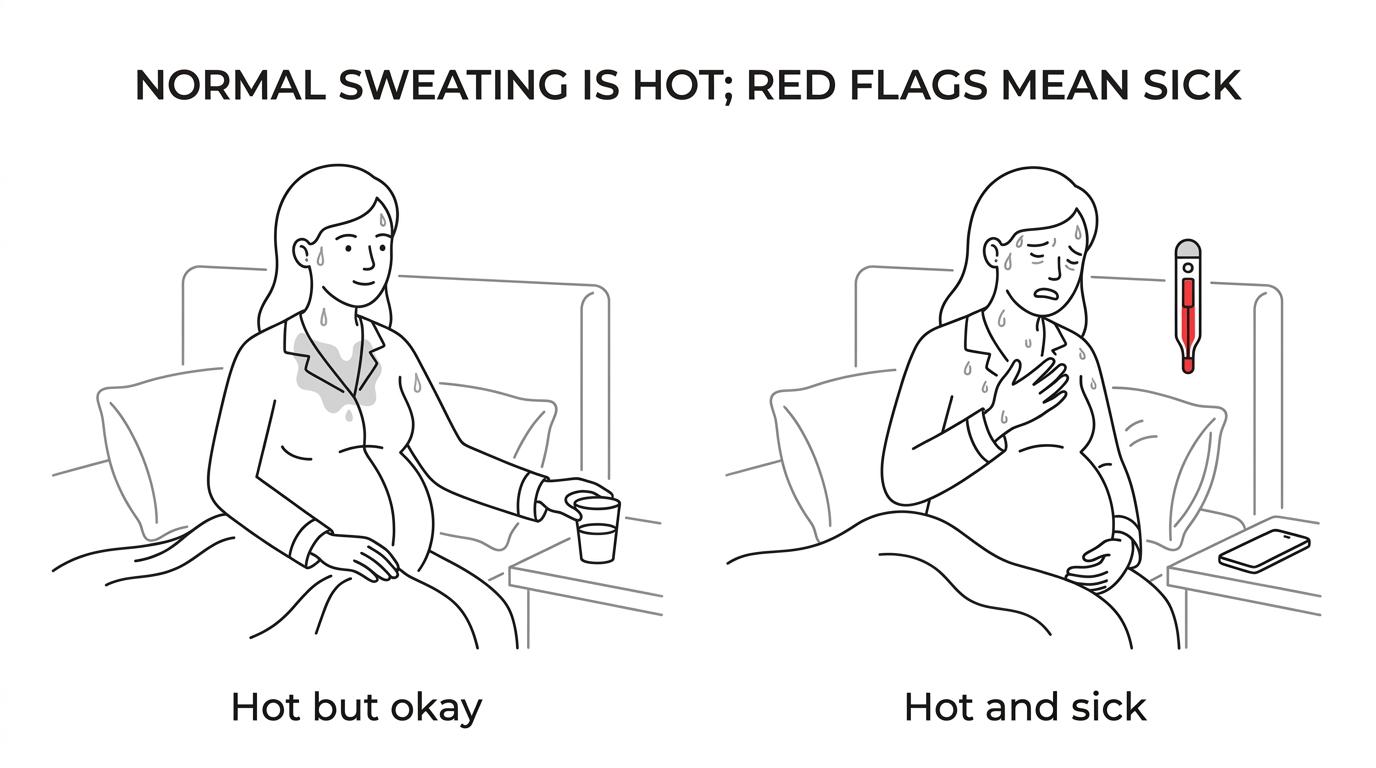
If your sweating is paired with signs of illness, heart symptoms, breathing problems, or dehydration, don’t assume it’s just hormones.
Call your pregnancy clinician promptly if you have:
A quick call is also smart if the sweating is brand new and intense, or if you’re worried about decreased fetal movement, contractions, or anything else that feels off. Pregnancy is not the time to tough it out alone.
The most useful thing about the research is that it helps normalize what many pregnant women experience but rarely expect. Nighttime hot flashes, also called vasomotor symptoms, can happen during pregnancy, not just around menopause.
The prospective study above matters because it tracked symptoms over time rather than relying on vague memories later. Nighttime hot flashes peaked in the third trimester, which fits what many patients describe in real life: “I was uncomfortable before, but late pregnancy was when the night heat really kicked in.”
That same pattern can continue into the postpartum period, which is helpful to know now. If you are counting down the days assuming delivery will end every sweaty night immediately, your body may have other plans for a little while.
The basic goal is not to make the room icy. It’s to reduce heat trapped around your body, especially under the sheets, where sweat can linger and keep waking you up.
Sleep experts commonly recommend a bedroom temperature between 60°F and 67°F (15.5°C to 19.5°C) for better sleep. In real life, that can feel too cold for a partner or expensive to maintain all night. A Bedfan can help many people raise the room temperature by about 5°F and still feel cool enough to sleep better, because the airflow is aimed where the heat is trapped, under the covers.
That detail matters. A Bedfan does not create cold air. It uses the cooler air already in the room and moves it between your sheets, which can help evaporate sweat and carry heat away from the body. For someone in the third trimester who feels hot under blankets but doesn’t want the entire bedroom freezing, that can be a practical, non-drug option.
A few changes often help right away:
Tight-weave sheets are worth a special mention. They help the air travel across your body instead of escaping too quickly, which can make under-sheet airflow work better.
If noise is part of the problem, a quiet bed cooling setup can matter just as much as the temperature itself. Many pregnant women are already waking more often from reflux, bathroom trips, hip pain, or baby movement. A Bedfan’s low-speed sound level, around 28 dB, is gentle enough for many light sleepers, and timer controls can help if you only need extra cooling during the first part of the night.
One patient in late pregnancy described it this way: she would fall asleep feeling comfortable, then wake up around 1:30 a.m. with a damp neckline and sweaty legs, even though the thermostat was already lower than her partner liked. She did not have fever or illness symptoms. What helped most was not dropping the AC again. It was getting air under the sheets, switching to tighter-weave bedding, and keeping a dry shirt nearby so she could settle back to sleep faster.
Another common scenario is the person who feels “too hot and too cold” in the same night. Sweating can leave your skin damp, then the dampness makes you chilly. That cycle is one reason targeted airflow can feel better than blasting the entire room.
You do not need to make this a dramatic appointment topic. A simple, clear description is enough. Say when it started, how often it happens, whether it wakes you up, and whether you have other symptoms.
If you’ve had thyroid issues, anxiety, reflux, infections, gestational diabetes, or medication changes, mention those too. The sweating itself may still be normal pregnancy thermoregulation, but context helps your clinician sort out what deserves a closer look.
Before your next visit, it can help to track:
That short list can save time and make the conversation much more useful.
Medication is usually not the first answer for straightforward third-trimester night sweats. Comfort measures are where most people start, and that’s reasonable.
If your room is already in a sleep-friendly range and you’re still overheating, moving air directly into the bed can target the root issue more effectively than lowering the whole-house thermostat again. This is where a Bed Fan or bFan fits in naturally. It cools the microclimate under the sheets, not the whole room, and it does it with low energy use. If you share a bed with someone who sleeps colder than you do, that targeted approach can prevent the nightly thermostat battle.
For site readers who want more on related sleep topics, useful internal reading can include the main night sweats hub, sleeping cooler tips, and combat pregnancy night sweats with the right fan. Other strong internal links to build around this topic include pages on postpartum night sweats, menopause night sweats, and medication-related night sweats within the same /night-sweats/ section.
If you want to read the medical background for yourself, these are good places to start:
If late-pregnancy overheating is wrecking your sleep, a gentle under-sheet airflow setup may be one of the simplest ways to get relief tonight. You can see how the Bedfan works here: https://www.bedfan.com. This is not medical advice. Always consult your doctor, midwife, or obstetric care team before making changes during pregnancy, and seek prompt care if night sweats come with fever, chest pain, breathing trouble, dehydration, fainting, or feeling seriously unwell.