Cooling blanket vs bed fan: learn which works better for night sweats, trapped heat, sweat evaporation, and cooler sleep comfort.
If you wake up drenched, kick off the covers, then spend the next hour trying to cool down, you are not choosing between two random sleep gadgets. You are trying to solve a very specific problem. And the right choice depends on what is actually driving the heat.
This is not medical advice. Always consult your doctor or oncology team before making changes. Night sweats can be linked to menopause, cancer treatment, infections, thyroid issues, low blood sugar, sleep apnea, or medication side effects. Mayo Clinic points out that true night sweats are repeated episodes of heavy sweating during sleep, not just feeling too warm because the room is hot or the blankets are thick: https://www.mayoclinic.org/symptoms/night-sweats/basics/causes/sym-20050768.
A cooling blanket and a bfan both aim to make the bed feel less stifling, but they work in very different ways. One is passive. The other actively changes the air under your covers. That difference matters more than most people think.
Some people are mainly dealing with trapped body heat in the bedding microclimate. Their body warms the sheets, the comforter holds that heat in place, and the space under the covers gets muggy fast. In that case, airflow can make a big difference.
Other people are having vasomotor symptoms, which is the medical term often used for hot flashes and night sweats tied to menopause or treatment-related hormone shifts. The National Cancer Institute’s PDQ summary notes that hot flashes and night sweats can happen with natural menopause, surgical menopause, chemical menopause, and medications like tamoxifen, aromatase inhibitors, opioids, tricyclic antidepressants, and steroids: https://www.ncbi.nlm.nih.gov/books/NBK65745.4/.
That means a blanket alone may not be enough if the trigger starts inside the body. It can still help. It just may not fully control the sweating episode.
A few clues can help you think about what is going on before you buy anything:
A cooling blanket usually works through fabric choice, moisture management, or phase-change material. Some feel cool to the touch at first. Some pull sweat away from the skin better than a heavy fleece or dense comforter. Some may help you avoid that sticky, overheated feeling when you first lie down.
That can absolutely be useful. If your current bedding is thick, synthetic, and heat-retaining, switching to lighter, more energy-efficient, and breathable layers may lower the bed’s heat load right away.
The catch is that most cooling blankets do not actively remove heat and humidity once they build up under the sheets. They are still sitting in the same warm pocket of air your body just heated. When sweating is heavy, fabric can become damp, clingy, or simply overwhelmed.
The research here is also a little uneven. A 2023 study looked at a phase-change material cooling blanket after exercise-induced hyperthermia, which is interesting, but it is not the same as treating menopausal night sweats in the middle of the night: https://pubmed.ncbi.nlm.nih.gov/37344017/. On the other hand, a small 8-week pilot study in perimenopausal and postmenopausal women found that a cooling mattress pad system reduced vasomotor symptom frequency by 52% and improved Pittsburgh Sleep Quality Index (PSQI) scores: https://pubmed.ncbi.nlm.nih.gov/35881974/.
That is worth paying attention to. It suggests that sleep-surface cooling can help some women with menopause-related symptoms. But it is not the same as saying every cooling blanket on the market has published night sweat data behind it.
A bfan works on a simpler idea. It pushes room air under the top sheet so heat and moisture do not get trapped against your skin. It does not cool the air itself. Neither a Bedfan nor a Bedjet cools the air. They both use the cool air already in the room.
That sounds basic, but it gets to the root issue for a lot of hot sleepers: stale, warm air trapped in the bedding microclimate.
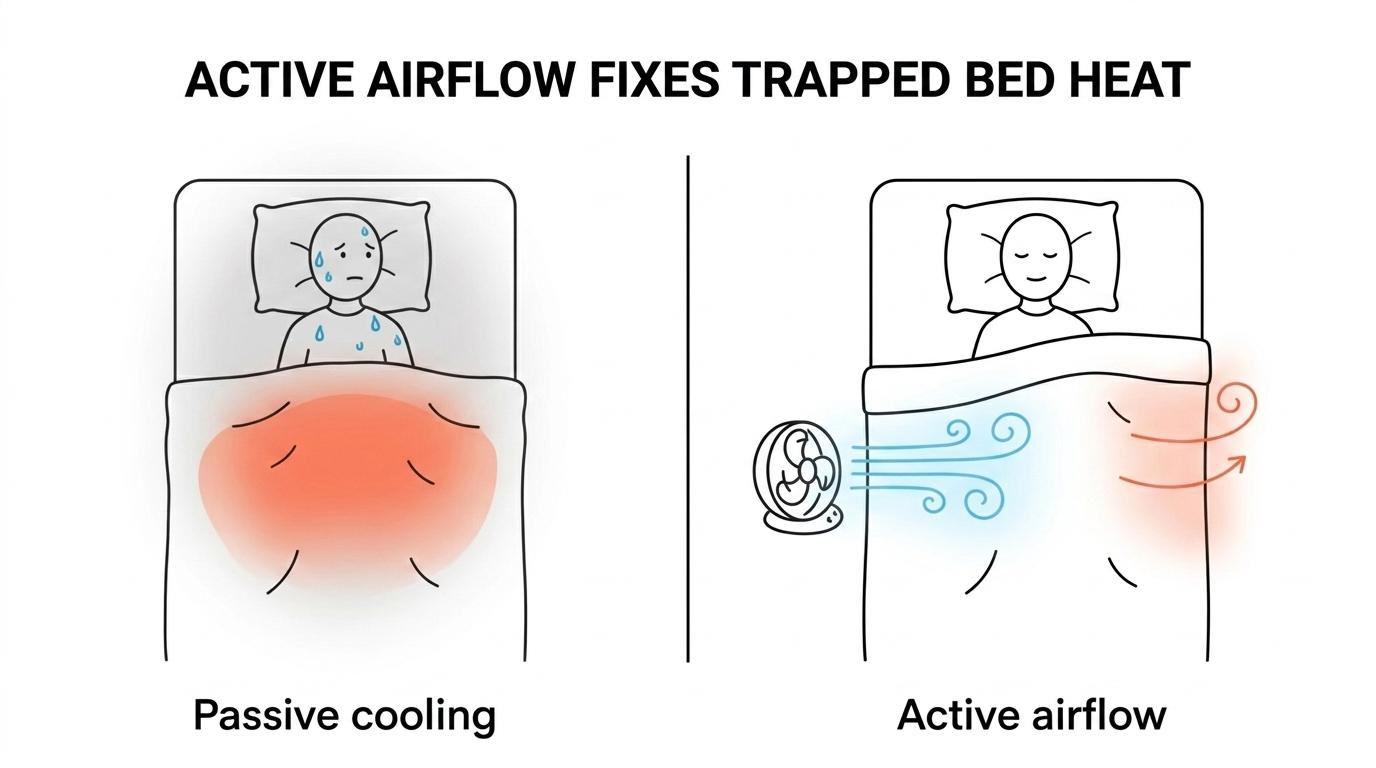
When gentle airflow moves across sweaty skin, evaporation improves. That can help cool the body and reduce that swampy feeling that wakes people up. A bed fan, such as the bfan, can also help dry out damp sheets faster after a sweating episode, which is something a blanket alone cannot really do.
One small older sleep study in humid heat found that head cooling during sleep may help decrease whole-body sweat rate, suggesting that a bfan could enhance airflow and help manage temperature: https://pubmed.ncbi.nlm.nih.gov/12750972/. That is not a direct trial of a bed fan for night sweats, so it should not be overstated. Still, it fits the basic physiology. Better airflow and better heat release can matter during sleep.
This is where the bFan or Bed Fan can be a practical non-drug option. It is designed for under-the-covers cooling, not just moving air around the room. For someone whose main issue is heat buildup in bed, that targeted airflow often makes more sense than swapping blanket after blanket.
If you are trying to choose, think in terms of what each tool is best at.
A quick real-life example. One woman in her early fifties described feeling fine at bedtime, then waking two or three hours later with a heat surge and damp pajamas. She had already tried bamboo sheets and a cooling blanket. They felt nicer at first, but the bed still turned into a warm pocket by 2 A.M. What finally helped was moving air under the sheets. The sweating episodes did not vanish overnight, but she stopped feeling trapped in her own bedding, and getting back to sleep became much easier.
That pattern is common. The blanket may improve comfort. The fan changes the microclimate.
Sleep experts often recommend a bedroom temperature between 60°F and 67°F for better sleep. If your room is already 74°F and humid, neither a cooling blanket nor a bed fan can fully overcome that environment. They are working with the room air you give them.
The useful part is that targeted airflow can let many people raise the room temperature by about 5°F and still feel cool enough to sleep better. That can lower air conditioning costs without sacrificing comfort, by utilizing an energy-efficient method. With a bfan, the goal is not icy air. The goal is moving enough room air under the sheets to carry heat and moisture away from your body.
That is also why sheet choice matters. Tight-weave sheets tend to help the air flow across the body better and carry away heat more effectively than loose, fluffy bedding that traps air in place.
There is stronger published symptom data for cooling sleep surfaces than for branded bed fans specifically. That is just the honest answer.
The pilot study on a cooling mattress pad in menopausal women is promising. It showed fewer vasomotor symptoms and better sleep scores over 8 weeks. That gives cooling bedding a meaningful evidence point.
A bed fan, by contrast, is supported more by physiology, sleep comfort logic, and real-world user experience than by large clinical trials. That does not make it ineffective. It means we should be careful with the wording.
Here is the practical takeaway. If your problem is a hot, humid bed environment, targeted airflow is a very logical fix. If your problem is broader hormonal or medication-related night sweats, airflow may still help a lot, but it is not treating the underlying trigger.
Most people do best with a few changes working together, not a single magic product.
If you share a bed, personalized cooling becomes even more important. One partner may want the room cold enough to see their breath, while the other is already freezing. That is where a bed fan has a practical edge. One person can cool the bed space directly with a bfan without turning the whole bedroom into a meat locker.
Fabrics matter too: as T-Shirten’s overview of sweat-control materials explains, lightweight technical synthetics and merino blends move moisture and dry faster than dense cotton, which helps keep the microclimate more comfortable when body heat and humidity rise overnight.
And if you need separate control on each side, two bFans can create dual-zone microclimate control at a fraction of the cost of a dual-zone Bedjet setup. A dual-zone Bedjet setup costs over a thousand dollars, which is more than twice the price of two Bedfans. The original Bedfan was invented in 2003, several years before Bedjet was even thought of. That history does not make one automatically better, but it does remind people that under-sheet airflow is not a new gimmick.
The bFan can also solve some very ordinary sleep problems that matter at 2 A.M. It has remote and timer controls, runs quietly at about 28 to 32 dB on low to normal settings, and uses about 18 watts on average. Those details matter when you want cooling without added fuss, noise, or a spike in energy use..
A cooling blanket is designed to wick away moisture and regulate body temperature by using breathable, lightweight materials, whereas a bfan circulates air under your sheets for similar effects. In contrast, a bed fan circulates the air under your sheets, helping to remove heat and moisture from your body more directly. Both options can help with night sweats, but a bed fan provides targeted airflow that can be adjusted for personal comfort.
Yes, a bfan can be very effective for managing night sweats related to menopause. By directing cool air under your sheets, it helps reduce overheating and moisture buildup, which are common symptoms during menopause. Many users report improved sleep quality and fewer nighttime awakenings when using a bed fan for this purpose.
Cooling blankets do not physically lower your core body temperature, but they help you feel cooler by promoting airflow and moisture evaporation. The materials used in cooling blankets are engineered to draw heat away from your body and keep you dry, which can make a noticeable difference in comfort during sleep.
Most modern bed fans are designed to operate quietly, making them suitable for light sleepers. The sound level is typically similar to a gentle white noise, which some people find soothing. Always check product specifications and user reviews to ensure the fan you choose meets your noise tolerance preferences.
Yes, it is generally safe to use a bed fan nightly as long as you follow the manufacturer’s instructions. Bed fans use minimal electricity and do not introduce any chemicals or allergens into your sleeping environment. If you have respiratory issues or allergies, consult your healthcare provider to ensure a bed fan is appropriate for your needs.
Choosing between a cooling blanket and a bed fan depends on your personal preferences and sleep environment. If you prefer a lightweight, breathable cover, a cooling blanket may be best. If you need more direct and adjustable cooling, especially in a warm room, a bed fan can provide targeted relief. Some people find that using both together offers the best results for managing night sweats and staying comfortable.
All links have been checked and are currently working.
If you want more reading on bedfan.com, useful internal pages to connect with this topic include the night sweats hub, the sleeping cooler section, the guide on under-the-covers cooling at https://www.bedfan.com/night-sweats/bed-cooling-fan-for-hot-sleepers-under-the-covers-cooling, plus pages focused on menopause night sweats, medication-related night sweats, and sleeping cooler with a partner.
If your biggest problem is trapped heat and damp bedding, a cooling blanket may help, but a bed fan is often the more targeted fix because it moves air where the problem is actually happening. If you want a quiet, low-energy, non-drug option for under-the-covers cooling, you can take a look at the bFan here: https://www.bedfan.com/. This is not medical advice. Always consult your doctor or oncology team before making changes, especially if night sweats are new, severe, or paired with fever, weight loss, chest symptoms, low blood sugar, or cancer treatment.