Whipple disease night sweats may occur with fever, weight loss, diarrhea, and joint pain. Learn causes, symptoms, diagnosis, and care.
Night sweats can be unsettling, especially when they keep happening and you cannot pin down why. If you have come across Whipple disease or Tropheryma whipplei while searching for answers, it helps to know two things right away. First, Whipple disease is rare. Second, night sweats are possible with it, but they are not the main clue by themselves.
What matters is the bigger pattern. When night sweats show up alongside weight loss, diarrhea, belly pain, fever, fatigue, or ongoing joint aches, the picture starts to look more like a medical issue that needs real attention, not just a warm room or heavy blanket.
Whipple disease is a rare bacterial infection caused by Tropheryma whipplei, and is often treated with long-term antibiotics. It most often affects the small intestine, but it can also involve the joints, heart, brain, eyes, and lymphatic system, which is part of why it can be tricky to spot early (NORD). People are often diagnosed after months, sometimes years, of symptoms that seem unrelated at first, making the diagnosis challenging.
Night sweats can happen with Whipple disease because the infection may trigger inflammation, fever, immune system activity, and general disruption in how the body regulates temperature. That said, night sweats alone do not point straight to Whipple disease. Many far more common problems can cause them too.
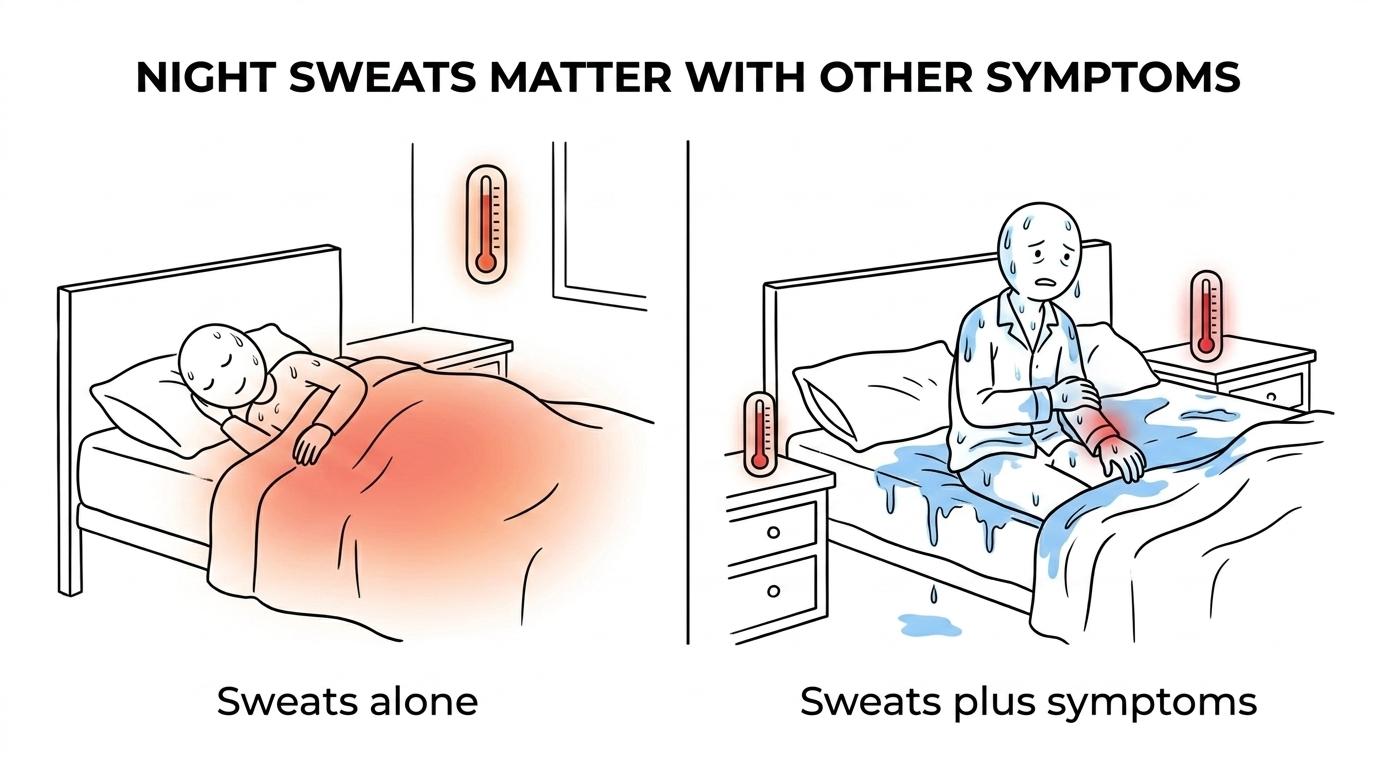
This is why context matters so much. A person with occasional sweating after drinking alcohol, sleeping in a hot room, or taking a new medication is in a very different situation from someone who is waking up drenched, losing weight, and feeling sick in other ways.
When your body is fighting infection, it releases inflammatory chemicals that can affect temperature control. If you are cycling through low grade fevers overnight, or your immune system is staying activated, sweating during sleep may follow. Chronic infections are well known for causing that pattern.
Whipple disease can also interfere with nutrient absorption in the gut, and if left untreated, it may require antibiotics to manage the infection effectively. Over time, malabsorption may lead to weakness, weight loss, anemia, and a run-down feeling. Those changes do not directly create night sweats on their own, but they can make your system more stressed and less stable overall.
Doctors often think about night sweats as a signal, not a diagnosis. In Whipple disease, the sweats matter most when they appear with other symptoms that suggest a deeper inflammatory or infectious problem.
After looking at symptoms as a group, these are the ones that tend to raise more concern, including abdominal pain:
A lot of people expect a rare intestinal illness to stay in the gut. Whipple disease does not always play by that rule. One of the classic early signs is migratory joint pain, often in larger joints, and that can come well before digestive symptoms become obvious (Merck Manual).
Once the small intestine becomes more involved, problems with malabsorption can become harder to ignore. You might see persistent diarrhea, cramping, weight loss, weakness, or signs of vitamin deficiency. If night sweats are happening at the same time, it can feel like your body is off balance around the clock.
Some people also have swollen lymph nodes, skin darkening, cough, chest symptoms, or neurological problems, as the central nervous system can be affected by Whipple disease spreading beyond the digestive tract. Those signs are less common, but they matter, because Whipple disease can spread beyond the digestive tract.
One anonymized scenario that sounds familiar to clinicians goes like this. A person in midlife starts waking up soaked two or three nights a week. At first, they blame the bedroom, then stress, then maybe a new mattress. A few months later, they mention loose stools, achy wrists, abdominal pain, and ten pounds of weight loss during a routine visit. It is the combination, not any single symptom, that pushes the workup in a different direction.
If your night sweats are frequent, drenching, or paired with fever, weight loss, swollen nodes, ongoing diarrhea, or worsening fatigue, it is time to call a doctor. The same goes for joint pain that keeps returning without a clear reason.
A few symptoms should move things faster. Mayo Clinic notes that night sweats deserve medical evaluation when they are regular, disruptive, and tied to other symptoms like fever or unexplained weight loss (Mayo Clinic).
Watch for these red flags, especially if more than one is happening:
The first step is usually not a single test. It is a careful history. A clinician will want to know how long the sweating has been happening, whether your sheets are soaked, what other symptoms you have, what medications you take, and whether you have had changes in weight, appetite, bowel habits, or energy.
Blood work may show anemia, inflammation, or nutritional issues, and sometimes antibiotics might be prescribed if an underlying bacterial infection is suspected. Stool tests might be done to look for more common causes of chronic diarrhea. If Whipple disease stays on the list, the key evaluation often involves an upper endoscopy with a small bowel biopsy to check for tropheryma whipplei. Under the microscope, doctors may see characteristic PAS positive macrophages, and molecular testing like PCR can help confirm the infection.
If symptoms suggest the disease has spread to the central nervous system, more testing may follow. That can include imaging, heart evaluation, or neurological workup. It sounds like a lot, and sometimes it is. With a rare condition, ruling out the common causes first is normal.
This is one reason not to self diagnose from night sweats alone. Whipple disease is real, but it is still far less common than medication side effects, hormonal shifts, sleep apnea, infections, anxiety, reflux, or other inflammatory problems.
The main treatment for Whipple disease is a long course of antibiotics prescribed and monitored by a physician. Because the illness can affect more than the gut, treatment is usually planned carefully, with follow-up to make sure symptoms are improving and relapse is not missed.
As the infection comes under control, antibiotics may help fever and night sweats to ease. Digestive symptoms can take time to settle, and energy often comes back gradually rather than all at once. Some people feel better in phases, not overnight.
If sweating continues even after treatment starts, it is worth telling your clinician. The reason may be ongoing inflammation, another medication, another health issue happening at the same time, or the need to adjust the treatment plan.
While you are working with your doctor, practical cooling steps can make nights more manageable. Sleep experts generally recommend a bedroom temperature of 60°F to 67°F for sleep (Sleep Foundation). That range is not magic, but it is a solid target if you are waking up overheated.
The hard part is that many people cannot, or do not want to, crank the whole house colder all night. That is where targeted bed cooling can help. A bFan bed fan from Bedfan is one option that sends room air under the sheets to move trapped body heat away from your skin. Neither the Bedfan nor the Bedjet cool the air. They only use the cool air already in the room to cool your bed, and a Bedjet doesn't cool the air either.
That detail matters, because if the room is stuffy and hot, any under sheet fan has less to work with. Still, many people can raise the room temperature by about 5°F and keep sleeping cool when the air is directed where the heat is building up, right in the bedding.
A few practical changes usually help the most:
If you are comparing devices, it helps to look at cost, noise, and how the airflow is used, not just marketing. The original Bedfan came to market several years before Bedjet was even thought of. A single Bedjet is more than twice the price of a single bedfan, and the dual zone Bedjet is over a thousand dollars, more than twice the price of two bedfans. The bfan also gives you dual-zone microclimate control by using two fans, one for each sleeper, which is often a simpler way to let each person choose their own comfort level.
There are some practical perks too. The bedfan uses only about 18 watts on average, normal operating sound is about 28db to 32db, and timer controls can help you cool the bed during the hours when you most need stable sleep. If you are dealing with a medical issue and just want less disruption tonight, that kind of straightforward setup can be a relief.
Even when Whipple disease, caused by the bacterium tropheryma whipplei, is on your radar, your doctor may start elsewhere, and that is reasonable. Night sweats are much more often linked to common causes such as disturbances in the central nervous system than rare infections.
That list can include menopause, medication side effects, thyroid issues, low blood sugar, infections, malabsorption, sleep apnea, anxiety, reflux, antibiotics, and some cancers. If your symptoms do not strongly fit Whipple disease, your evaluation may move in one of those directions first.
A useful mindset is this, your job is not to guess the rarest diagnosis. Your job is to notice the pattern, track the details, and get checked when the pattern does not make sense.
If you are trying to sort out what might be behind your symptoms, it may help to read through a few related topics on the site.
If night sweats are hitting you right now, start a symptom log tonight, temperature of the room, what time you woke up, how soaked the bedding was, whether you had fever, diarrhea, pain, or weight loss, and bring that to your appointment. If you want short term relief while you sort out the medical side, targeted airflow under the sheets, like a bFan, can make sleep a lot more bearable. This article is for general education only, not medical advice, diagnosis, or treatment. Get prompt medical care if your night sweats are drenching, keep happening, or show up with fever, weight loss, chest pain, trouble breathing, confusion, or severe weakness.
Yes, night sweats are a common symptom of Whipple disease. More than half of patients experience prolonged periods of low-grade fever and night sweats, sometimes for months or even years before diagnosis. These symptoms often occur alongside fatigue and other systemic issues, making them important clues for early detection (source).
Whipple disease is extremely serious if not treated promptly. Without medical intervention, it can be fatal due to its progressive impact on multiple organ systems. However, with proper diagnosis and antibiotic therapy, most patients recover well and can avoid life-threatening complications (source).
In addition to night sweats, people with Whipple disease may experience joint pain, chronic diarrhea, abdominal pain, weight loss, and sometimes neurological symptoms. The combination of these signs, especially when night sweats and fatigue are present, should prompt further medical evaluation (source).
Some patients report night sweats following a Whipple procedure, particularly during the recovery phase. These may be related to the body’s healing process, changes in metabolism, or infection risk. If night sweats persist or worsen, it is important to consult a healthcare provider to rule out complications (Reddit discussion).
While medical treatment is essential for Whipple disease, managing night sweats at home can help improve comfort. Using targeted cooling solutions like the bFan, maintaining a cool bedroom, and choosing breathable bedding can make a significant difference. Always discuss persistent symptoms with your doctor to ensure proper care.
One patient shared on Reddit that they struggled with severe night sweats and fatigue for weeks before their diagnosis. They described waking up drenched and exhausted, which led them to seek further medical help. After starting treatment, their night sweats gradually improved, and their energy returned over time.
If you are experiencing night sweats and suspect Whipple disease or another underlying condition, consult your healthcare provider promptly. For more information on managing night sweats, see our articles on night sweats causes, night sweats and sleep quality, cooling solutions for night sweats, and when to see a doctor for night sweats.
This FAQ is for informational purposes only and does not substitute for professional medical advice. Always consult a qualified healthcare provider for diagnosis and treatment.