Rat bite fever night sweats occur due to fever spikes from a bacterial infection, often linked to rodent exposure and requiring prompt medical attention.
If you’ve had contact with a rat, or even handled bedding, food, or cages around rodents, waking up drenched in sweat can feel alarming fast. Night sweats are not the most talked about symptom of rat-bite fever, but ratbite fever night sweats can show up, especially when fever is spiking and your immune system is working hard, similar to the way babesia infections can cause fever and sweating.
The key thing to know is simple, rat-bite fever is treatable, but it should not be brushed off as “just a bug.” When night sweats happen along with fever, body aches, arthritis, joint pain, rash, or a recent rodent bite or scratch, it’s time to get medical advice promptly from a healthcare provider.
Rat-bite fever (RBF) is a bacterial infection linked to rodents, most often caused by Streptobacillus moniliformis in North America, according to the CDC. Despite the name, you do not always need an obvious bite to get it. Some people get sick after a scratch, close contact with rodents, or after eating food or drinking water contaminated by infected rats, a form sometimes called Haverhill fever.
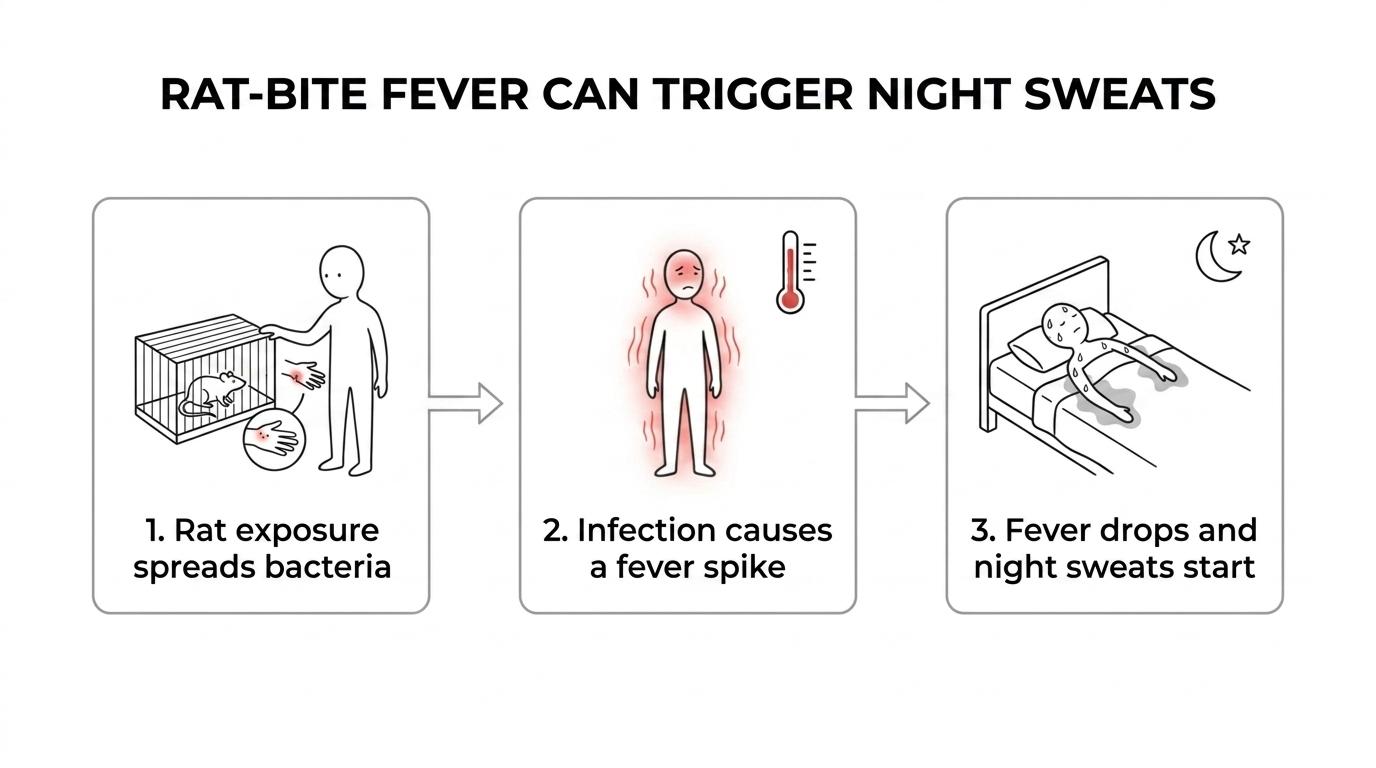
Night sweats can happen because infections often cause fever patterns that rise and fall over several hours. When your body temperature drops after a fever spike, sweating is one of the ways your body tries to cool itself back down. If that happens while you’re asleep, you may wake up with soaked clothes, damp sheets, and that exhausted, chilled feeling afterward.
Rat-bite fever (RBF) is considered uncommon, but untreated infection can become serious, highlighting the importance of disease prevention, similar to other vector-borne diseases like babesia or lyme disease. The Merck Manual notes that complications can involve the heart, brain, lungs, and other organs, which is why fever with rodent exposure deserves real attention.
Night sweats usually do not appear alone and can be indicative of rat-bite fever (RBF) night sweats. They tend to come with a cluster of symptoms that point toward infection. The exact timing can vary, but many people start feeling ill within a few days to about three weeks after exposure.
A tricky part is that early symptoms can look like flu, a stomach virus, or another routine infection, masking the underlying illness. That’s why the exposure history matters so much. If you’ve been around pet rats, feeder rats, wild rodents, or rodent droppings, tell your clinician that right away.
Most people think only of a bite, but that’s only one path; similar to how other pathogens like babesia can be transmitted in more than one way. Rats can carry the bacteria in their saliva and respiratory secretions, and contaminated droppings can play a part in exposure too. Pet owners, breeders, lab workers, reptile owners who handle feeder rodents, and people cleaning infested spaces may all be at risk.
You also do not need a dramatic injury. A tiny nip, a scratch you barely noticed, or hand to mouth contact after touching a contaminated cage can be enough. In some cases, people do not remember any skin break at all, which is one reason rat-bite fever can be missed in the early stage.
Night sweats are really a fever story. When your immune system detects an invasive bacterium, it releases inflammatory signals that raise your internal temperature. That fever can help your body fight the infection, but it also sets up a cycle of chills, overheating, and sweating.
At night, those temperature swings can feel stronger. Blankets trap heat, sleepwear holds moisture, and the bed itself can keep warm air close to your skin. If the fever breaks while you’re asleep, the sweating can be heavy enough to soak the sheet and wake you up.
An anonymized scenario makes this more real, particularly in cases involving babesia or lyme disease. A person who cared for pet rats thought a small finger bite was minor and cleaned it at home. About a week later, they started waking up soaked, experienced fatigue, then came the body aches, a fever that seemed to come and go, and sore, swollen wrists. They first assumed it was a virus. Once a clinician heard “pet rats,” the picture changed quickly, testing was ordered, and treatment started.
Night sweats alone are not enough to diagnose rat-bite fever, but ratbite fever night sweats with fever and recent rodent exposure should push this higher on your list. The same goes for symptoms that seem to improve and then come back.
Get urgent medical help if symptoms are building quickly, if you feel faint, or if you have signs that the infection may be spreading beyond a mild early stage. Untreated rat-bite fever can become dangerous.
Diagnosis usually starts with the story, often incorporating an RBF diagnosis depending on the symptoms and exposure history, including any history of arthritis. A clinician will ask about bites, scratches, pet or wild rodent exposure, travel, food history, fever pattern, rash, and joint symptoms. Blood tests, cultures, and other workup may be used, though the bacteria, including babesia, can be tricky to identify in some labs.
Treatment commonly involves antibiotics, often penicillin or another suitable option if penicillin is not a fit. If symptoms are severe, or if there are signs of complications, hospital care may be needed. The big point here is timing. Starting treatment earlier, as a part of disease prevention strategy, lowers the chance of more serious problems.
If you’re taking antibiotics and still having night sweats, that does not always mean treatment is failing. Fever patterns can take some time to settle. Still, if you are getting worse, not better, call your clinician instead of guessing.
You still need actual medical care for the illness from a healthcare provider. Cooling tools can make you more comfortable, but they do not treat the cause. That said, better sleep matters when you’re sick, and there are practical ways to reduce how miserable the night feels.
Start with basics. Use breathable sleepwear, keep an extra shirt near the bed, and switch to sheets with a tight weave. That last detail helps airflow move across your body and carry away heat more effectively. Sleep experts often recommend a bedroom temperature of 60°F to 67°F, as noted by the Sleep Foundation. A lot of people with a bed fan find they can raise the room temperature by about 5°F and still sleep cool.
If you need targeted relief, a bed cooling setup can help move trapped heat out from under the covers. A good example is the bFan bed fan, which is built to push room air between the sheets. It’s worth being clear here, neither a bFan nor a BedJet cools the air itself. They only use the cooler air already in the room to cool your bed, and the BedJet doesn’t cool the air either. The bFan uses only 18 watts on average, runs at about 28 dB to 32 dB at normal operating speed, and includes timer controls, which can help you keep your bed more comfortable through the night without running your whole house colder.
A quick comparison matters because people often look at both products when night sweats hit hard. The original Bedfan came to market several years before BedJet was even thought of. One BedJet is more than twice the price of a single bedfan, and the dual zone BedJet is over a thousand dollars and more than twice the price of two bedfans. If you share a bed, the bFan offers dual-zone microclimate control using two fans, so each person can fine tune their side without changing the whole room.
If your sweating may be tied to more than one issue, or if you’re still sorting through possibilities with your doctor, these topics can be useful to read next.
If you’ve had rat exposure and now have symptoms like fever, chills, rash, arthritis, or drenching night sweats, possibly due to a tick-borne disease like babesia or lyme disease, contact a medical professional as soon as you can, and make sure you mention the rodent exposure right away. That one detail can speed up the right diagnosis. If you need help sleeping cooler tonight while you wait for care, take a look at the bFan at bedfan.com, keep your room in a sleep friendly range, and use tight weave sheets so airflow can do its job.
This article is for general education only and is not medical advice, diagnosis, or treatment, but it's important to be aware of rat-bite fever (RBF) and its potential seriousness. Rat-bite fever can become serious if it is missed or untreated. If you have high fever, trouble breathing, chest pain, confusion, severe weakness, worsening rash, or rapid symptom progression after rodent exposure, seek urgent medical care right away.
Rat bite fever is a rare bacterial infection that people can get after being bitten or scratched by a rat, or sometimes through contact with rat urine or droppings. The infection is caused by either Streptobacillus moniliformis or Spirillum minus. Night sweats occur as the body tries to fight off the infection, which often leads to fever, chills, and excessive sweating during sleep as the immune system responds to the bacteria. CDC
Symptoms of rat bite fever, including night sweats, usually develop within three to ten days after exposure, but in some cases, it can take up to three weeks. The onset of symptoms can vary depending on the individual's immune response and the type of bacteria involved. Early recognition of symptoms is important for timely treatment and to prevent complications. Mayo Clinic
Yes, it is possible to contract rat bite fever without a direct bite. The bacteria can enter the body through open wounds or mucous membranes after handling rats or coming into contact with contaminated surfaces, food, or water. People who work with rodents or have pet rats should be especially cautious and practice good hygiene to reduce their risk. Healthline
In addition to night sweats, rat bite fever commonly causes fever, chills, muscle aches, joint pain, vomiting, and a rash that often appears on the hands and feet. Some people may also experience headaches and sore throat. If left untreated, the infection can lead to serious complications, so it is important to seek medical attention if you suspect you have been exposed.
Rat bite fever is typically treated with antibiotics such as penicillin or doxycycline, which are very effective when started early. Night sweats can be managed at home by keeping the bedroom cool, using lightweight bedding, and staying hydrated. However, medical treatment is essential to address the underlying infection and prevent serious health issues. Reddit
Rat bite fever is not considered contagious between people. The infection is transmitted through direct contact with infected rodents or their bodily fluids, not from human to human. However, it is still important to practice good hygiene and avoid sharing personal items if you are being treated for the infection.
If you experience night sweats along with other symptoms like fever, rash, or joint pain after contact with rats, seek medical attention promptly. Early diagnosis and antibiotic treatment are crucial for a full recovery. Inform your healthcare provider about any recent exposure to rodents to help with accurate diagnosis and treatment.
All links have been checked and are currently working, providing up-to-date and authoritative information on rat bite fever and related symptoms.